

2,250 Metres. Welcome to Hell.
The Estadio Azteca sits at 2,250 meters above sea level, and the visiting team discovers this fact during the first sustained sprint. The first ten minutes feel normal -- the adrenaline of a World Cup match, the noise of 87,000 spectators, the famili
Published: June 6, 2026
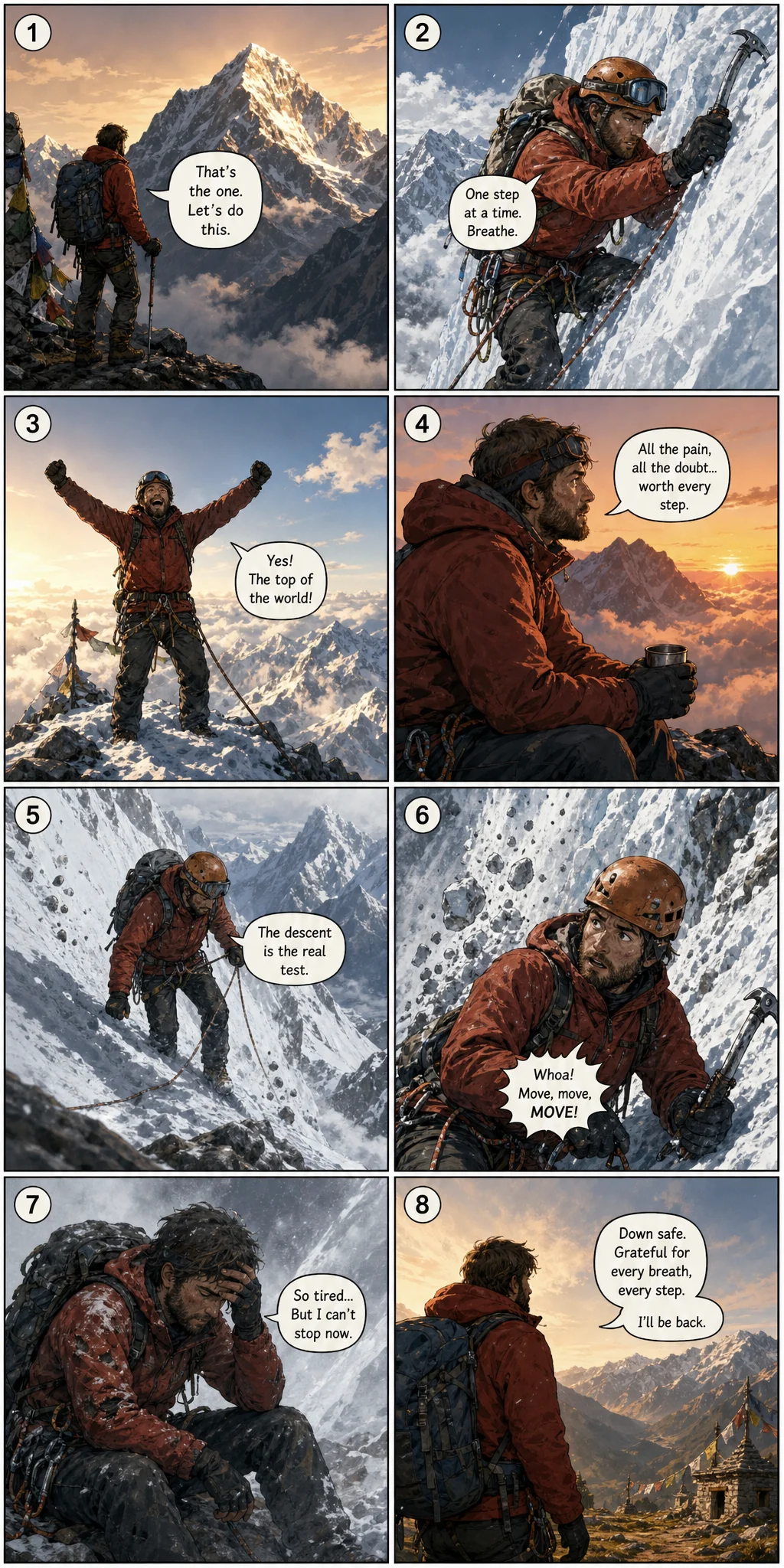
Comic content and match statistics are for entertainment purposes only and may contain inaccuracies. For Accurate Data, please refer to the reference's official website.
# 2,250 Metres. Welcome to Hell: The Azteca's Altitude Weapon
The Estadio Azteca sits at 2,250 meters above sea level, and the visiting team discovers this fact during the first sustained sprint. The first ten minutes feel normal -- the adrenaline of a World Cup match, the noise of 87,000 spectators, the familiar rhythm of the game. The next ten minutes feel like running through water that is getting progressively deeper. The remaining seventy feel like drowning, slowly, while the television cameras capture none of it. Mexico's home stadium is not just a venue. It is a physiological weapon, and it has been doing its work on visiting teams since 1970.
The science is straightforward. At 2,250 meters, the partial pressure of oxygen in the atmosphere is approximately 25 percent lower than at sea level. Every breath a player takes delivers less oxygen to their bloodstream. The body compensates by increasing breathing rate and heart rate, but the compensation is incomplete -- arterial oxygen saturation drops by 3 to 5 percent even in well-trained athletes, and the drop is larger during high-intensity exercise when oxygen demand is greatest. The result is a measurable decline in maximal oxygen uptake, the physiological ceiling on aerobic performance. A player whose VO2max at sea level is 65 milliliters per kilogram per minute -- typical for an elite midfielder -- might operate at the equivalent of 58 to 60 at the Azteca's altitude. The difference is not theoretical. It is felt in every sprint that ends a fraction of a second slower, every recovery period that takes a few extra heartbeats, every decision made with a brain that is receiving slightly less oxygen than it is accustomed to.
Mexico's players do not experience this decline, or at least not to the same degree. They are born at altitude, raised at altitude, trained at altitude. Many of them learned to play football in Mexico City or its surrounding highlands, where every match, every training session, every informal kickabout occurred in the same thin air that will suffocate their opponents. Their bodies have undergone the physiological adaptations that require years of exposure: increased lung capacity, higher red blood cell counts, more efficient oxygen extraction at the tissue level. They play at the Azteca's tempo, a rhythm calibrated to the altitude's demands, and they have learned -- through a lifetime of experience that cannot be replicated in a two-week training camp -- exactly how hard they can push before the altitude pushes back. The visiting team must discover this boundary in real time, during the match, while Mexico's players exploit the hesitation that comes from not knowing where the boundary lies.
The Azteca's altitude advantage is not merely physical. It is psychological. Visiting players know, before they step onto the pitch, that they will suffer. They have been briefed by their medical staffs, presented with oxygen saturation projections and recovery timelines, warned about the specific sensation of altitude-induced breathlessness and the deceptive normalcy of the first ten minutes. Knowledge does not prevent the suffering. It may even intensify it, as players monitor their own bodies for the symptoms they were told to expect and find those symptoms arriving exactly on schedule. The psychological burden of knowing that your opponent is not experiencing the same physical duress -- that their lungs are delivering more oxygen, their muscles are clearing lactate more efficiently, their brains are operating with more cognitive clarity -- adds a layer of mental fatigue to the physical exhaustion. You are not just playing against Mexico. You are playing against the atmosphere, and the atmosphere has chosen a side.
The ball behaves differently at altitude, and this compounds the home-field advantage in ways that are harder to quantify but no less real. The reduced air density at 2,250 meters means that the ball travels faster and further for a given force of impact. A long pass that would travel 50 meters at sea level might travel 53 or 54 at the Azteca. A shot struck with the same power flies with a trajectory that is subtly but meaningfully different. Goalkeepers, who depend on thousands of hours of trained intuition about how the ball moves through the air, find their instincts slightly wrong in ways that are impossible to correct during a single match. Outfield players who have spent their careers calibrating the weight of their passes discover that the same motion produces a different result. Mexico's players, trained since childhood in these conditions, have internalized the differences. For them, the ball's behavior at altitude is not abnormal. It is simply how a football moves.
The history of the Azteca's altitude advantage is a history of visiting teams suffering and occasionally succumbing. The 1970 World Cup, the first held at the Azteca, saw European teams struggle visibly in the thin air -- England's defending champions, in particular, were a diminished version of themselves throughout the tournament. The 1986 World Cup, also hosted at the Azteca, produced similar patterns, with South American teams generally coping better than their European counterparts due to the altitude of their own domestic stadiums. The 2026 tournament will be the first to feature the Azteca as a venue in an otherwise largely sea-level competition, creating a unique home-field advantage for Mexico that no other host nation can replicate. Canada and the United States have no equivalent. Their stadiums are at or near sea level. Their home-field advantage derives from crowd support and familiarity with the venues, not from the physiological assault of thin air.
The visiting teams that prepare specifically for the Azteca -- arriving in Mexico City at least a week early, training at altitude, monitoring oxygen saturation with medical precision, simulating the specific physical demands of high-altitude football -- will compete. Their players will still suffer, but they will suffer within manageable bounds, their bodies having begun the acclimatization process that requires days to initiate and weeks to complete. The teams that do not prepare, that treat the Azteca as just another stadium in just another host city, will suffer more. They will watch their players gasp for air in the second half, their tactical structures collapse under the weight of physical exhaustion, their World Cup ambitions dissolve in the thin air of a stadium that has been punishing the unprepared since before most of their players were born.
The Azteca does not guarantee Mexico anything. Football matches are not decided solely by oxygen saturation, and the history of the stadium includes visiting teams that overcame the altitude through tactical discipline, squad rotation, and sheer physical resilience. But the Azteca provides a physiological advantage that no tactical system can replicate and no motivational speech can neutralize. It is the most extreme home-field advantage in the 2026 tournament, possibly in World Cup history, and it will be a factor in every match played there. Mexico's opponents will know this. They will prepare for it. And they will still, at some point in the second half, feel their lungs burning and their legs slowing and their brains fogging, and they will understand, in a way that no briefing document could convey, what it means to play football at 2,250 meters.