

A Folding Bed and a Million-Person Party
The fan camp is the most honest piece of infrastructure at the 2026 World Cup. It does not pretend that the tournament is accessible to everyone. It admits, in its folding beds and shared tents and communal bathrooms, that the World Cup's commercial
Published: June 6, 2026
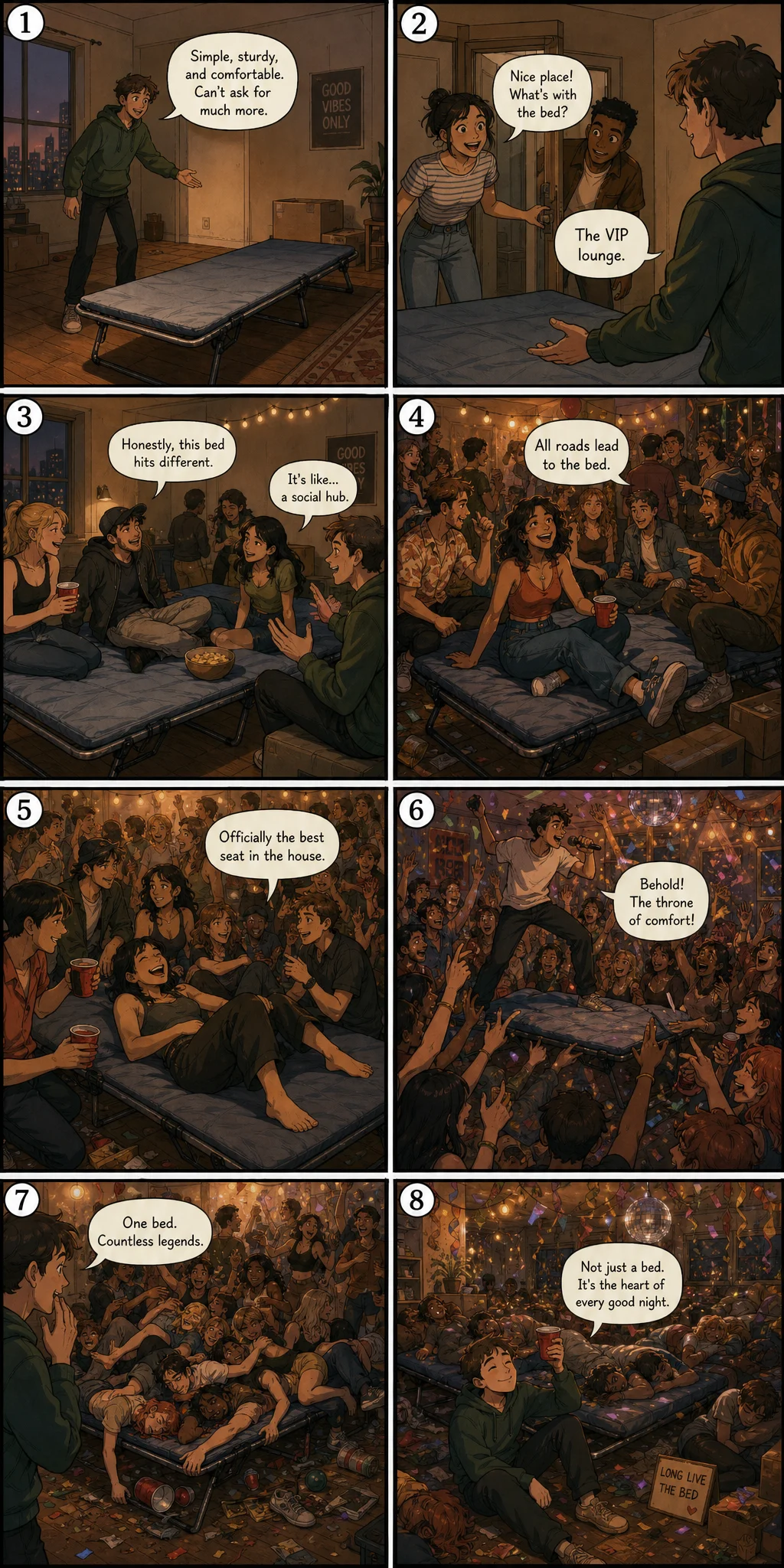
Comic content and match statistics are for entertainment purposes only and may contain inaccuracies. For Accurate Data, please refer to the reference's official website.
# A Folding Bed and a Million-Person Party: The Fan Camps of World Cup 2026
The fan camp is the most honest piece of infrastructure at the 2026 World Cup. It does not pretend that the tournament is accessible to everyone. It admits, in its folding beds and shared tents and communal bathrooms, that the World Cup's commercial infrastructure has permanently outpaced the financial reach of the ordinary supporters who once formed the backbone of its matchday atmosphere. The fan camp is simultaneously a solution to an accommodation crisis and an acknowledgment that the crisis exists -- that the tournament has become so expensive that a significant portion of its audience must sleep in temporary shelters because the alternative is not attending at all.
The economics that produced the fan camps are straightforward. The 2026 World Cup is being hosted across cities where summer hotel inventory is already strained by ordinary tourism and business travel. The injection of World Cup demand into these markets has produced price increases that place hotel rooms beyond the reach of ordinary supporters. A mid-range hotel room in New York or Los Angeles that costs $250 per night in a normal summer can command $800 to $1,200 during the tournament window. A ten-night stay at those rates consumes a budget that most international supporters simply do not have. The fan camp, with its $50 to $100 per night price point, represents a form of accommodation that exists within the financial reality of the tournament's audience. It is not luxurious. It is not even particularly comfortable by the standards of ordinary travel. But it is possible, and for a growing number of supporters, possibility is the only criterion that matters.
The fan camp experience varies by location and organizer. The most basic configuration consists of large tents divided into sleeping areas, each containing folding beds arranged in rows with minimal privacy but reasonable comfort. Shared bathroom facilities -- portable toilets and shower trailers -- serve the camp population. Food vendors provide meals at prices that are lower than stadium concessions but higher than what supporters might pay in their home countries. Security personnel patrol the perimeter. Transportation to and from match venues is provided, typically by shuttle bus on a fixed schedule. The experience is not dissimilar to a music festival, and for supporters who have attended Glastonbury or Tomorrowland or Rock in Rio, the rhythm of a fan camp -- communal, slightly chaotic, sustained by collective enthusiasm -- will feel familiar and even enjoyable.
For supporters who have never camped at a major event, the adjustment is steeper. The lack of privacy can be jarring. The noise level, sustained by thousands of excited supporters in close proximity, makes sleep difficult. The shared bathroom facilities require patience, flexibility, and a tolerance for queues that can extend to twenty minutes during peak hours. The weather -- whether the heat of a Miami summer or the grey drizzle of a Vancouver evening -- intrudes into the camping experience in ways that hotel air conditioning and insulated walls are designed to prevent. The fan camp is not for everyone. It is for those who have decided that attending the World Cup matters more than the discomfort of attending it on a budget.
The social dynamics of the fan camps are among the most interesting phenomena of the tournament. Thousands of supporters from dozens of nations, sharing temporary accommodation in close quarters, create a microcosm of the World Cup's international community. The Brazilian supporter who sleeps on a folding bed next to the Japanese supporter who sleeps next to the Moroccan supporter is participating in a form of cultural exchange that the hotel lobbies and VIP lounges of the tournament cannot replicate. Friendships form across language barriers. Rivalries are conducted with a warmth that the stadium's segregated seating sections do not permit. The fan camp, for all its material limitations, produces a version of the World Cup experience that is more authentically communal than the isolated luxury of the hotel alternative. The supporters who sleep on folding beds will have stories to tell that the supporters who sleep in suites will not.
But the fan camp also makes visible something uncomfortable about the tournament's class structure. The World Cup has always had a hierarchy of experience. Corporate sponsors and VIP guests have always occupied a different tournament from the ordinary supporters in the upper tiers of the stadium. The 2026 edition, hosted by the most commercially sophisticated nation on earth, simply makes the hierarchy more visible and more structural. The fan camp supporter and the luxury suite occupant are attending the same matches, watching the same players, experiencing the same goals and saves and moments of drama. But they are not attending the same tournament. The distance between the folding bed and the five-star hotel is not just a matter of comfort. It is a measure of the tournament's transformation from a sporting event into a tiered commercial product, stratified by price in ways that the World Cup's founding rhetoric of universal accessibility struggles to accommodate.
The fan camps have generated their own controversies. Local residents in some host cities have objected to the construction of large-scale temporary accommodation in public parks and recreational spaces. Concerns about waste management, noise, and security have been raised and, in some cases, litigated. The camps' organizers have responded with detailed operational plans, environmental impact assessments, and commitments to restore affected sites after the tournament concludes. These are legitimate logistical concerns, and they speak to the broader challenge of hosting a tournament of this scale in cities that were not designed for temporary populations of tens of thousands of international visitors. The fan camps are a pragmatic response to an accommodation crisis that the tournament's planners should have anticipated and the host cities' hotel markets were never going to solve.
The longer-term question is whether the fan camp model represents a sustainable future for World Cup accommodation or a temporary patch for a tournament whose economic model is increasingly disconnected from the financial reality of its audience. The 2030 World Cup, spread across six countries on three continents, will face accommodation challenges that make the 2026 situation look manageable. If the fan camp model succeeds -- if it provides safe, functional, affordable accommodation for the supporters who would otherwise be excluded -- it may become a permanent feature of the World Cup infrastructure, as essential as the stadiums themselves. If it fails -- if the camps become sites of conflict, disease, or exclusion -- the tournament's claim to be a global celebration rather than a luxury event will be further eroded. The 2026 fan camps are an experiment in World Cup accessibility, conducted at full scale with real consequences for the real people who sleep in them. The results will shape the future of the tournament.