

Sixteen Strangers Walk Into a Party
The World Cup draw is the only sporting event in which the outcome is entirely predetermined and the entertainment derives exclusively from watching people react to preordained results. No competition occurs. No skill is demonstrated. A series of for
Published: June 6, 2026
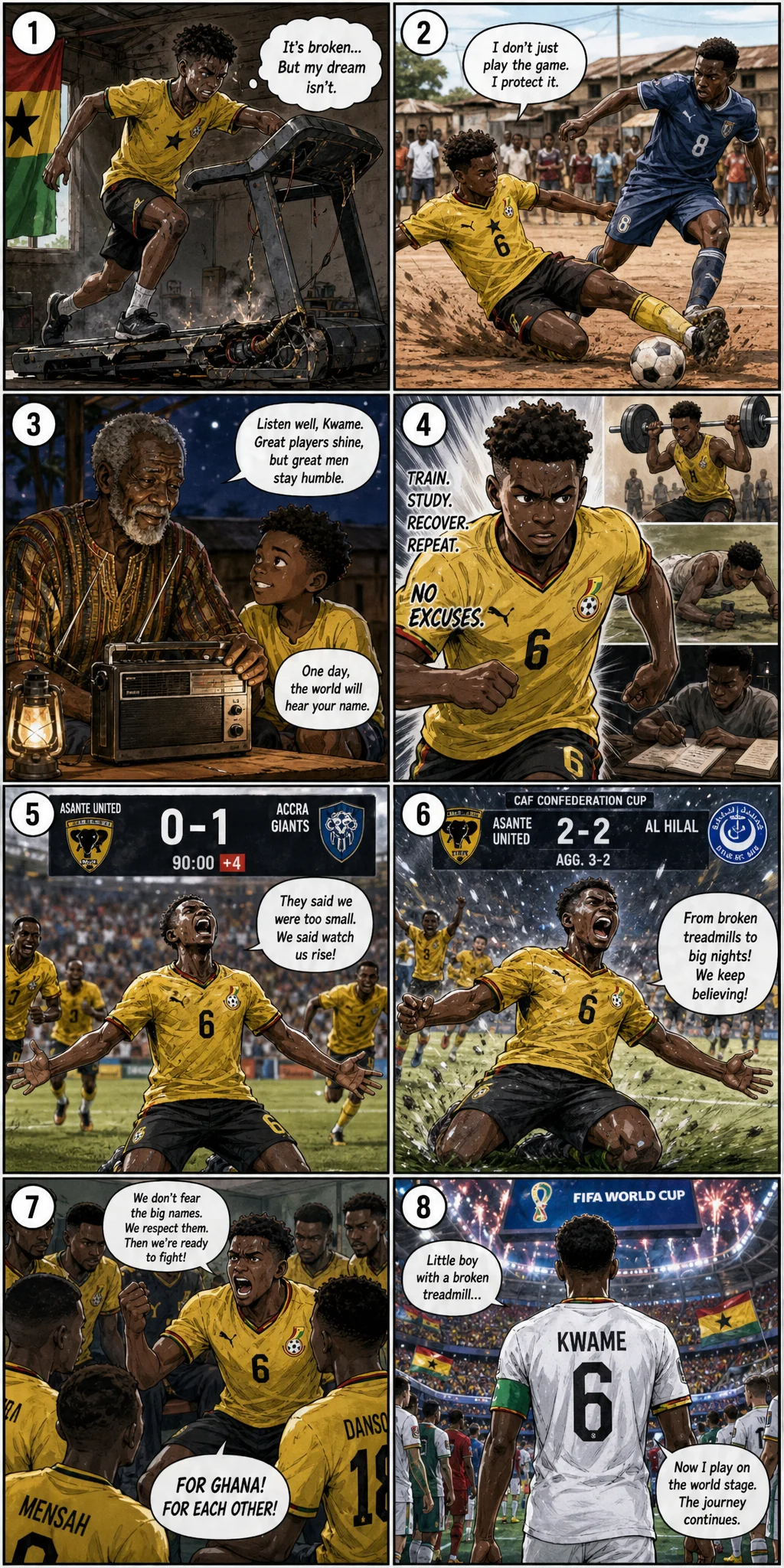
Comic content and match statistics are for entertainment purposes only and may contain inaccuracies. For Accurate Data, please refer to the reference's official website.
# Sixteen Strangers Walk Into a Party: The Ritual of the World Cup Draw
The World Cup draw is the only sporting event in which the outcome is entirely predetermined and the entertainment derives exclusively from watching people react to preordained results. No competition occurs. No skill is demonstrated. A series of former players -- chosen primarily because they won something decades ago and can still fit into a suit -- pull balls from bowls while a global audience of hundreds of millions watches and a live television production, costing millions of dollars and involving hundreds of personnel, solemnly presents the proceedings as though something important were happening. It is absurd. It is also the exact moment the tournament transitions from abstraction to reality.
The 2026 draw ceremony will follow a familiar template, refined over decades of FIFA productions that have perfected the art of making a lottery feel like a coronation. The host nation's cultural heritage will be celebrated through musical performances designed to project warmth and welcome. The tournament's official mascot and match ball will be presented with the reverence normally reserved for religious artifacts. The draw procedure will be explained at length by a host whose primary qualification is the ability to make complex seeding rules sound simple and simple procedures sound momentous. And then, over the course of approximately two to three hours, the 48 qualified nations will learn their group-stage assignments -- their opponents, their venues, their travel schedules, the specific shape of their World Cup destinies.
The mechanics of the 2026 draw are more complex than any previous World Cup, reflecting the tournament's expansion to 48 teams and its geographic spread across three host nations. The 48 teams are divided into twelve groups of four -- the old format's eight groups of four expanded by 50 percent. The seeding system places the top twelve teams, based on FIFA's world rankings, into Pot 1, with the host nations -- the United States, Canada, and Mexico -- automatically occupying three of those twelve positions as a privilege of hosting. The remaining 36 teams are distributed across Pots 2, 3, and 4, again based on rankings, with geographic constraints applied to ensure that no group contains more than one team from any confederation other than UEFA, which is permitted a maximum of two per group due to the disproportionate number of European qualifiers.
The geographic clustering innovation is the 2026 draw's most significant departure from precedent. Because the tournament spans an entire continent, FIFA has attempted to regionalize the group stage to minimize travel burden. Teams are assigned not just to groups but to geographic clusters -- a western cluster built around Vancouver, Seattle, the Bay Area, and Los Angeles; a central cluster built around Kansas City, Dallas, Houston, and Monterrey; an eastern cluster built around Atlanta, Miami, Toronto, Boston, Philadelphia, and New York. A team drawn into the western cluster will play all three group matches in western venues, eliminating the need for cross-continent flights during the group stage. A team drawn into the eastern cluster will remain in the east. The system is rational, efficient, and equitable. It also removes from the group stage one of its traditional sources of drama -- the team forced to travel vast distances between matches, accumulating fatigue that becomes a competitive variable. The draw's fairness is the draw's predictability, and the tension between those two qualities defines the 2026 ceremony.
The draw's televised ritual follows patterns that have become so familiar they function as a kind of liturgy. The balls are displayed in transparent bowls, their contents verified by a notary whose presence suggests that the integrity of a lottery requires legal certification. The former players who serve as draw assistants -- World Cup winners, legends of the game, ambassadors for the sport -- approach the bowls with the solemnity of priests approaching an altar. They extract a ball, open it, display the team name inside, and the camera cuts to the delegation from that nation, whose representatives react with expressions that range from quiet satisfaction to theatrical despair. The reactions are genuine but also performative -- the draw is television, and television requires emotion. A coach who learns that his team has been placed in a manageable group must suppress a smile that would be interpreted as disrespect. A coach who learns that his team has been placed in a nightmare group must project confidence that his tactical system can handle whatever the draw has delivered. The micro-expressions that escape these efforts at composure are the draw's most compelling content.
The draw's significance is simultaneously enormous and entirely contingent. The group assignment determines everything about a team's World Cup experience -- which opponents it will face, in which cities, under which climate conditions, with which travel burdens, on which matchdays. The difference between a favorable draw and an unfavorable one can be the difference between a deep tournament run and an early exit, between a manager who is celebrated and one who is fired, between a generation of players who fulfill their potential and one remembered for what might have been. And yet, the draw's predictive power is limited. Teams that looked formidable when the balls were pulled from bowls in December can arrive at the tournament in June diminished by injuries, disrupted by internal conflicts, or simply out of form. Teams that were dismissed as group-stage cannon fodder can arrive transformed by a season of unexpected development, a tactical innovation, or the mysterious alchemy of tournament momentum. The draw matters enormously and not at all. Most pre-draw predictions will be wrong by the end of the group stage. The ceremony's simultaneous significance and irrelevance is what makes it the strangest, most compelling pre-tournament ritual in global sport.
The 2026 draw will be analyzed, criticized, and memed within minutes of its conclusion. The group of death -- the inevitable configuration in which three or four strong teams are drawn together, guaranteeing that at least one credible contender will be eliminated before the knockout stage -- will be identified and mourned before the ceremony has finished. The group of life -- the inevitable configuration in which a top-seeded team finds itself alongside three opponents it should comfortably defeat -- will be identified and celebrated, its beneficiary already imagining a straightforward path to the round of 32. The tournament's narrative structure will be established, its heroes and villains provisionally assigned, its dramatic arcs sketched in the minds of the billions who watched. The draw does not determine the World Cup. But it determines the story the World Cup will tell, and in a tournament whose meaning is as much narrative as competitive, the storyteller is as important as the players.
The ceremony will end. The former players will return to their ambassador roles. The television production will dismantle its elaborate set. The 48 nations will depart with their assignments, their travel schedules, their dreams and their anxieties. The tournament will not begin for another six months. But the moment the final ball is drawn, the World Cup stops being a concept -- a distant event on a future calendar, a possibility rather than a reality -- and becomes, in the minds of every player, coach, and supporter whose nation's name emerged from a transparent bowl, the organizing principle of their lives. The draw is a ritual. The ritual works.