

Round of 32: One More Match, One Less Life
The 2026 World Cup introduces a new knockout round -- the round of 32 -- that the 48-team format mathematically requires. Thirty-two teams emerge from the group stage, and thirty-two teams must be reduced to sixteen before the tournament can proceed
Published: June 6, 2026
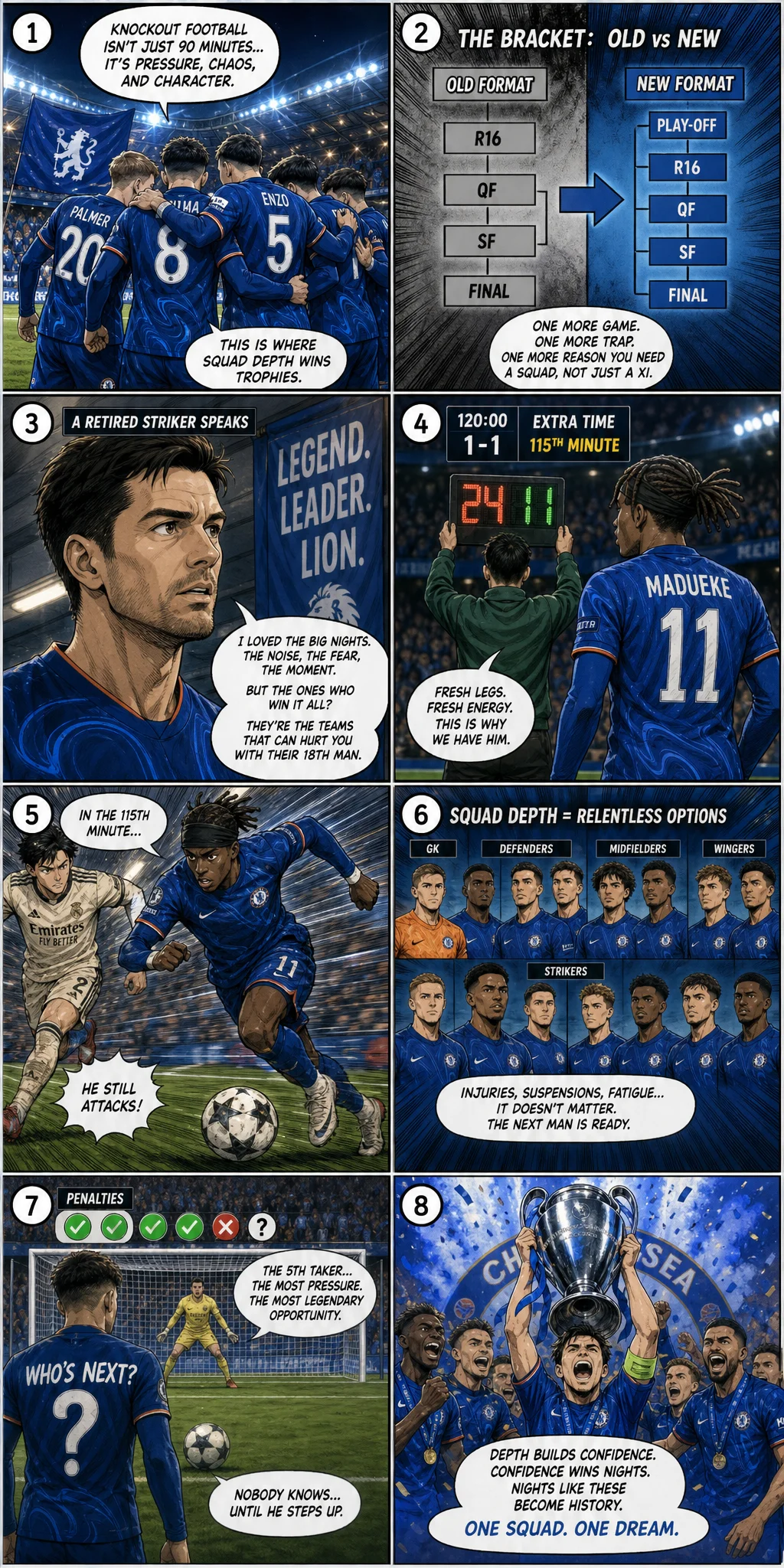
Comic content and match statistics are for entertainment purposes only and may contain inaccuracies. For Accurate Data, please refer to the reference's official website.
# Round of 32: One More Match, One Less Life
The 2026 World Cup introduces a new knockout round -- the round of 32 -- that the 48-team format mathematically requires. Thirty-two teams emerge from the group stage, and thirty-two teams must be reduced to sixteen before the tournament can proceed to the familiar architecture of the round of 16, quarter-finals, semi-finals, and final. This additional match changes everything. The path to the trophy now requires eight victories instead of seven, five knockout rounds instead of four, and a level of physical and psychological endurance that no previous World Cup champion has been required to demonstrate. The round of 32 is not cosmetic. It is a structural change to tournament football, and its consequences will ripple through every subsequent match.
The round of 32 functions, in competitive terms, as a sorting mechanism. The 32 teams that advance from the group stage are not equal. The group winners and runners-up who qualified comfortably, perhaps rotating players for their third group match, arrive at the round of 32 with a manageable accumulation of fatigue. The third-placed teams who squeezed through on goal difference, having played every group match at maximum intensity because they could not afford to do otherwise, arrive with more miles in their legs and more stress in their nervous systems. The round of 32 matchups pair these differently-fatigued teams against each other, and the resulting contests are shaped as much by the differential in accumulated wear as by the differential in talent. A group winner facing a third-placed qualifier should, on paper, advance comfortably. But the paper does not account for the fact that the third-placed team is playing with house money -- having already exceeded expectations by surviving the group stage -- while the group winner carries the burden of favoritism and the expectation that elimination at this stage would constitute a catastrophic failure.
The round of 32 will produce at least one seismic result. This is not a prediction. It is a statistical near-certainty, derived from the structural reality of a knockout round that matches teams of unequal quality in a single-elimination format. The FA Cup, the DFB-Pokal, the Coupe de France -- every domestic cup competition in every football nation regularly produces results in which a heavily favored team is eliminated by an opponent it was expected to defeat comfortably. The World Cup's round of 32, with its 16 matches and its mixture of established powers and surprise qualifiers, provides 16 opportunities for such a result to occur. At least one overconfident group winner, convinced that its superior talent will carry it through, will encounter an inspired underdog playing without pressure or inhibition, and the result will be the kind of shock that defines a tournament's narrative. The identity of that underdog -- a third-placed qualifier from Africa or Asia or CONCACAF, a team that arrived at the World Cup with no expectations and advanced through the group stage on a combination of defensive organization and counter-attacking opportunism -- will become one of the tournament's defining stories. The round of 32 exists, in part, to create that story.
For the tournament favorites, the round of 32 presents a strategic dilemma that the old format never required them to confront. In a 32-team World Cup, the knockout stage began with the round of 16. A favorite that won its group faced a runner-up from another group -- a credible opponent, certainly, but one that had already demonstrated vulnerability by failing to win its group. The match was serious, but it was not terrifying. In the 48-team format, a favorite that wins its group could face a third-placed qualifier, an opponent that by definition lost at least one group match and possibly two. The match should, by all reasonable expectations, be a formality. But knockout football is never truly formal, and the psychological challenge of facing an opponent that should be beaten is different from -- and in some ways more difficult than -- the challenge of facing an opponent that demands respect. The favorite must balance the desire to rest key players against the fear of humiliation. It must manage the squad's energy levels across a tournament that now requires eight matches instead of seven. It must treat the round of 32 seriously without expending the emotional and physical resources that will be needed in later rounds. The teams that navigate this balance successfully -- that advance without drama, without injuries, and without exhausting their emotional reserves -- will arrive at the round of 16 with an advantage over the teams that were forced to fight for their survival.
The round of 32 also changes the yellow card calculus that shapes tournament strategy. In a four-round knockout format, a player who receives a yellow card in the round of 16 and another in the quarter-finals misses the semi-final -- a devastating sanction that forces managers to consider resting card-carrying players in matches where their absence could be decisive. In a five-round format, the same accumulation pattern stretches across an additional match. Players who receive early yellow cards must navigate more knockout rounds without picking up a second, and managers who rely on aggressive, card-prone players -- defensive midfielders who break up opposition attacks with tactical fouls, aggressive full-backs who collect cautions as a cost of doing business -- face a more extended period of vulnerability. The teams that manage this best -- that enter the later knockout rounds with clean disciplinary records and full squad availability -- gain an advantage that is invisible to the casual viewer but decisive to the coach who knows that his best defensive midfielder is one yellow card away from missing the quarter-final.
The physical demands of the additional knockout round compound across the tournament's extended timeline. The 39-day tournament length means that players who reach the final will have played eight high-intensity matches across more than five weeks, with recovery windows that are adequate but never generous. The round of 32 arrives shortly after the group stage concludes, providing minimal recovery for the teams that played their third group match at full intensity. The round of 16 arrives with similar urgency. The cumulative effect is a tournament that rewards squad depth, recovery infrastructure, and physiological management to a degree that previous World Cups did not. The teams that arrive with 26 players who can all contribute at the required level -- not just a strong starting eleven and a few reliable substitutes, but a genuinely deep squad capable of rotation across multiple knockout rounds -- will survive the tournament's second half. The teams that arrived with shallow rosters, built around a core of stars who were expected to carry the load, will fade. The round of 32 is where the fade begins.
The round of 32 also represents FIFA's bet on the commercial value of additional knockout matches. Every match in the knockout stage generates more television revenue, more sponsor exposure, and more global attention than any group-stage match. Adding 16 knockout matches to the tournament calendar -- the round of 32 is the single largest injection of knockout content in World Cup history -- is a commercial proposition as much as a competitive one. The round of 32 exists because the mathematics of the 48-team format require it, but it also exists because FIFA's broadcast partners were willing to pay for it. The additional drama, the additional upsets, the additional narratives -- these are the tournament's return on that investment. Whether the round of 32 enhances the World Cup or dilutes it depends on whether the drama it produces outweighs the competitive distortion it introduces. The answer will be written across sixteen matches, in the moments when an underdog's dream survives an extra round and a favorite's campaign ends earlier than anyone expected. The round of 32 is one more match. For someone, it will be one less life in the tournament. That's the promise of knockout football, scaled to a format the World Cup has never seen.