

Eleven Men Standing in Front of a Goal. Now What?
The deepest truth about tournament football is not about attacking talent or creative genius. It is about what happens when a team with superior individual quality encounters a team that has decided, with absolute conviction, that it will not concede
Published: June 6, 2026
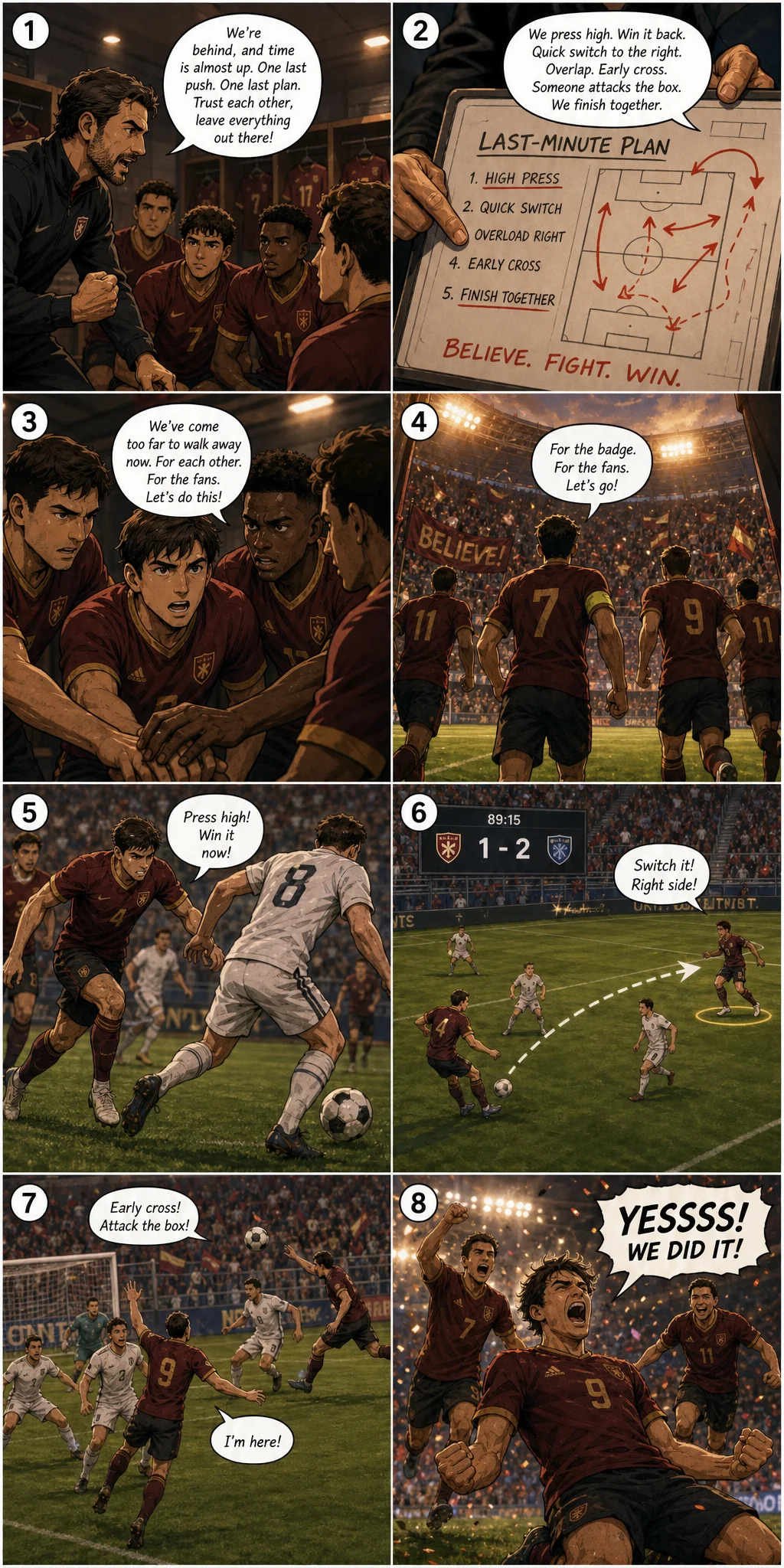
Comic content and match statistics are for entertainment purposes only and may contain inaccuracies. For Accurate Data, please refer to the reference's official website.
# Eleven Behind the Ball: The Deep Block and the Tournament Equalizer
The deepest truth about tournament football is not about attacking talent or creative genius. It is about what happens when a team with superior individual quality encounters a team that has decided, with absolute conviction, that it will not concede. This encounter -- the clash between creative ambition and defensive organization -- is the fundamental tactical drama of every World Cup, and it is about to become more prevalent than ever before.
The deep block, for those who prefer the poetry of the game to its mechanics, is the tactical equivalent of a fortress built at the edge of the penalty area. All eleven players retreat into a compact defensive shape, typically a 4-4-2 or 5-4-1 low block that leaves virtually no space between the defensive line and the goalkeeper. The distance between the back four and the midfield line is compressed to perhaps 15 or 20 meters, creating a density of bodies that makes progressive passing -- already difficult against a set defense -- functionally impossible through the center. The opposition is forced wide, where crosses must navigate a forest of defenders who have had time to organize themselves, or backward, where the whole exercise resets without having achieved anything.
The deep block is not a tactic in the traditional sense; it is a philosophy, a recognition that in a single-elimination context, survival is the only metric that matters. It has been deployed by underdogs throughout World Cup history -- Costa Rica against the Netherlands in 2014, Iran against Argentina in the same tournament, Morocco against Spain and Portugal in 2022 -- and its effectiveness is not a function of the quality of the defending team but of the patience of the attacking one. A deep block cannot be broken by talent alone. It requires something rarer: the willingness to probe, to recycle possession, to wait for the one moment when a defender's concentration lapses or a passing lane opens for a fraction of a second.
The 2026 World Cup, with its expanded 48-team format, will almost certainly feature more deep-block defending than any previous tournament. The reason is structural: the expansion introduces a larger number of teams whose primary objective is not to win the tournament -- or even to reach the quarterfinals -- but to survive the group stage, to avoid embarrassment, to give their supporters something to celebrate. These are teams for whom a 0-0 draw against a seeded opponent is not a disappointment but a triumph, and they will configure themselves accordingly.
But the prevalence of the deep block in 2026 is not merely a consequence of the format. It reflects a broader tactical evolution in which defensive organization has become, in many respects, a more sophisticated discipline than attacking creativity. The modern deep block is not the desperate last stand of an outmatched team; it is a carefully calibrated system with triggers, rotations, and contingent responses that have been drilled on training grounds with the same precision that elite teams devote to their attacking patterns. When Morocco held Spain to 77 percent possession and zero goals across 120 minutes in the round of 16 in Qatar, that was not luck or heroism. It was a defensive structure that had been designed, trained, and executed to near-perfection.
The specific mechanics of the modern deep block are worth examining, because they reveal why it has become so difficult to break down. The defensive team typically deploys in a 4-1-4-1 or 5-4-1 shape without the ball, with the striker dropping to occupy the opposition's deepest midfielder and the wingers tucking inside to deny access to the half-spaces -- the channels between the center and the touchline that have become the primary avenue for chance creation in modern football. The back four remains narrow, sometimes as close as 15 meters across, forcing the opposition to play around the outside where the geometry of the penalty area makes goal-scoring chances geometrically less probable.
This narrowness is deliberate and effective. By conceding the flanks, the defending team accepts that crosses will come into the box, but it also ensures that those crosses will arrive in an area where numerical superiority favors the defense. Two center-backs, shielded by a holding midfielder, facing two or three attackers who must generate power and direction from a ball traveling at speed -- the expected goals value of a cross from open play against a set defense is, across large samples, below 0.03 per attempt. The mathematics of the deep block are, in this sense, cruel but accurate: force the opposition to take low-probability shots, absorb the pressure, and trust that over 90 minutes the variance will not produce a goal.
The implications for tournament favorites are significant and, for neutrals hoping for a festival of attacking football, somewhat alarming. A team like France or Brazil or England, constructed around creative midfielders and incisive wide forwards, may find itself facing a defensive shape against which its normal patterns of chance creation are structurally ineffective. The half-spaces will be congested. The passing lanes into the penalty area will be blocked by five or six defenders who are not interested in winning the ball, only in occupying the space where the ball might go. The creative midfielders -- the Bellinghams and the Pedris and the Musialas -- will receive the ball in areas where the geometry offers them no meaningful forward options.
What breaks a deep block, in the end, is not a tactic but a temperament. The teams that have historically succeeded against low-block defenses in tournament contexts -- Spain in 2010, Germany in 2014, France in 2018 -- share a characteristic that is rarer than most fans appreciate: patience. Not the passive patience of a team passing sideways, but the active patience of a team that understands the deep block will eventually crack, that the concentration required to maintain a compact defensive shape for 90 minutes exceeds the physical and mental resources of all but the most exceptional defensive units. The first 60 minutes against a deep block are a siege. The last 30 minutes are a pursuit, and the team that can maintain its attacking structure while the defenders' legs and minds begin to falter is the team that finds the breakthrough.
There are specific weapons that work against a deep block, and the teams most likely to succeed in 2026 will be those that have invested in them. Set pieces become disproportionately valuable when open-play chance creation is structurally suppressed: a well-delivered corner or a clever free-kick routine can produce a goal from a situation where the defensive team's organization offers no advantage. Long-range shooting, however much it is disparaged by expected goals models, serves a purpose: a shot from 25 meters that forces a save or a deflection can disrupt the defensive shape in ways that methodical passing cannot. And the cross from deep, delivered early before the defensive block has time to compress into its penalty-area shape, can catch defenses in the transition between positions -- the one moment when the geometry briefly favors the attacker.
The 2026 tournament will test these principles more thoroughly than any World Cup before it. The format guarantees that at least 16 teams -- the entirety of the knockout round participants -- will include several who have advanced primarily through defensive organization, and the draw will inevitably pair some of those teams against attacking powers in the round of 32. The question is not whether the deep block will be deployed; it is whether the favorites have the patience and the tactical intelligence to overcome it, or whether we will witness an unprecedented number of knockout round upsets.
The deep block is not beautiful. It is not what anyone dreams of when they imagine a World Cup. But it is the most democratic weapon in tournament football -- the tactic that gives a team with 10 percent of its opponent's talent a 30 percent chance of surviving 90 minutes. In a 48-team World Cup, democracy matters. So does patience.