

Two Teams Walk Into a Match. Neither Wants to Win.
The most infamous 90 minutes in World Cup group stage history did not feature a single shot that mattered. On June 25, 1982, West Germany and Austria took the field at El Molinón in Gijón knowing exactly what result would send both teams through to t
Published: June 6, 2026
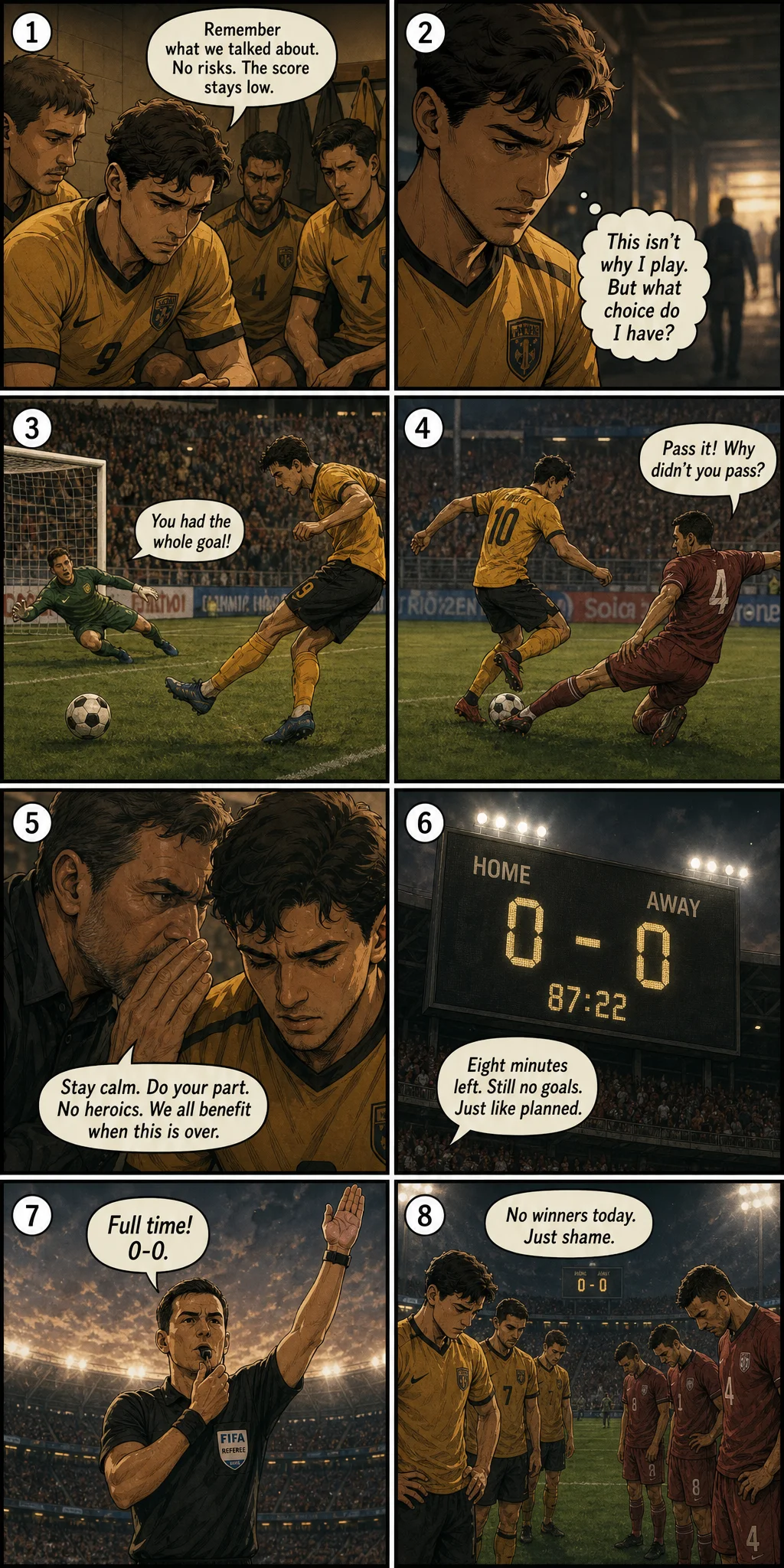
Comic content and match statistics are for entertainment purposes only and may contain inaccuracies. For Accurate Data, please refer to the reference's official website.
# The Gijón Shadow: Collusion Risk in the 48-Team World Cup
The most infamous 90 minutes in World Cup group stage history did not feature a single shot that mattered. On June 25, 1982, West Germany and Austria took the field at El Molinón in Gijón knowing exactly what result would send both teams through to the second round at the expense of Algeria, who had played their final group match the previous day. A West German victory by one or two goals would suffice. When Horst Hrubesch scored for West Germany in the 10th minute, the calculation crystallized. For the remaining 80 minutes, both teams engaged in what can only be described as a non-aggression pact: passes rolled harmlessly across the back line, challenges became exhibitions of politeness, and the ball spent more time stationary than in motion. The German television commentator fell silent. The Spanish crowd waved white handkerchiefs -- their gesture for surrender, or disgust. Algeria were eliminated, and the "Disgrace of Gijón" entered football's permanent lexicon.
The Gijón precedent has haunted every World Cup format discussion since, and it is the unspoken anxiety beneath the surface of FIFA's 48-team expansion for 2026. The new format -- 16 groups of three teams, with the top two advancing to a 32-team knockout round -- introduces a structural vulnerability that the traditional four-team group was specifically designed to prevent: the final group match between two teams who both know exactly what result benefits them both. When all three teams in a group play their final match simultaneously, as the format demands, the risk of what game theorists call "tacit collusion" is not hypothetical. It is mathematically embedded in the structure.
To understand why, consider the mechanics of a three-team group. Each team plays two matches. If Team A beats Team B in the opening match, and then Team A faces Team C while Team B faces Team C in the final round, the possibility exists -- depending on the earlier results -- that both Team A and Team C can advance with a specific result, rendering their match a formality. The simultaneous scheduling of final group matches, introduced after Gijón precisely to prevent teams from knowing the result they need, cannot fully eliminate this risk in a three-team format because the teams that play the final group match share the same objective: mutual advancement.
The specific scenarios in which collusion becomes possible are more numerous than casual observers might assume. If the first two matches produce a winner and a loser -- say, Team A beats Team B, and then Team B beats Team C -- the final match between Team A and Team C exists in a shadow world of mutually beneficial outcomes. Team A, already on three points, needs only to avoid a heavy defeat to advance. Team C, on zero points, needs a victory by a specific margin. The gap between these positions can produce a zone of overlap: a result that satisfies both teams' requirements simultaneously. A narrow Team A victory, a draw, or even a narrow Team C victory might -- depending on goal difference -- send both through at the expense of Team B, whose earlier victory over Team C suddenly counts for nothing.
The mathematical literature on this problem is precise and unforgiving. A 2018 study published in the Journal of Sports Analytics examined the probability of collusion-amenable scenarios across various tournament formats and found that three-team groups with two advancing produce, by a significant margin, the highest risk of any conceivable group structure. The probability that at least one group in a 16-group tournament will produce a situation where mutual interests align between the teams playing the final match is not marginal; it is, by the authors' calculation, above 50 percent. The question is not whether such scenarios will arise in 2026. It is whether they will produce visibly collusive behavior, and whether the tournament's integrity mechanisms can withstand the pressure.
FIFA's primary defense against Gijón-style collusion has been simultaneous scheduling, a reform implemented immediately after 1982 and maintained ever since. The theory is straightforward: when both matches in a group kick off at the same time, neither team knows the exact result required from the other match, and therefore cannot precisely calibrate their own behavior to achieve a mutually beneficial outcome. This has largely worked in the four-team group format, where the simultaneous matches involve different pairs of teams with different incentives. Team A and Team B, playing each other, cannot collude because their own match outcome is the only one that affects their fate; they cannot know what Team C and Team D are doing on the other pitch in real time.
But the three-team format undermines this defense because the teams playing the final match are the only ones whose actions matter to each other. They share the pitch. They can communicate through their behavior on the ball, through the tempo of their play, through the unspoken language of mutual understanding that professional footballers -- who have, after all, spent their careers reading the game's subtle signals -- are exquisitely trained to interpret. If both teams in the final group match realize, at some point in the second half, that a particular result will send them both through, the simultaneous kickoff becomes irrelevant. They are already on the same field, and they already know.
There are additional complications that make the 2026 format particularly vulnerable. The expansion to 48 teams means that several third-placed teams will advance to the knockout round, a feature that introduces cross-group comparison as a factor in teams' calculations. If a team knows, from earlier results elsewhere in the tournament, that a specific goal difference or points total will suffice for advancement as one of the best third-placed teams, that knowledge can shape behavior in ways that are not visible to casual observers but are deeply consequential for tournament integrity. A team that is losing by one goal with ten minutes remaining may decide, entirely rationally, that preserving goal difference is more valuable than chasing an equalizer that -- even if achieved -- would not change its qualification status. This is not collusion, precisely, but it is a species of strategic passivity that shares the same DNA.
What can FIFA do? The options are limited by the format itself. One proposal, floated in various academic papers and FIFA internal discussions, is to mandate penalty shootouts after every drawn group match, ensuring that every game produces a winner and therefore reducing the zone of mutually beneficial outcomes. This would certainly complicate collusion -- teams could no longer settle for a draw that suits both -- but it introduces its own distortions. A team that wins a penalty shootout after a drawn match receives two points rather than three, a structure that punishes teams for failing to win in regulation while still providing a meaningful incentive to compete. Whether this is an improvement or merely a different set of problems is a matter of ongoing debate.
Another approach is the radical transparency of intent: FIFA could explicitly warn teams that collusive behavior will be punished with disqualification, point deductions, or financial penalties, backed by a post-match review panel empowered to examine match footage for evidence of non-competition. The difficulty, as the Gijón case demonstrated, is that intent is extraordinarily difficult to prove. West Germany and Austria did not openly conspire; they simply stopped trying to score. The silence of the German television commentator was not evidence of a conspiracy but evidence of an uncomfortable truth: there was nothing to describe because nothing was happening. Proving that nothing was happening for a specific reason, rather than because both teams were tired or cautious or simply incompetent, is a burden of proof that may be impossible to meet.
The deeper problem is that the three-team group format was adopted not because it is the best sporting structure but because it enables a 48-team tournament to fit within a manageable calendar -- 104 matches over approximately 39 days, compared to the 80 matches that a 32-team, eight-group tournament with a round of 32 knockout would require. The format is a compromise, and like all compromises, it trades purity for practicality. The question is whether the trade is worth making, and whether the integrity risks embedded in the format can be managed well enough to prevent a repeat of Gijón.
The answer will not come from FIFA's technical documents or its public reassurances. It will come on a specific day in June or July 2026, when two teams take the field for a final group match and realize -- perhaps in the 60th minute, perhaps in the 80th -- that the result they both need is within reach, and that playing football is no longer the most efficient way to achieve it. What happens next will determine whether the "Disgrace of Gijón" remains a historical curiosity or becomes a template for the 48-team era.