
Messi's Phone Is Still Ringing
June 11, 2026. Opening day. Buenos Aires. A city that hasn't slept properly since December 2022. The obelisk on 9 de Julio Avenue — still wearing the scars of a million footprints from that night — stands in the afternoon heat. Two men in their seven
Published: June 6, 2026
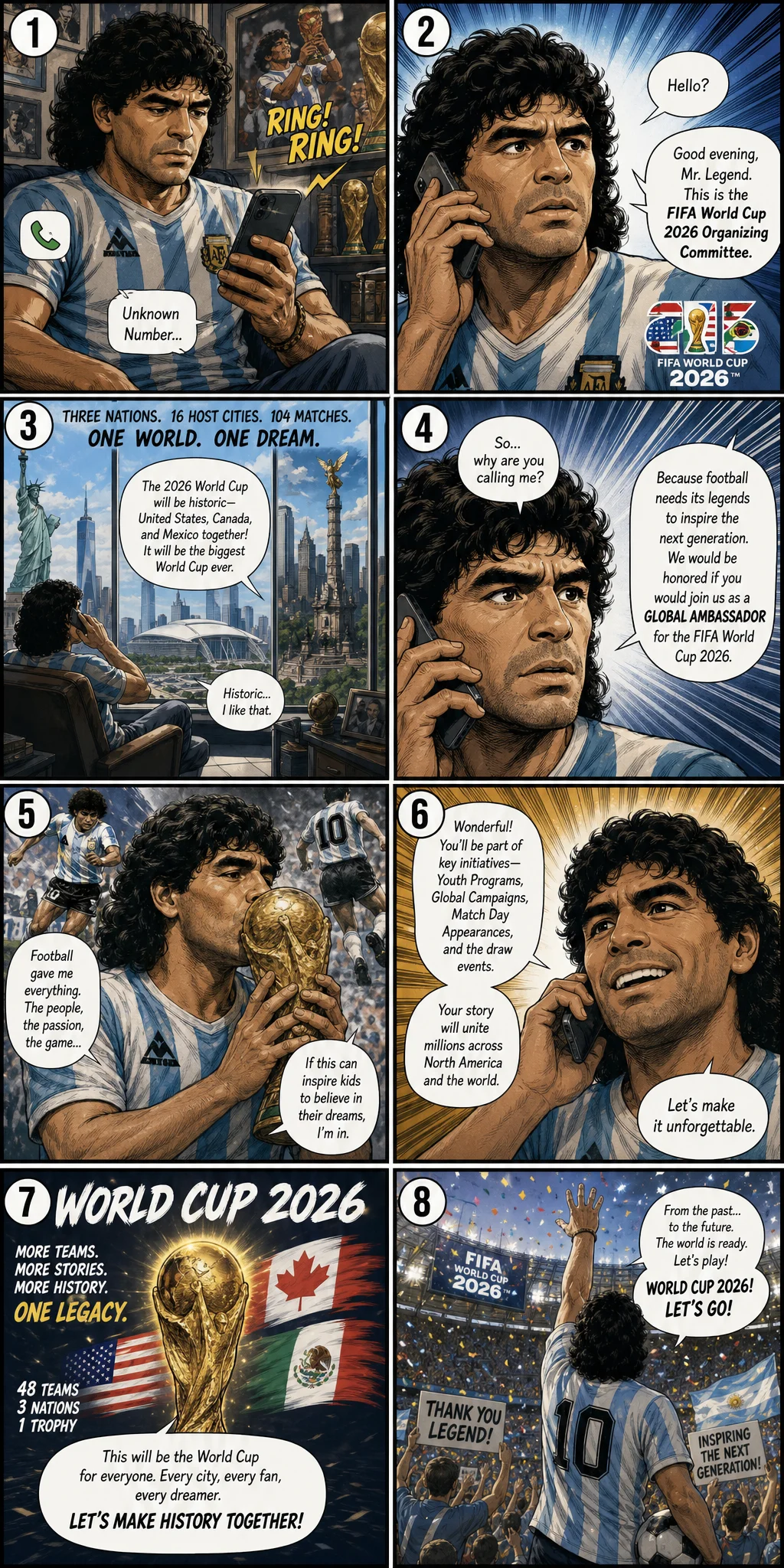
Comic content and match statistics are for entertainment purposes only and may contain inaccuracies. For Accurate Data, please refer to the reference's official website.
# Messi's Phone Is Still Ringing, But Someone Else Has to Pick Up
June 11, 2026. Opening day. Buenos Aires. A city that hasn't slept properly since December 2022. The obelisk on 9 de Julio Avenue — still wearing the scars of a million footprints from that night — stands in the afternoon heat. Two men in their seventies argue over cortados in a café in Palermo. One says Messi should start. The other says Messi should be wrapped in cotton wool and deployed only when absolutely necessary — like a fine Malbec you don't open for just anyone. They have been having this argument for two years.
I flew into Ezeiza three days ago. The taxi driver, Gustavo, has a tattoo of the World Cup trophy on his forearm. "The Saudi game," he says, without me asking. "I cried. Then I didn't cry again until the final. Then I cried for three days." He laughs at himself in the rearview mirror. "My wife says I need therapy." This is what winning does to a country that waited thirty-six years. It doesn't fix anything. It just replaces one kind of longing with another.
The question that hangs over Argentina's 2026 campaign is deceptively simple: can they do it again? But that's the wrong question. The right question — the one Scaloni has been answering with his team selections for eighteen months — is: can they do it without Messi?
Not literally without Messi. He'll be there. He said so himself, in that characteristically understated way of his: "At worst, I'll be watching it live." At best? At best he's a 38-year-old version of the player who dragged Argentina through Qatar — less explosive, certainly, but no less capable of finding a seam in the universe where no seam should exist. The free kick against Porto last month, scored while playing through muscle discomfort, was a reminder. The man's right foot is a printing press. It produces moments.
But Scaloni knows. He has always known — this is what makes him a great international manager, perhaps the greatest Argentina has ever had — that a team can't be built on one man's genius forever. The 2024 Copa América final proved it. Messi went off injured in the 66th minute. Argentina got better. Not because Messi was holding them back — please. But because the players around him, finally, after all these years, stopped waiting for him to solve everything.
Julián Álvarez dropped into Messi's space and became a different player. Lautaro Martínez — the tournament's top scorer, lest we forget — found the winner. Enzo Fernández and Alexis Mac Allister controlled the midfield with the quiet authority of men who no longer need to check if the grown-up is watching. The kids had grown up.
This is Argentina's 2026 paradox. Messi makes them special. But Messi-dependency makes them vulnerable. Scaloni has spent the past year solving this equation, and the results are — remarkably — encouraging. A 4-1 demolition of Brazil in March. A 1-0 win in Montevideo. Both without Messi. Nine changes from the Qatar squad in his final 26 — Dybala out, Garnacho out, a whole generation of "next Messi" candidates set aside. Scaloni picks systems, not reputations.
The group is kind — Algeria, Austria, Jordan. On paper, the kindest group Argentina has ever had. But that's exactly what they said about Saudi Arabia. The scars from Lusail are still pink.
And then there are the threats. The four horsemen, if you will — though calling Spain, France, Brazil, and England "horsemen" seems unfair to horses. Spain arrives as European champions, Luis de la Fuente having constructed something genuinely terrifying: a team that blends the old tiki-taka possession DNA with the raw vertical threat of Lamine Yamal, a teenager who plays like he's already seen the ending of every match. France — well, France requires its own chapter, its own book, its own library. Mbappé at his peak, Dembélé holding a Ballon d'Or, a squad so deep their second eleven would reach the semifinals. Brazil under Ancelotti is the wildest variable — a pragmatic Italian managing the most romantic football nation on earth, Vinícius Júnior with twenty-four years of national hunger on his shoulders. And England, Tuchel's England, the most expensively assembled squad in tournament history, finally with a manager who doesn't flinch.
Scaloni has watched all of this. He's studied it. The nine changes from Qatar are not random — they are a philosophical statement. Dybala — a player who shares Messi's gravitational field but none of his defensive utility — is gone. Garnacho, for all his Old Trafford electricity, doesn't fit a system that demands positional discipline. Nico Paz, the Como midfielder who most Argentines couldn't have picked out of a lineup eighteen months ago, is in. Scaloni doesn't build highlight reels. He builds ecosystems.
The defensive spine remains the tournament's best-kept secret. Emiliano Martínez — el Dibu — is a goalkeeper who has turned penalty-saving into performance art. Cristian Romero and Lisandro Martínez form a center-back pairing that operates on the edge of legality and the far side of intimidation. The midfield three of Enzo Fernández, Alexis Mac Allister, and Rodrigo De Paul covers ground like a weather system.
But what if Messi gets injured? In 2014, that question would have ended the conversation. In 2018, it would have silenced the room. In 2022, it would have drawn nervous laughter. In 2026, Scaloni has an answer: Julián Álvarez drops into the ten, Lautaro stays high, and the system adjusts without collapsing. Argentina beat Brazil 4-1 in March without Messi on the pitch. In Brazil. Against Ancelotti's Brazil. If you're looking for a single data point that explains why Argentina might do the impossible, start there.
The historical argument against them is impossible to ignore. Defending a World Cup is harder than winning one. The last country to manage it — Brazil, 1962 — did so with a 21-year-old Pelé and a supporting cast of immortals. Before that, Italy in 1938. That's it. Two teams in nearly a century of tournament football. The reasons are obvious: motivation sags, opponents study you obsessively, the hunger that carried you through the last cycle has been fed and put to sleep. Argentina's own history teaches this lesson — they arrived in 1990 as defending champions and crawled to the final on Diego's fading genius and Goycochea's penalty saves. They arrived in 2010 with Messi in his prime and Maradona on the touchline and were dismantled by Germany. Defending is not in Argentina's football DNA.
But this Argentina is different. Not because they're more talented than their predecessors — they're not. Because they've learned something no Argentina team has ever learned: how to win without needing to be beautiful. The Qatar campaign was not a masterclass in aesthetic football. It was a masterclass in competitive suffering. Every knockout game went to the edge. Every moment required someone to be braver than the moment demanded. And every time, someone was.
I think about Gustavo, the taxi driver, and his tattoo. I asked him, as we pulled up to my hotel, whether he thought Argentina would win again. He turned off the engine. Sat for a moment. "You know what's funny?" he said. "In 2022, I was sure we would lose. Every Argentine was sure. We're not built for optimism — our history has trained us to expect tragedy. And we won. Now everyone expects us to win. And I'm terrified." He smiled. "Maybe that's a good sign."
Nobody has defended the World Cup in sixty-four years. The last team to do it had a 21-year-old Pelé. Argentina's best player is old enough to have a Pelé poster on his childhood bedroom wall. The math is not in their favor. But Argentina — this Argentina, Scaloni's Argentina, the Argentina that learned to win ugly in Qatar and then learned to win without their talisman in 2024 — has never been very interested in math.
Prediction: semifinals. And then — well. Ask Gustavo. He'll tell you. Sometimes tragedy and triumph wear the same face.