
The Man Who Runs Faster Than Time
December 18, 2022. Lusail Stadium. Mbappé stood at the centre circle. France down two goals, ten minutes left. His face — you remember — expressionless. Not "defeated" expressionless. "I'm about to do something you will all remember forever" expr
Published: June 6, 2026
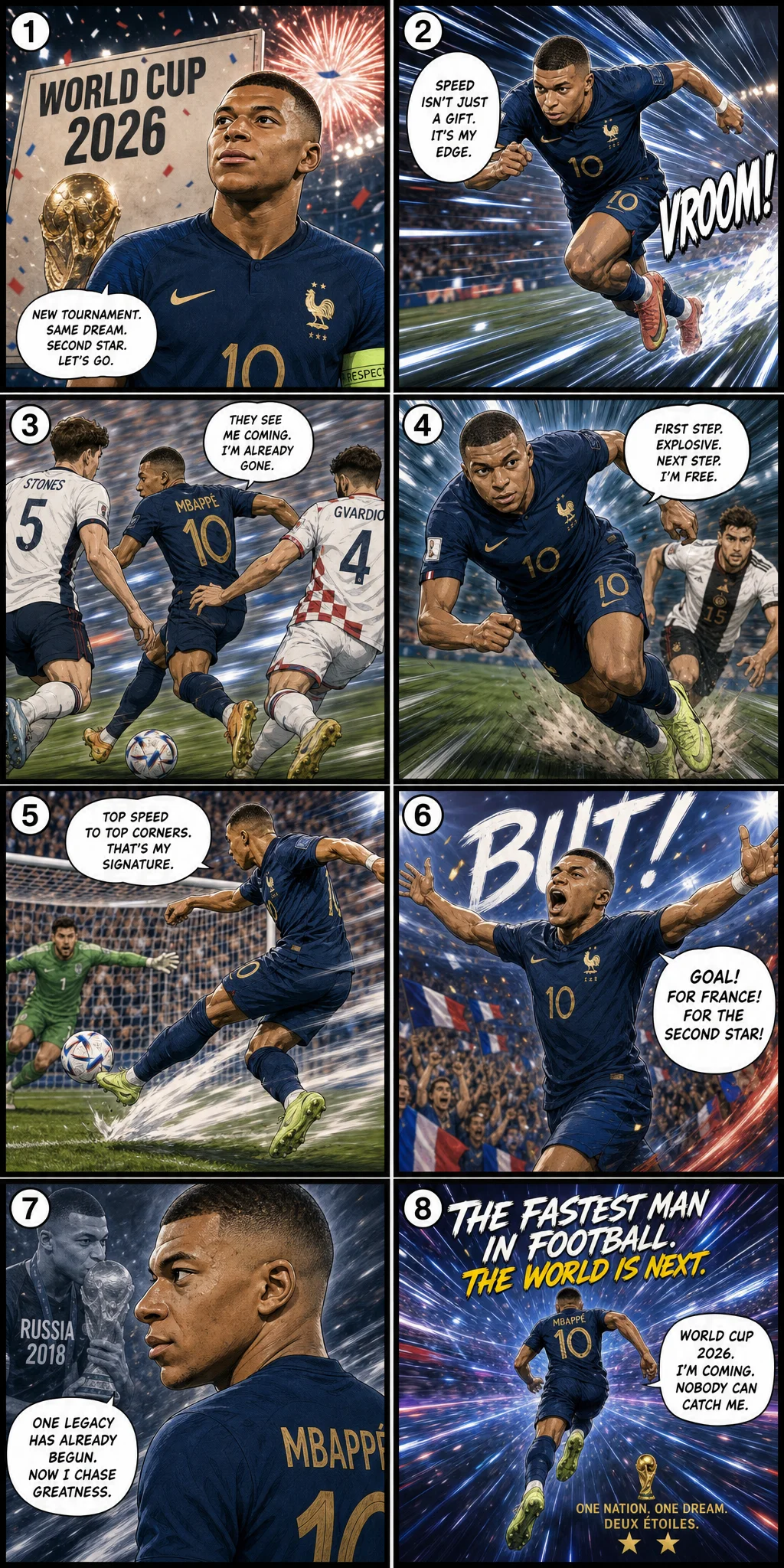
Comic content and match statistics are for entertainment purposes only and may contain inaccuracies. For Accurate Data, please refer to the reference's official website.
# The Man Who Runs Faster Than Time Is Coming to Collect
December 18, 2022. Lusail Stadium. Mbappé stood at the centre circle. France down two goals, ten minutes left. His face — you remember — expressionless. Not "defeated" expressionless. "I'm about to do something you will all remember forever" expressionless. Ninety-seven seconds. Two goals. World Cup final hat-trick. France lost. Mbappé won the world's jaw. Walking past the FIFA president on the podium, he didn't look at the trophy. He looked ahead. Not sadness. Hunger. Like a man told a restaurant is sold out who says to himself: Fine. I'll buy the restaurant.
Four years later, he's back. Twenty-seven years old. Athletic prime. Standing at the intersection of talent and ambition where very few humans have ever stood — the Pelé intersection, the Maradona intersection. Twelve World Cup goals already, joint-sixth all-time. Fifty-six for France, one behind Giroud's record. If France reaches the semifinals — and they should — Mbappé will almost certainly become the tournament's all-time leading scorer. Klose's sixteen goals is a number that has stood since 2014. It won't survive 2026.
But here's what nobody tells you about being Kylian Mbappé: the thing that makes you unstoppable is the same thing that makes you unmanageable.
I was in Madrid in February, at a tapas bar near the Bernabéu, when a Real Madrid season ticket holder named Carlos told me something I haven't been able to shake. "Mbappé scored forty goals this season," he said, spearing an anchovy. "Fans are divided on whether this was a good season." He wasn't joking. That's the standard. Forty goals, and Madridistas are squinting. Welcome to the Mbappé paradox — the only player in world football for whom a forty-goal season invites scrutiny.
The criticism has a familiar shape. He doesn't press enough. He walks when the team loses the ball. Luis Enrique's "Michael Jordan" jibe from Paris still echoes — you can score all the goals, but basketball has five players and football has eleven. At Real Madrid, a season described by the Spanish press as "rife with controversy and division" produced elite output and constant drama. The Mbappé experience, in one sentence: you get everything, and you pay for everything.
For France, this tension is the tournament. Not because Mbappé isn't good enough. Because the squad around him might be too good.
Ousmane Dembélé arrives as the reigning Ballon d'Or winner. Think about that sentence for a moment. Dembélé — the man who couldn't stay fit for five consecutive games at Barcelona, the man whose career was supposed to be a cautionary tale — just won the biggest individual prize in football. Two Champions Leagues. A season of relentless, terrifying output. He is no longer Mbappé's sidekick. He is his peer. And nobody knows how Mbappé feels about that.
Behind them: Michael Olise, the Bayern Munich creator who sees passing lanes that don't exist. Désiré Doué, nineteen years old, already making defenders look like they're running through treacle. Bradley Barcola, Rayan Cherki, Marcus Thuram. France's attack isn't just deep. It's embarrassingly deep. Lucas Hernandez, the defender, called it "the best attack in the world." He was underselling it. This is the best collection of attacking talent assembled by any national team since Brazil 1970.
Deschamps has one job: don't let the egos collide. It's what he does best — the iron fist in the velvet glove, the man who managed Benzema's exile and return, who built a World Cup-winning midfield out of a converted winger and a man who runs like he's carrying furniture. But he's never had to manage this. Two Ballon d'Or candidates on the same team. One of them the captain. The other coming off a better season.
If it works — if Mbappé sublimates enough ego to press when needed, if Dembélé accepts the secondary creative role behind his captain, if Olise is deployed correctly as the lock-pick against deep blocks — nobody beats France. Nobody. The defense is absurd: Saliba, Upamecano, Konaté, Koundé. Maignan behind them. Tchouaméni and the ageless Kanté screening. This is a squad that could field two different starting elevens and both would reach the quarterfinals.
If it doesn't work — if Mbappé walks, if Dembélé sulks, if the dressing room fractures along the fault lines of Real Madrid versus Barcelona versus Bayern versus PSG — then France becomes the most expensive cautionary tale in World Cup history.
Group I is interesting: Senegal, Iraq, Norway. The Norway game, Mbappé versus Haaland, is the marquee group-stage fixture of the tournament. Two men who have been measured against each other since they were teenagers, finally meeting on the World Cup stage. Haaland will want to prove what every Premier League defender already knows. Mbappé will want to prove that there are levels to this.
Deschamps' final tournament. Fourteen years in charge. Three major finals. One World Cup. The man who captained France to 1998, who has been involved in French football's greatest moments for nearly three decades, takes his final bow in North America. The symmetry is almost too neat — his international career began in a World Cup, and it will end in one.
The squad he leaves behind — whoever takes over after 2026 — is the envy of every football federation on earth. Saliba at 25, Konaté at 27, Tchouaméni at 26, Mbappé at 27, Olise at 24, Doué at 20. This isn't a golden generation. It's a golden era. France could — should — contend in 2030 and 2034 regardless of what happens this summer. The production line that produced Mbappé, Kanté, Pogba, Griezmann, Varane has not slowed. It has accelerated. The Île-de-France suburbs alone could probably field a competitive international team, and that's only half a joke.
But history doesn't care about production lines. History cares about trophies. And France's history with this level of talent is — how to put this gently — complicated. The 2002 disaster, defending champions eliminated in the group without scoring a goal. The 2010 mutiny in South Africa, players refusing to train, the definitively French implosion. The 2021 Euros, Mbappé missing the decisive penalty against Switzerland after a tournament of simmering internal tension. French football has two modes: imperial dominance and operatic self-destruction. There is no third setting.
This is what makes 2026 so fascinating — and so terrifying for anyone wearing a French tricolor. The talent says: champions, obviously. The history says: be careful what you wish for.
I spent an evening in the 19th arrondissement last month, watching a youth tournament on a concrete pitch wedged between apartment blocks. A dozen teenagers, most of them faster than anyone I ever played with or against, playing with the kind of freedom that only exists before money and agents and Instagram followers enter the equation. An old man next to me — Algerian, maybe seventy, wearing a France '98 jacket faded to near-white — watched silently for twenty minutes before speaking. "You see the kid in the orange boots?" I nodded. "He's twelve. Chelsea want him." He shrugged, the shrug of someone who has watched this story play out a hundred times. "We produce geniuses. The question is whether we can produce a team."
That's Deschamps' entire tenure in one sentence. Can we produce a team? In 2018, the answer was yes — a team built on Kanté's lungs and Mbappé's explosions and a defensive solidity that bordered on cruelty. In 2022, the answer was almost — the most talented squad in the tournament reached the final and lost on penalties, because penalties don't care about talent. In 2026, the question feels heavier than ever. Because on paper, this France team should be better than 2018. Better than 2022. Better than any France team that has ever existed, including the Zidane generation. And that's the problem. On paper, France has been the best team in the world for roughly six years. Paper doesn't win World Cups.
Group I is interesting: Senegal, Iraq, Norway. The Norway game, Mbappé versus Haaland, is the marquee group-stage fixture of the tournament. Two men who have been measured against each other since they were teenagers, finally meeting on the World Cup stage. Haaland will want to prove what every Premier League defender already knows. Mbappé will want to prove that there are levels to this.
Deschamps' final tournament. Fourteen years in charge, three major finals, one World Cup. He deserves a fairytale ending. But football doesn't write fairytales. Football writes chaos, and France's chaos — if it comes — will be spectacular.
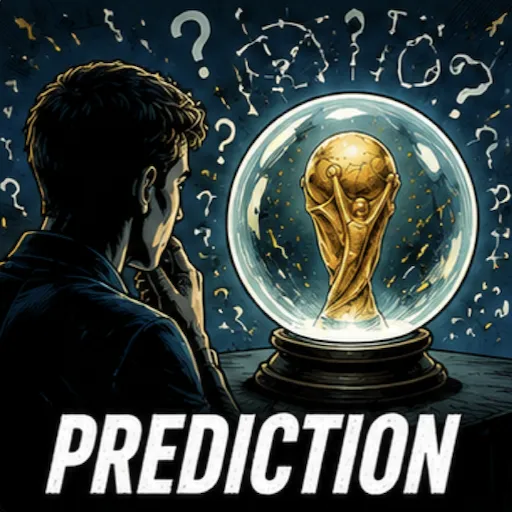
Prediction: finalists. And depending on which Mbappé shows up — the one who scored a hat-trick in a World Cup final, or the one who walked while his teammates pressed — they either win it all or go home wondering why the most talented squad in the world couldn't get out of its own way.