

Eight Matches Twenty-Six Men
The expanded 2026 format demands eight matches to lift the trophy, creating a squad-depth arms race unprecedented in World Cup history. This feature examines how national teams are restructuring talent pipelines for a tournament of attrition, which nations possess the 23-to-26 player depth to survive injuries and suspensions, and why your favorite's bench may matter more than its starting eleven.
Published: June 6, 2026
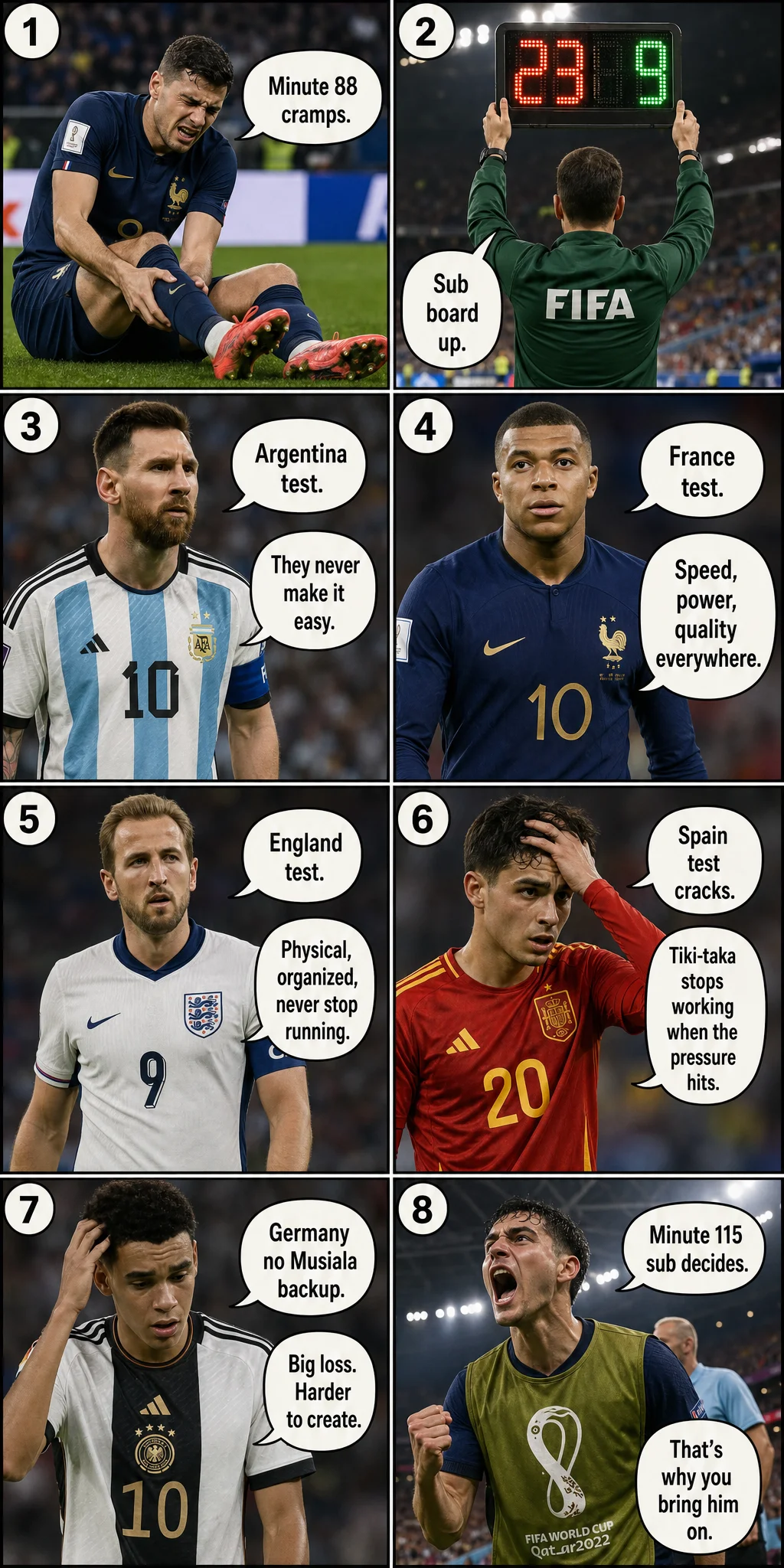
Comic content and match statistics are for entertainment purposes only and may contain inaccuracies. For Accurate Data, please refer to the reference's official website.
Eight Matches, Twenty-Six Men: Squad Depth as the 2026 World Cup's Defining Requirement
The 2026 World Cup's eight-match path to the trophy -- three group-stage fixtures plus five knockout rounds -- fundamentally rewrites the squad construction calculus that has governed every previous tournament. In a seven-match World Cup, an elite starting eleven reinforced by three or four reliable substitutes could theoretically carry a team through the knockout stage with minimal rotation. Argentina in 2022 demonstrated the outer limits of this approach: eight players started every knockout match beyond the round of sixteen, Lionel Scaloni's substitutions were notably conservative even by the cautious standards of tournament football, and the physical toll was absorbed by a core of players who understood that their minutes were non-negotiable and managed their exertion accordingly. In an eight-match tournament, that strategy transitions from ambitious to dangerous, and the teams that constructed their squads accordingly will be rewarded with an advantage that compounds with each passing round.
The arithmetic is unforgiving. An additional knockout match at elite intensity -- the specific physiological demand of a World Cup quarterfinal or semifinal, where players cover eleven to thirteen kilometres at an average heart rate exceeding eighty-five percent of maximum -- means an additional ninety-plus minutes where the accumulated fatigue of previous rounds manifests not as general tiredness but as specific, localised muscle damage that increases injury risk exponentially. Research on tournament football has demonstrated that the risk of hamstring injury increases by approximately thirty percent for each additional match played within a two-week window after the third match. The fourth, fifth, and sixth matches of a tournament campaign each carry incrementally higher injury risk than the previous one, and the eighth match -- the World Cup final, in 2026 -- will be contested by players whose hamstrings, quadriceps, and calf muscles have been subjected to a physiological load that no previous World Cup finalist has experienced.
The positional implications are specific. Four reliable centre-backs -- enough to cover two starters, one rotation option for the group-stage match against the weakest opponent, and one injury replacement -- transitions from competitive advantage to tournament requirement. The modern centre-back covers more high-intensity running distance than any previous era of the position, the demands of defending in a high line requiring repeated maximum-velocity sprints that accumulate muscle damage in the hamstring and quadriceps groups. A team that arrives in North America with three centre-backs it trusts and a fourth it hopes never to use is building a vulnerability into its squad that the tournament's length will almost certainly expose. Four is the minimum. Five is the competitive advantage.
Central midfield is the position most affected by the tournament's expanded length. Midfielders cover more ground than any other outfield player -- an average of eleven to twelve kilometres per match, with high-intensity running accounting for approximately ten percent of total distance -- and the specific demands of repeated high-intensity efforts in the middle third, where transitions occur most frequently and the space to decelerate is most limited, produce the highest non-contact injury rate of any position group. A squad that arrives with four central midfielders capable of starting a World Cup semifinal -- covering two starters, one rotation option, and one injury replacement -- possesses the minimum viable depth for the tournament's new length. The teams that invested in developing midfield depth across the previous four-year cycle -- France, with the Tchouameni-Camavinga partnership backed by the next generation; Spain, with Pedri, Gavi, and the emerging talent beneath them; England, with Bellingham, Rice, and the options behind them -- gain an advantage that no tactical system can replicate and no individual brilliance can substitute.
The forward line is the least affected by the tournament's length -- forwards cover less ground than midfielders, and the specific explosive efforts that define their position can be managed through in-match conservation rather than between-match rotation -- but the yellow-card accumulation rules create a secondary depth requirement. An attacker who collects a yellow card in the round of thirty-two carries that caution through the round of sixteen and into the quarterfinal, where a second yellow means suspension for the semifinal. The expanded knockout stage means expanded exposure to the specific tactical fouls that produce yellow cards for forwards -- the frustrated lunge after a turnover, the late challenge on a defender clearing the ball -- and the teams whose forward depth extends two-deep at every attacking position will survive the accumulation cycle that eliminates less carefully constructed squads.
The 2026 World Cup does not simply add a match to the schedule. It changes what it means to construct a World Cup-winning squad. The teams that arrived with a brilliant starting eleven and a thin bench -- the specific profile of tournament dark horses throughout World Cup history -- will be exposed by the tournament's new length not through any single dramatic failure but through the gradual accumulation of fatigue, injury, and suspension that the additional match makes mathematically more likely. The 2026 champion will not merely be the best team in the tournament. It will be the team that best understood, eighteen months before a ball was kicked, that an eight-match tournament requires a twenty-six-man squad constructed for a war of attrition rather than a sprint to the finish.