

The Wall Wins More Than the Sword
World Cup history delivers an unambiguous verdict: defensive excellence wins tournaments. From Italy 2006 through Argentina 2022, the champion has almost always conceded fewest, not scored most. This deep-dive examines 2026's most defensively formidable squads, the systems built to survive eight matches, and why clean sheets remain football's most undervalued championship currency.
Published: June 6, 2026
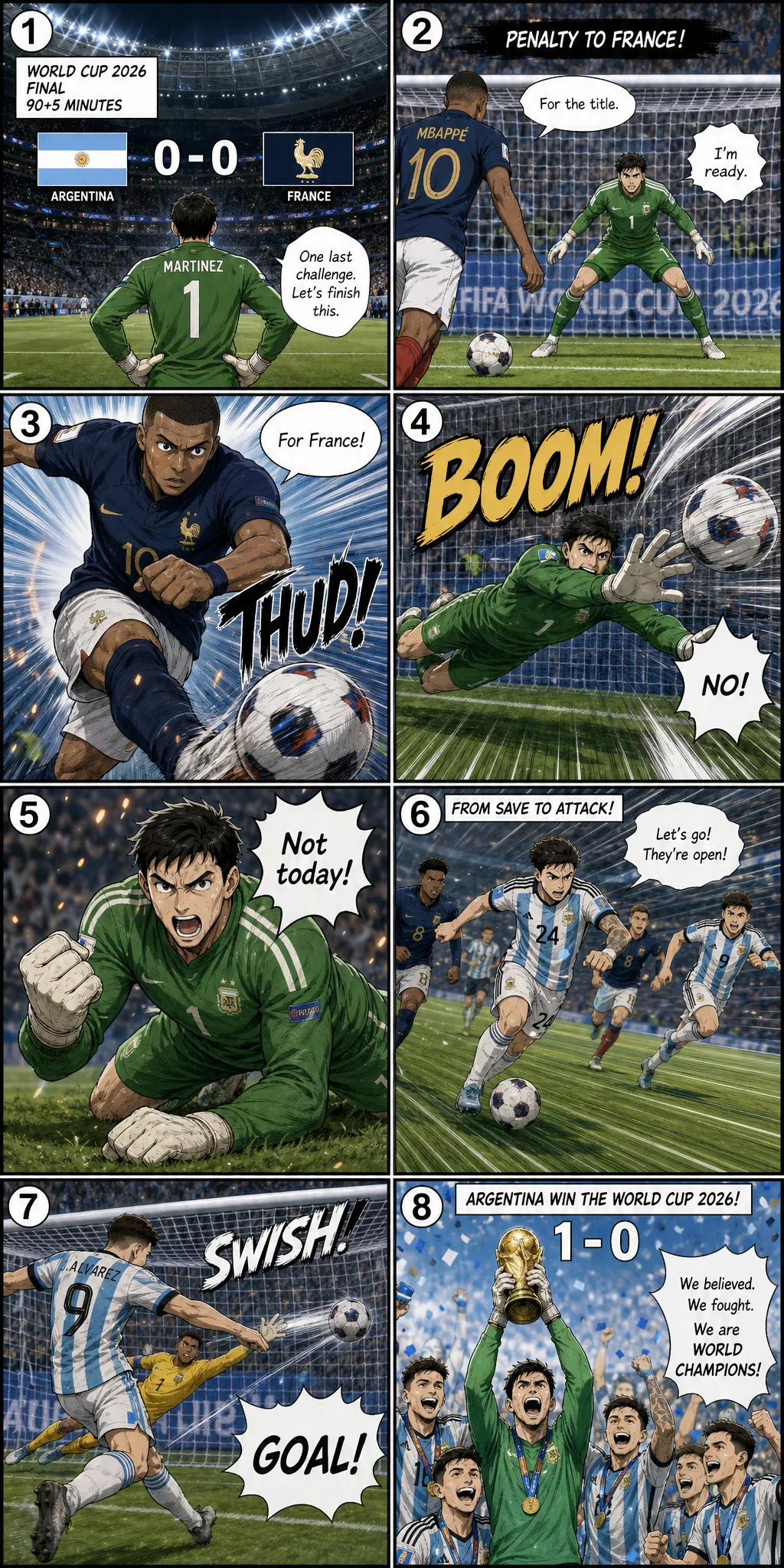
Comic content and match statistics are for entertainment purposes only and may contain inaccuracies. For Accurate Data, please refer to the reference's official website.
The Wall Wins More Than the Sword: Why Defensive Excellence Remains the World Cup's Only Reliable Formula
Since 2010, every World Cup winner has ranked among the three best defensive teams in that tournament by goals conceded per match, clean sheets recorded, and expected goals against in the knockout stage. The pattern is so consistent that it has hardened into something approaching statistical law. Spain 2010 conceded two goals in seven matches, zero in the knockout stage -- four consecutive 1-0 victories that transformed defensive parsimony into an aesthetic principle. Germany 2014 conceded four goals before the final, then kept a clean sheet against an Argentina attack featuring Messi, Higuain, and Aguero. France 2018 recorded four clean sheets in seven matches, N'Golo Kante and Blaise Matuidi functioning as a midfield screen that effectively operated as a second back four. Argentina 2022 conceded first in four of their seven matches and then locked every door -- zero goals conceded after the seventieth minute in any knockout game, Lionel Scaloni's defensive adjustments after conceding early becoming the tournament's most reliable tactical pattern.
The pattern extends backward through tournament history with the consistency of a metronome. Italy 2006 conceded two goals in seven matches -- an own goal against the United States and a Zinedine Zidane penalty in the final, the only goals scored against a defensive unit that conceded from open play on precisely zero occasions across 690 minutes of tournament football. Brazil 2002 conceded four goals in seven matches, three of them in a single dead-rubber group game against Costa Rica after qualification for the knockout stage had already been secured. France 1998 conceded two goals in seven matches, both in the group stage, both inconsequential to the result -- a penalty against Denmark in the final group match and a goal against Croatia in the semifinal that did not alter the outcome. The data speaks across a quarter-century and a dozen tournaments with one voice: defensive excellence is necessary for World Cup victory; attacking brilliance is optional and frequently counterproductive.
The tactical explanation for this pattern is structural rather than cultural. Knockout football, by its nature, compresses the space in which attacking talent operates. Defensive blocks deepen, pressing triggers become more conservative, and the risk-reward calculus that governs attacking decisions shifts fundamentally: the cost of a turnover in a Champions League group match is three points, recoverable over five remaining fixtures; the cost of a turnover in a World Cup knockout match is elimination. Teams that have built their identity around attacking fluency -- the Netherlands of 1974, Brazil of 1982, Argentina of 2006 -- have repeatedly discovered that the specific qualities that make them beautiful are the same qualities that make them vulnerable in the precise moments when vulnerability is fatal. The teams that win World Cups are the teams that have constructed their tactical identity around defensive solidity and then added attacking quality as a secondary characteristic rather than a primary one.
The 2026 edition provides a natural experiment in this hypothesis. France enters with the tournament's deepest defensive unit -- Mike Maignan in goal, the Saliba-Konate partnership at centre-back, the Tchouameni-Camavinga screen in midfield -- and the tournament's most potent attacking talent in Mbappe and Dembele. If France wins, the defensive-excellence hypothesis is confirmed. Spain enters with a system built on possession as a defensive mechanism -- controlling the ball as a means of preventing the opponent from attacking -- and a goalkeeper in Unai Simon whose distribution initiates transitions as effectively as his shot-stopping prevents goals. Argentina enters with the tournament's most experienced defensive organiser in Cristian Romero and a system that has demonstrated, across two major tournament victories, the specific capacity to concede early and then refuse to concede again.
The counter-examples are instructive precisely because they are so rare. Brazil 1970 -- widely considered the greatest World Cup-winning team -- conceded seven goals in six matches, an average that would rank among the tournament's worst defensive records in any modern edition. But Brazil 1970 played in a tournament where goals were simply more common: the average goals per match in 1970 was 2.97, compared to 2.69 in 2022, and the tactical innovations that would later compress the space in which attacking talent operates -- zonal marking, the offside trap, the systematic pressing that emerged in the 1970s -- had not yet been developed. The 1970 tournament existed in a different tactical universe, and its attacking statistics cannot be compared to the modern era without accounting for the structural changes that have made goals progressively harder to score at World Cups since the 1990s.
The implications for 2026 are specific and actionable. The teams that invested their preparation in defensive organisation -- the training-ground hours spent drilling the distances between centre-backs, the positioning of the midfield screen during opposition transitions, the specific choreography of the defensive line when the ball is in wide areas -- will survive the moments, inevitable in any knockout campaign, when the attacking plan fails and the only path to victory runs through a clean sheet. The teams that invested their preparation in attacking patterns will be entertaining in the group stage and eliminated in the quarterfinals. The pattern is too consistent to be coincidence and too enduring to be ignored. The wall wins more than the sword because, at a World Cup, one defensive lapse erases ninety minutes of attacking ambition. The team that suffers best without the ball will lift the trophy. The history of the tournament allows no other conclusion.