

The Eyes Behind the Goal Line
Five goalkeepers arrive at 2026 with the talent, temperament, and tournament pedigree to steal the trophy the way Emiliano Martinez did for Argentina and Hugo Lloris for France. This prediction feature profiles the shot-stoppers capable of penalty-shootout heroics, the sweeper-keepers revolutionizing build-up play, and the reality that a single pair of hands can override months of tactical preparation.
Published: June 6, 2026
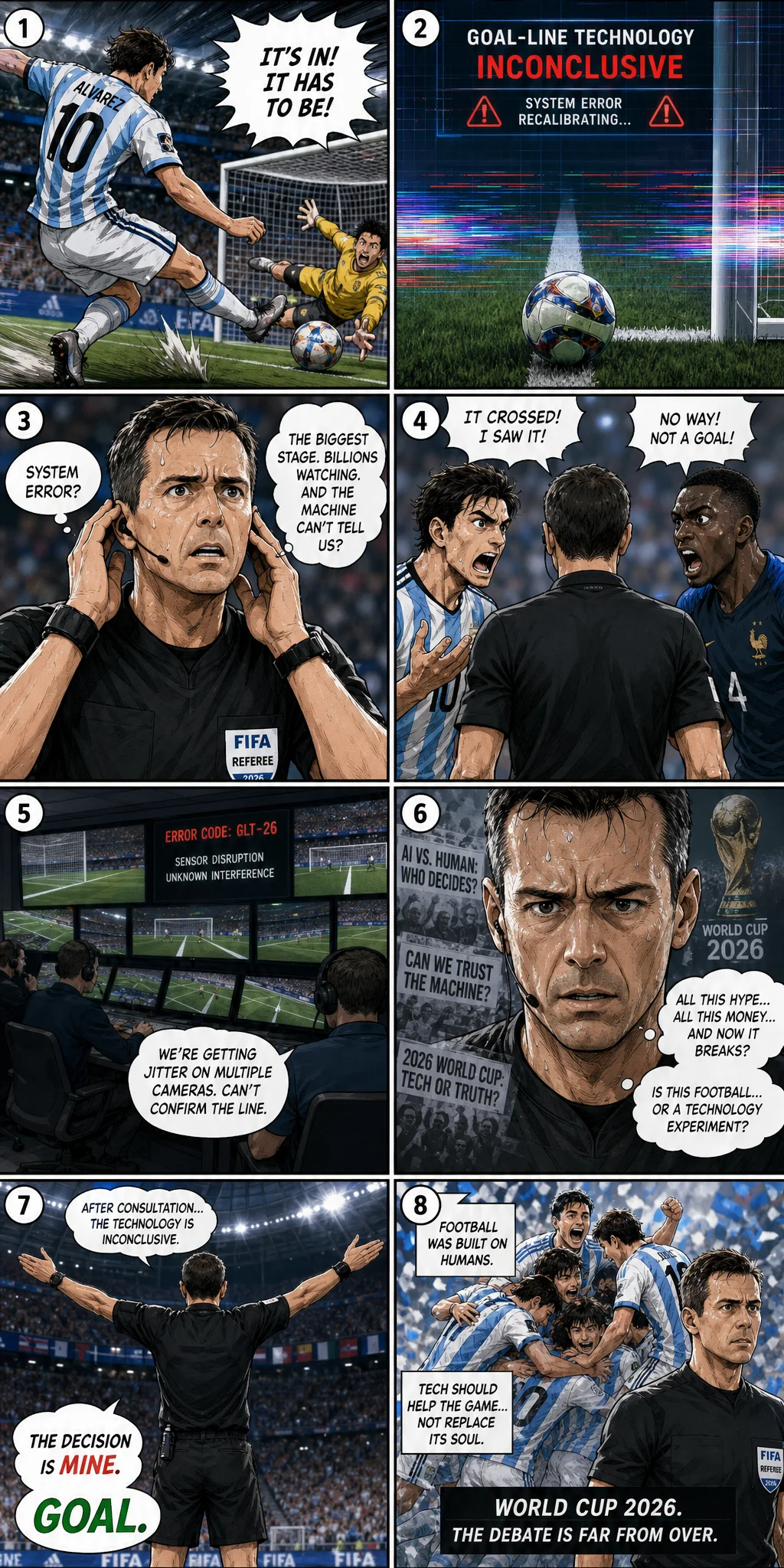
Comic content and match statistics are for entertainment purposes only and may contain inaccuracies. For Accurate Data, please refer to the reference's official website.
The Eyes Behind the Goal Line: Five Goalkeepers Who Can Steal This World Cup
I have a theory about goalkeepers. It was formed in a bar in Buenos Aires in the early hours of a December morning in 2022, surrounded by Argentines who had just witnessed Emiliano Martinez stretch his left leg backward in the hundred and twenty-third minute of a World Cup final and redirect Randal Kolo Muani's shot away from the goal with the inside of his toe. The bar did not erupt. It collapsed -- into silence, into tears, into the specific emotional exhaustion of people who had just experienced the most important moment of their football-supporting lives and understood that it had been delivered by a man wearing gloves. "Dibu," the man next to me whispered, using Martinez's childhood nickname with the reverence of a prayer. "Dibu saved everything. Dibu saved us." He was not wrong.
Goalkeepers do not win World Cups on their own. Except when they do. Gordon Banks against Pele in 1970 produced one save -- one save, a single biomechanical event lasting less than one second -- that is still described as the greatest in football history. Sergio Goycochea dragged Argentina through two penalty shootouts in 1990, a backup goalkeeper who became a national hero because he guessed correctly four times from twelve yards. Iker Casillas denied Arjen Robben with his toe in the 2010 final, the save that preserved Spain's footballing philosophy and enabled an entire era. Manuel Neuer redefined what a goalkeeper could be against Algeria in 2014, playing effectively as a sweeper, charging from his line to clear through-balls with his head, expanding the positional vocabulary of his craft in real time. And then Martinez, that sprawling leg, the most important save since Banks, the save that preserved Messi's legacy and rewrote the emotional history of a football-obsessed nation.
The 2026 tournament features five goalkeepers capable of joining this lineage. Emiliano Martinez remains the obvious candidate, a goalkeeper who in penalty shootouts transforms into something other than a goalkeeper -- a psychological warfare specialist who talks to opponents during their walk from the centre circle, who throws the ball away when they approach the spot, who has constructed an entire competitive identity around making penalty takers uncomfortable in the specific ways that produce missed penalties. Martinez has never lost a shootout in an Argentina shirt, and the statistic has transcended its mathematical meaning to become a psychological truth that opposing players must carry with them as they approach the penalty spot. He is not merely a shot-stopper. He is a performance artist whose medium is the twelve-yard box and whose audience is the terrified opponent standing over the ball.
Mike Maignan is the most complete goalkeeper in the tournament. His distribution -- throws that travel forty metres with the accuracy of a quarterback, kicks that find wide players in stride -- initiates France's counter-attacking transitions as effectively as any midfielder's through-ball. His shot-stopping is exceptional but almost secondary to his broader function: Maignan is a tactical weapon, a goalkeeper whose positioning allows France's defensive line to push higher because he operates as an auxiliary sweeper, cleaning up the through-balls that penetrate a high line. France's deepest strength in 2026 is its defensive unit, and Maignan is the foundation on which that unit is built.
Alisson Becker remains among the world's three best goalkeepers at thirty-three. His Liverpool visibility has actually demonstrated his quality through the increased volume of shots faced behind a defence that has been structurally vulnerable for two seasons. Alisson saves shots that other goalkeepers concede, and the specific quality that defines him -- the capacity to make difficult saves look routine, to position himself so precisely that reaction saves appear as anticipation -- is the quality that tournament football most rewards. Unai Simon arrives as the goalkeeper who saved two penalties in the Euro 2024 final shootout, his distribution the tactical foundation of Spain's buildup system. Gianluigi Donnarumma completes the quintet, the player of the tournament at Euro 2020, a twenty-seven-year-old with the experience of a thirty-five-year-old, the specific scar tissue of a goalkeeper who has navigated major tournament pressure and emerged with a winner's medal.
The last three World Cups have been won by the tournament's best goalkeeper in the knockout stage. Martinez in 2022. Hugo Lloris in 2018. Manuel Neuer in 2014. The pattern is statistically significant and tactically explicable: in the knockout stage, when the margins compress and the opportunities reduce, the goalkeeper who prevents the one goal that would mean elimination is more valuable than the striker who scores the one goal that would mean progression. Someone on this list is about to make the save that everyone remembers. The ball will be struck, the goalkeeper will move, and the history of the tournament -- compressed into a single moment between a boot and a pair of gloves -- will be written by the hands that keep the world out.