
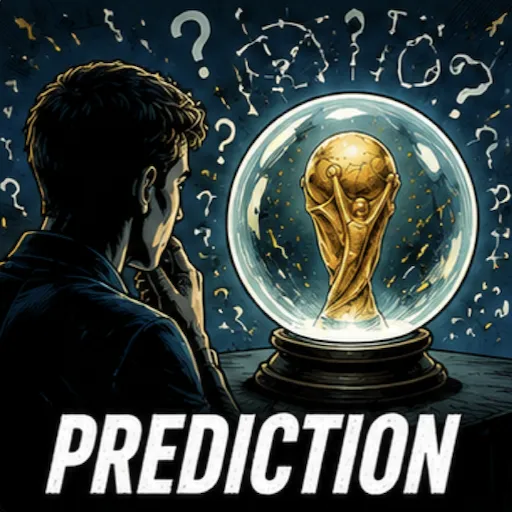
The Supercomputer Cannot Calculate This
Every World Cup cycle, supercomputers crunch millions of simulations and confidently declare a champion — and every cycle, football's chaos humiliates their algorithms. This skeptical feature examines the statistical models, the variables no computer can capture, and why the machine that gave Argentina a 7% chance in Qatar is the same one now predicting 2026's winner with misplaced confidence.
Published: June 6, 2026
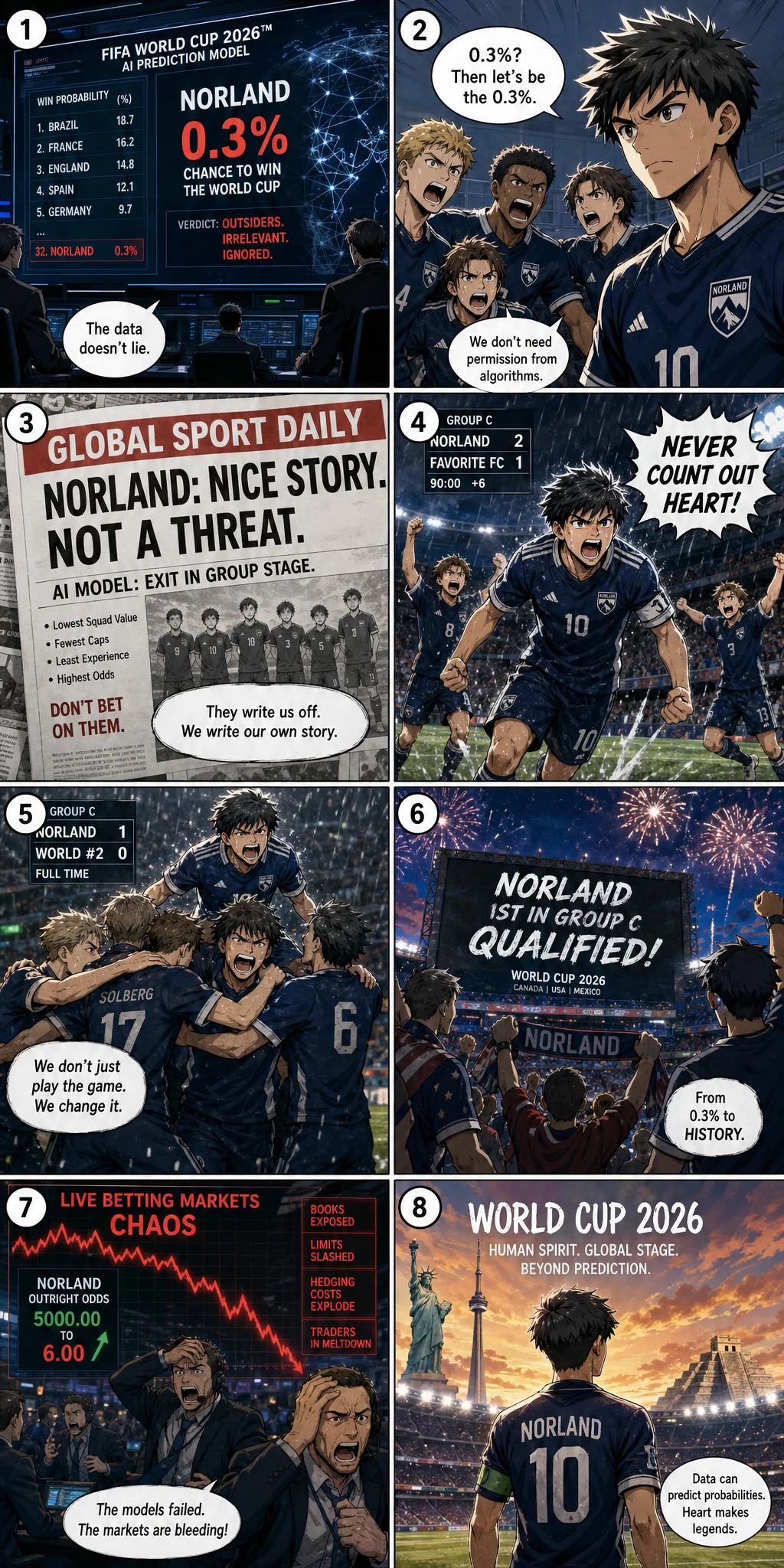
Comic content and match statistics are for entertainment purposes only and may contain inaccuracies. For Accurate Data, please refer to the reference's official website.
The Supercomputer Cannot Calculate This: Why World Cup Predictions Always Fail
One million simulations. That is how many times Opta's predictive model ran the 2026 World Cup before producing its probability distribution: France 19.7 percent, Spain 15.2 percent, Brazil 14.8 percent, Argentina 11.3 percent, England 9.1 percent. Percentages distributed to two decimal places, the algorithmic confidence of a machine that has processed every touch from every qualifying match, every pass map from every friendly, every expected goal from every club fixture involving every player who will participate in this tournament. The supercomputer has correctly predicted exactly zero of the last three men's World Cup winners. It forecast France in 2022. Brazil in 2018. Argentina in 2014 -- a version that at least produced a finalist. The supercomputer's predictive record is not an argument against data. It is a demonstration of the fundamental limits of predictive modelling when applied to a competition that operates on variables no model can encode.
What the supercomputer cannot model, because no dataset contains these variables: a dressing-room argument that festers across three weeks and detonates in the quarterfinal, the specific interpersonal resentment that develops when a star player believes a teammate has been selected on reputation rather than form and the manager refuses to intervene. A player's partner announcing a separation on social media at the worst possible moment during the tournament's second week, the distraction arriving precisely when emotional regulation becomes the difference between concentration and collapse. A hotel chef in Houston serving contaminated seafood to a starting centre-back the night before a round-of-sixteen match, a single meal altering a career and a tournament trajectory. A VAR decision that defies every known interpretation of the handball law and every precedent established in the group stage, applied in the eighty-seventh minute of a knockout match by a referee whose interpretation of the rulebook differs from the interpretation that governed the previous forty-eight matches. A specific quality of shared suffering -- the Argentina of 2022, forged through a Copa America victory, a Finalissima, and the opening-day trauma of defeat to Saudi Arabia, connected by bonds that no performance data can measure and no model can weight -- that transforms a collection of talented individuals into a collective entity whose resilience exceeds the sum of its statistical parts.
The supercomputer operates on the assumption that a World Cup is a series of independent events that can be modelled as conditional probabilities: if Team A beats Team B with probability X, and Team C beats Team D with probability Y, then the probability of Team A winning the tournament is the product of these conditional probabilities across all possible bracket paths. The assumption is false. World Cup matches are not independent events. They are sequential experiences within a shared emotional container, and the outcome of Match N is not independent of the outcome of Match N-minus-1 but causally related to it in ways that probability theory cannot capture. A team that loses its opening match becomes either galvanised or demoralised. A team that wins its opening match becomes either confident or complacent. The direction of the effect cannot be predicted from pre-tournament data. It emerges from the specific interactions between specific personalities in specific circumstances that a Monte Carlo simulation, processing one million iterations of pre-tournament ratings, cannot access.
The tournament's structural features compound this unpredictability. The 48-team format introduces three-team groups where the margin for error is reduced from three matches to two, where a single bad performance eliminates a team before the tournament has established its competitive rhythm, where the third-place qualification rules create bracket asymmetries that no pre-tournament model can fully anticipate. The expanded knockout stage introduces an additional elimination match where the specific pressure of a World Cup penalty shootout -- a procedure that the analytics community has demonstrated is fundamentally a random event, with no player or team demonstrating a statistically significant long-term advantage -- determines progression. The supercomputer can model the probabilistic properties of a penalty shootout. It cannot model which player, walking from the centre circle to the penalty spot in the eighty-seventh minute of a tied quarterfinal, will experience the specific neurological response that transforms a professionally competent penalty taker into someone who cannot feel his legs.
One million simulations. All of them wrong in the specific way that matters. All of them useful as a description of what should happen if the World Cup operated according to the laws of probability rather than the laws of narrative. The supercomputer's value is not predictive. It is diagnostic: the gap between the model's forecast and the actual tournament outcome reveals, with each passing World Cup, precisely how much of football's meaning resides in the space beyond what data can capture. The 2026 World Cup will produce a result that exactly zero of those one million simulations anticipated in the specific sequence required to produce it. The model will be wrong. The model will be necessary -- because without it, we would not appreciate why it is always, beautifully, inevitably wrong.