
The Real Champions Walk the Touchline
Great World Cups are won on the touchline as much as on the pitch. Five managers at 2026 possess the tactical intellect to bend the expanded format to their will. This profile examines these coaching masterminds — their systems, substitutions philosophy, and pressure temperament — asking whether the champion is decided in a training-ground office rather than a stadium tunnel.
Published: June 6, 2026
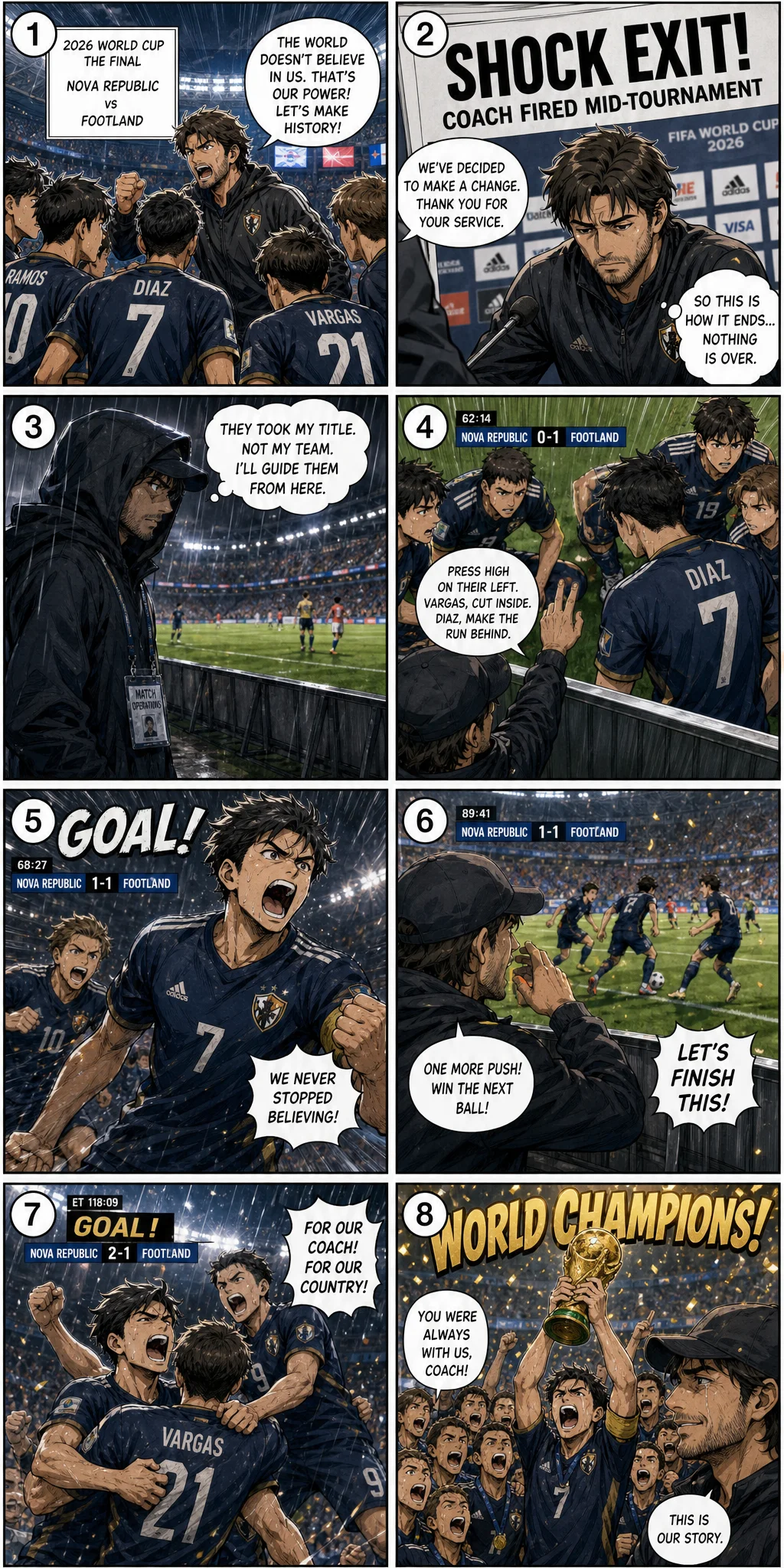
Comic content and match statistics are for entertainment purposes only and may contain inaccuracies. For Accurate Data, please refer to the reference's official website.
The Real Champions Walk the Touchline: Five Managers Who Will Decide the 2026 World Cup
World Cups are won by players. This is the conventional wisdom, and it contains enough truth to survive casual scrutiny: twenty-two men determine the outcome of a football match, and the manager who takes credit for their performance is engaged in the oldest and most successful con in professional sport. But the 2026 World Cup features a concentration of coaching talent so remarkable that the conventional wisdom requires qualification. Five managers, each representing a fundamentally different theory of how a tournament is won, arrive in North America with the specific combination of experience, tactical intelligence, and institutional authority that elevates touchline decisions from secondary considerations to primary competitive weapons.
Carlo Ancelotti manages Brazil with the most decorated resume in football history: four Champions League titles, league championships in Italy, England, Spain, Germany, and France, and the specific reputation for making great players feel trusted and free that has become his institutional signature. Ancelotti's genius is not tactical innovation -- his systems are rarely the most sophisticated in any tournament he enters, his in-game adjustments are competent without being revolutionary -- but the ego management that modern elite football demands. He convinces Vinicius Junior that he is the most dangerous attacker in the world without allowing that belief to curdle into the entitlement that destroys dressing rooms. He manages the specific tension between Brazil's expectation of joyous, improvisational football and the structural solidity that modern tournament success requires. Ancelotti does not outcoach his opponents. He outmanages them, and the distinction -- between tactical brilliance and the capacity to create an environment in which tactical instructions are actually followed -- is the distinction on which Brazil's 2026 campaign depends.
Thomas Tuchel leads England as the tournament specialist, the manager who won the Champions League with Chelsea in 2021 by outmaneuvering Pep Guardiola in the final, who reached another final with Paris Saint-Germain in 2020, whose tactical flexibility -- the capacity to adjust formation, pressing triggers, and buildup patterns not between matches but within them, at halftime, in response to specific opposition threats -- is the quality that knockout football uniquely rewards. Tuchel's England is less predictable than Gareth Southgate's England, more capable of the mid-game adjustments that determine knockout ties, more likely to produce the specific tactical surprise -- a formation switch, a pressing scheme designed for a single opponent, a buildup pattern that exploits a weakness identified in the previous round -- that eliminates a superior opponent in a one-off fixture. The questions are cultural: can a German manager, in a football nation that has defined itself in opposition to German football for sixty years, command the institutional trust that tournament success requires, and can he do so in the specific pressure cooker of an England World Cup campaign where the tabloid media is actively rooting for his failure?
Didier Deschamps concludes fourteen years managing France with a record that places him among the greatest international managers in football history: one World Cup, one World Cup final, one European Championship final, and the specific institutional memory of navigating a national team through the political, media, and interpersonal chaos that destroyed France's 2010 campaign and has threatened every subsequent tournament. Deschamps' invisible skill -- the capacity to manage the egos of twenty-six millionaire athletes who believe, with some justification, that they should be starting -- is the skill that no tactical board can capture and no coaching course can teach. His France team in 2026 is the deepest squad in the tournament, the most talented collection of individuals, and the most likely to implode under the weight of its own expectations. Deschamps' presence on the touchline is the variable that prevents implosion, the institutional memory that translates individual talent into collective output. France without Deschamps is a collection of brilliant players. France with Deschamps is a team that has reached three major finals in eight years.
Lionel Scaloni returns with Argentina as the accidental genius, the interim placeholder who became the most successful Argentina manager in history, whose evolution from Messi-dependency to systemic independence represents the most impressive tactical arc in modern international football. Scaloni's Argentina in 2022 won the World Cup through the specific combination of defensive resilience after conceding early, tactical flexibility across multiple formations within a single tournament, and the emotional leadership that transformed a group of players into a collective entity. His 2026 iteration must navigate the post-Messi transition -- Messi will be thirty-nine, his role reduced, his presence still the emotional centre but no longer the tactical one -- with the specific challenge of winning a second consecutive World Cup without the player who defined the first.
Luis de la Fuente brings Spain as the Basque pragmatist who inherited chaos and built a European champion. His Euro 2024 Spain was not the tiki-taka of 2010: it was more direct, more vertical, more willing to sacrifice possession for penetration, and the specific tactical evolution it represented -- the acknowledgment that Spain's football culture had become a prison as well as a philosophy -- was the most impressive coaching achievement of the tournament. De la Fuente's squad selection is the boldest of any manager in 2026, but his system is the most coherent: a defined style of play that every player understands and executes with institutional fluency.
Five managers. Five theories of tournament victory. Ancelotti's trust, Tuchel's flexibility, Deschamps' ego management, Scaloni's evolution, De la Fuente's coherence. The players play. The managers decide who wins. The 2026 World Cup, more than any previous edition, will be won from the touchline rather than the pitch. The manager who makes the right adjustment at the right moment -- the substitution that changes a semifinal, the tactical shift that unlocks a low block, the emotional intervention that prevents a dressing-room fracture -- will lift the trophy. The players run. The manager thinks. In 2026, thinking may finally be more valuable than running.