
The Champions League Invisible Finger
A Champions League winner has appeared in every World Cup final since 2002 — a statistical spine running through twenty years of football history. This predictive feature identifies 2026 Champions League winners heading to North America, examines why elite club knockout experience transfers to World Cup pressure, and asks whether this pattern can identify the finalists before qualifying begins.
Published: June 6, 2026
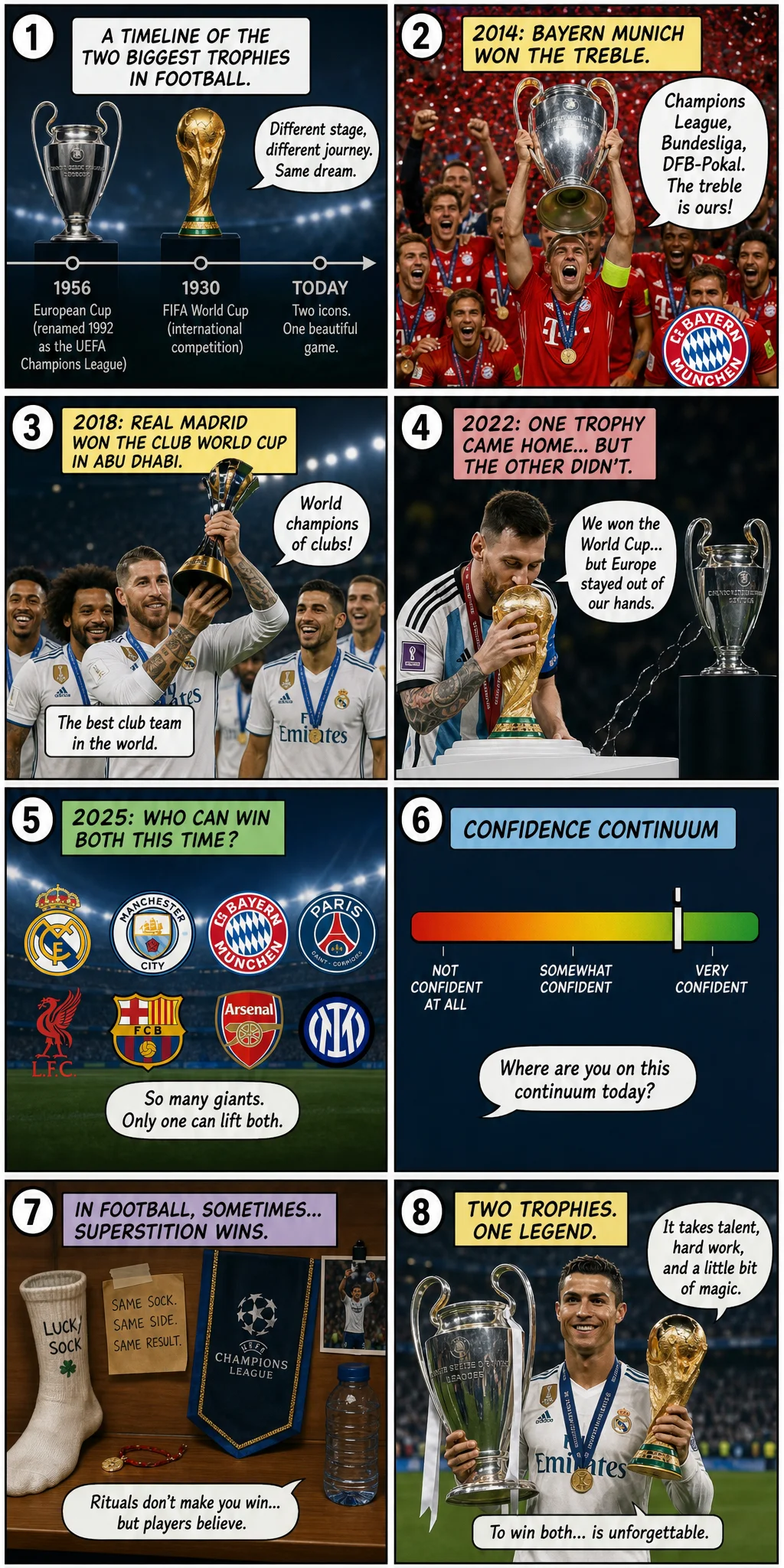
Comic content and match statistics are for entertainment purposes only and may contain inaccuracies. For Accurate Data, please refer to the reference's official website.
The Champions League's Invisible Finger: How Club Football's Ultimate Prize Predicts World Cup Winners
A pattern in modern World Cup history has accumulated sufficient statistical weight to qualify as something approaching predictive law: the winner of the pre-tournament Champions League final provides the structural spine of the subsequent World Cup champion. The mechanism is psychological rather than tactical, institutional rather than individual, and its consistency across six consecutive tournaments spanning sixteen years demands explanation rather than dismissal.
The data is unambiguous. Spain 2010 was built on Barcelona's core: Xavi, Iniesta, Carles Puyol, Gerard Pique, Sergio Busquets, Pedro -- six starters from the team that had won the 2009 Champions League final against Manchester United, supplemented by Iker Casillas's Real Madrid experience and David Villa's finishing. The collective understanding that enabled Spain's tiki-taka to function as a defensive mechanism -- controlling possession not merely to create chances but to prevent the opponent from creating them -- was the product of years of shared training at Barcelona, compressed into a World Cup campaign that conceded two goals in seven matches. Germany 2014 drew its spine from Bayern Munich: Manuel Neuer, Philipp Lahm, Jerome Boateng, Bastian Schweinsteiger, Thomas Muller -- five starters from the team that had won the 2013 Champions League final against Borussia Dortmund, transplanted into Joachim Low's system with the specific authority that comes from having already climbed the mountain. The 7-1 semifinal demolition of Brazil was not a tactical innovation. It was the expression of a collective confidence that could only have been produced by players who had already won everything worth winning and understood, at a cellular level, that a World Cup semifinal is not different in kind from a Champions League semifinal -- it is merely more consequential in its outcome.
France 2018 threaded the connection through the specific institutional memory that Raphael Varane carried from Real Madrid's three consecutive Champions League titles (2016-2018), that N'Golo Kante carried from Chelsea's remarkable 2012 triumph and Leicester's improbable 2016 Premier League, that Antoine Griezmann absorbed from Atletico Madrid's repeated deep Champions League runs. The spine was less concentrated in a single club than Spain 2010 or Germany 2014, but the underlying mechanism was identical: players who had experienced the specific emotional architecture of winning a major tournament entered a World Cup knockout stage not hoping to win but expecting to, because they recognised the quality of the air at the summit. Argentina 2022 was the loosest application of the pattern -- the squad lacked a concentrated Champions League-winning core, with most of its key players (Messi at PSG after Barcelona's decline, Julian Alvarez as an emerging talent at Manchester City, Enzo Fernandez as a recently arrived European professional) carrying institutional memory from clubs that had won domestic titles rather than European ones. And yet the pattern held: Lionel Messi arrived at the 2022 World Cup after winning the 2021 Copa America and the 2022 Finalissima, trophies that, while not the Champions League, provided the specific psychological inoculation against the fear of losing that had defined his previous international failures.
The mechanism is not mysterious. Champions League winners arrive at a World Cup having already navigated the specific emotional sequence that a tournament victory demands: the group-stage qualification that requires consistency rather than brilliance, the round-of-sixteen match where a single defensive error eliminates you, the quarterfinal where the opponent is good enough to punish any vulnerability, the semifinal where the prize is within reach and the fear of losing becomes the primary obstacle, the final where ninety minutes determines whether a career is remembered as successful or incomplete. The players who have experienced this sequence and emerged with a winner's medal possess a form of tournament literacy that cannot be trained, simulated, or purchased. They know what a victorious dressing room feels like because they have stood in one. They know what the days between a semifinal and a final demand because they have lived them. They know that the moment before a trophy lift requires something that no tactical board can diagram -- the specific emotional regulation that prevents the occasion from overwhelming the performance.
The 2026 Champions League winner was Real Madrid, with Kylian Mbappe as the attacking focal point, Aurelien Tchouameni and Eduardo Camavinga in the midfield spine, and the accumulated institutional memory of a club that has won more European Cups than any other. If the historical pattern holds -- and it has held through six consecutive tournaments, which in any field other than football would be considered conclusive evidence rather than interesting coincidence -- France's squad is the primary beneficiary. The Mbappe-led French team enters the 2026 World Cup with a spine that has just won the Champions League and a captain who understands, with the specific clarity that only multiple major tournament finals can provide, what winning requires and what losing costs. Patterns are not guarantees. They are probability distributions. But a probability distribution that recurs across six tournaments spanning sixteen years has crossed the threshold from interesting observation to actionable intelligence. The Champions League's invisible finger is pointing toward the French. The tournament will determine whether the pattern holds for a seventh time or whether 2026 is the year the statistical law is broken. Either outcome is interesting. Only one favours the holders of Europe's greatest club prize. History, for now, suggests that France should be very confident indeed.