

Germany: The Machine That Never Breaks
There is a German word that football does not use but should: Wiederkehrprinzip. The principle of return. It describes the specific quality that separates Germany from every other football nation in history -- not the number of trophies, though four
Published: June 6, 2026
Comic content and match statistics are for entertainment purposes only and may contain inaccuracies. For Accurate Data, please refer to the reference's official website.
There is a German word that football does not use but should: Wiederkehrprinzip. The principle of return. It describes the specific quality that separates Germany from every other football nation in history -- not the number of trophies, though four World Cups is a tally exceeded only by Brazil, but the institutional capacity to rebuild, return, and compete at the tournament's highest level across fundamentally different eras, different systems, different generations of players. Eight World Cup finals. Four victories. Four defeats. And the remarkable thing is not the symmetry of the record. The remarkable thing is the span.
The first final, 1954, arrived just nine years after the end of the Second World War. West Germany, a nation still under Allied occupation when the tournament began, faced Hungary's Mighty Magyars in Bern. The Hungarians had not lost a match in four years. They had beaten West Germany 8-3 two weeks earlier in the group stage. They had Puskas, Kocsis, Hidegkuti -- the most sophisticated attacking unit football had ever seen. And then it rained. German football lore calls it Fritz-Walter-Wetter, after the captain whose war injuries ached in dry conditions but who came alive when the pitch turned heavy and the ball stopped rolling true. West Germany won 3-2. The Wunder von Bern, the Miracle of Bern, became the founding myth of post-war German identity, a moment when a nation that had lost the right to feel pride in anything found it again in twenty-two men playing in the mud. The importance of that final transcends sport. It was a national psychological event.
The second final, 1966 at Wembley, produced a wound that burned for decades. England 4, West Germany 2, after extra time, but the third English goal -- Geoff Hurst's shot striking the crossbar, bouncing down on or over the line depending on your angle of allegiance -- remains the most disputed moment in World Cup final history. The Soviet linesman, Tofiq Bahramov, awarded the goal. German football absorbed this as a specific type of competitive fuel: the sense of having been wronged by fate, a sense that would power the next cycle of reconstruction.
The third final, 1974 in Munich, was the aesthetic high point. Franz Beckenbauer, the Kaiser, the sweeper-libero who redefined the center-back position as a platform for creative distribution rather than a fortress of destruction, led West Germany against Johan Cruyff's Netherlands. The Dutch scored in the first minute -- a penalty won before a German player had touched the ball. And then Germany, playing in their own Olympic Stadium, absorbed the shock and methodically dismantled the most beautiful team in the world. Paul Breitner equalized from the spot. Gerd Muller, Der Bomber, scored the winner with that characteristic turn in the box, the one that defied biomechanical explanation. Beckenbauer lifted the trophy. Total Football had been defeated.
The fourth and fifth finals came in 1982 and 1986, both losses. Italy's Paolo Rossi produced a hat-trick in the 1982 semifinal and then scored the opener in the 3-1 final victory. Diego Maradona, four years later in Mexico, produced five assists and scored five goals in the tournament, culminating in the 3-2 final in which he set up Jorge Burruchaga's winner with a pass that traveled thirty meters through dense Argentine traffic. Germany found the runner-up position twice in five years. Lesser nations would have called it a golden era. For Germany, it was the prologue.
The sixth final, 1990 in Rome, was the crowning of Lothar Matthaus. He had been on the field in 1982 and 1986 for the losses. He had absorbed the pain and metabolized it into a leadership style that was less about inspiration than about absolute competitive refusal. The 1-0 victory over Argentina, Andreas Brehme's penalty in the 85th minute, was a grim, functional affair -- Maradona's Argentina had reached the final despite scoring only five goals in six matches -- but it arrived as German reunification approached. When Matthaus raised the trophy, the Berlin Wall had been down for eight months. The two German football associations had already agreed to merge. The World Cup was not the cause of German unity, but it was the soundtrack.
The seventh final, 2002 in Yokohama, belonged to Oliver Kahn, the tournament's best player, the goalkeeper who had carried a limited German squad past superior opponents through sheer force of will. And then, in the 67th minute of the final against Brazil, Kahn made his only mistake of the tournament. Rivaldo's shot slipped from his gloves. Ronaldo scored the rebound. Germany's best player became the tragic hero of a narrative he had dominated.
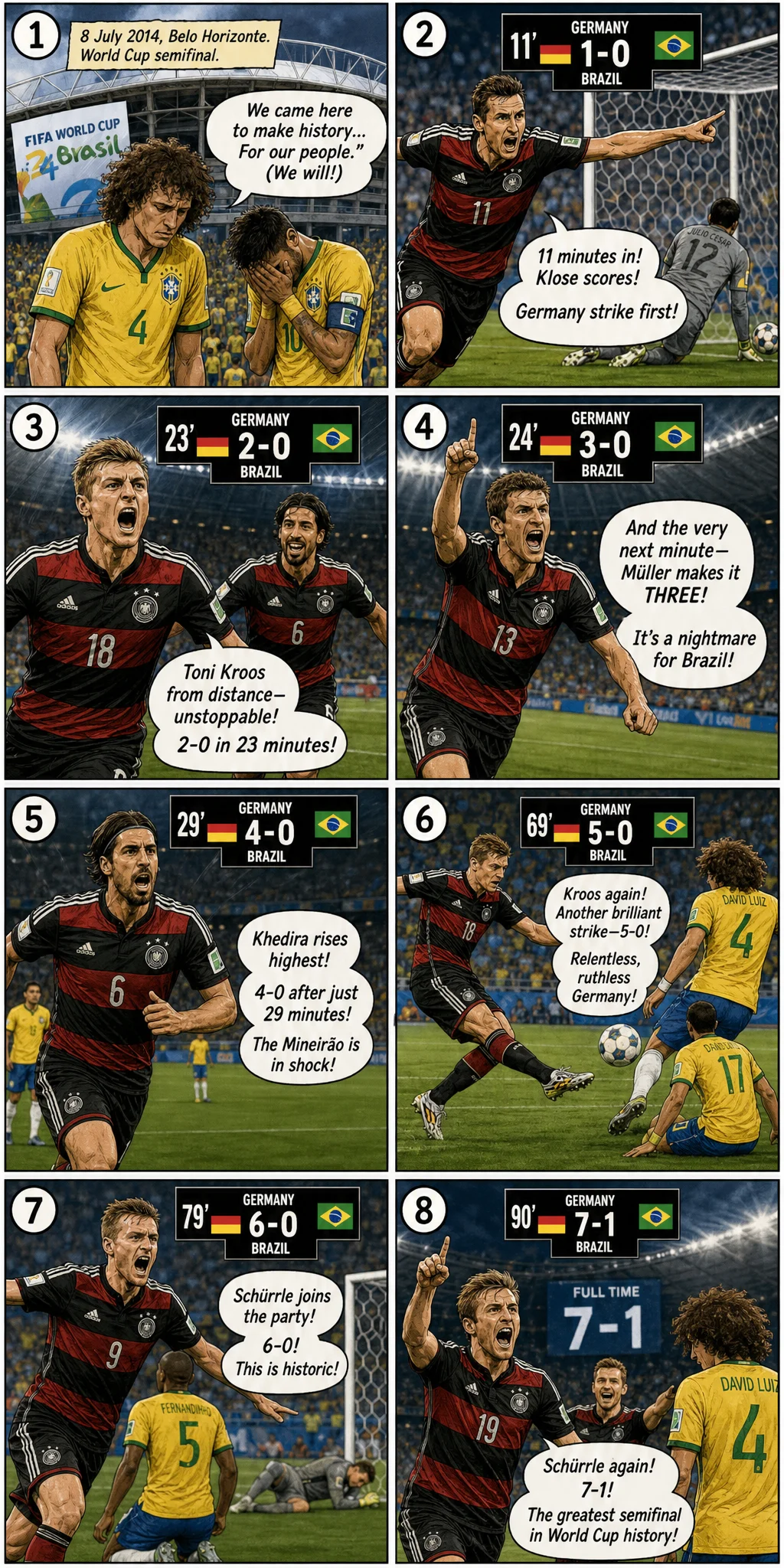
The eighth final, 2014 at the Maracana, was the apotheosis. Germany had spent a decade reconstructing its football infrastructure after the disappointing early exits of 1998 and 2000. The DFB had mandated youth academies at every professional club. A generation emerged -- Lahm, Schweinsteiger, Neuer, Muller, Kroos, Ozil, Gotze -- that combined technical sophistication with the old German virtues of positional discipline and competitive relentlessness. The 7-1 semifinal destruction of Brazil announced the project's completion more forcefully than any manifesto could. The final, a 1-0 victory over Argentina on Mario Gotze's chest-and-volley in the 113th minute, confirmed it. The machine had not just returned. It had returned at a higher specification than any previous iteration.
Four victories. Four defeats. The machine never breaks permanently. It simply undergoes its scheduled overhaul and returns to the final, which is where, in the German understanding of football, it has always belonged.