

Five Stars, Five Wounds
The scar tissue is what makes it beautiful. Brazil has won the World Cup five times -- more than any nation on earth -- yet ask a Brazilian of a certain age about football and they will not begin with the triumphs. They will begin with the wound. The
Published: June 6, 2026
Comic content and match statistics are for entertainment purposes only and may contain inaccuracies. For Accurate Data, please refer to the reference's official website.
The scar tissue is what makes it beautiful. Brazil has won the World Cup five times -- more than any nation on earth -- yet ask a Brazilian of a certain age about football and they will not begin with the triumphs. They will begin with the wound. The wound has a name: Maracanazo. It has a date: July 16, 1950. And it carries a number that still evokes silence in any conversation about Brazilian football: 173,850 people inside that stadium, every single one of them leaving in a silence so profound the players who lived through it spent decades unable to speak about it without their voices cracking.
Brazil had built the largest football cathedral in the world to host the first post-war World Cup. They had printed victory newspapers the morning of the final. They had composed victory sambas. They had prepared the celebrations. Moacir Barbosa, the goalkeeper, became the face of the catastrophe that followed. Uruguay won 2-1, Alcides Ghiggia scoring the decisive goal in the 79th minute, and a nation's self-image shattered. Barbosa died in 2000, having spent fifty years as the designated villain of Brazilian sport. He once remarked that under Brazilian law the maximum prison sentence was thirty years, and he had served fifty. He was never forgiven. The white shirts Brazil wore that day were burned, metaphorically, and permanently retired. The yellow-blue-green combination recognized globally today was born from trauma.
Five years before the Maracanazo, Brazil was already building toward something. 1958 was the pivot point. Sweden hosted, and a seventeen-year-old named Edson Arantes do Nascimento announced himself. Pele scored a hat-trick in the semifinal against France. He scored twice more in the final against the hosts. A nation that had been defined for eight years by its catastrophic defeat was now defined by its impossible youth. But the deeper story of that first title is less about Pele than about psychology. The Brazilian delegation had traveled to Sweden with a team psychologist, Joao Carvalhaes, who had been summoned because the 1950 trauma was understood by the federation as a psychological wound rather than a tactical failure. Carvalhaes recommended against selecting several players he deemed psychologically unfit. The federation ignored most of his advice, but the presence of a psychologist on a World Cup delegation was unheard of in 1958. Brazil was already treating football as an expression of national psychological health.
The 1962 title in Chile proved the depth. Pele injured himself in the second match and never returned. The burden shifted to Garrincha, the crooked-legged winger from Botafogo whose left leg curved outward and right leg curved inward -- a body that should not have functioned for walking, let alone winning World Cups. Garrincha scored twice against England in the quarterfinal, twice more against Chile in the semifinal, and dominated the final against Czechoslovakia. A player who had been diagnosed by doctors as physically incapable of a sporting career won a World Cup almost single-handedly.
Then came 1970, and this is where the Brazilian myth truly crystallized. The team that traveled to Mexico was the most aesthetically complete football side ever assembled. Pele, in his fourth World Cup and still not thirty. Jairzinho, who scored in every match. Tostao, recovered from a detached retina. Rivelino, with the cannon of a left foot. Carlos Alberto, the captain whose goal in the final against Italy remains the most perfect team goal in World Cup history: nine passes, eight players, one devastating diagonal run from the right-back who had started the move deep in his own half. The ball from Pele, rolled into space with the weight and direction of inevitability. Carlos Alberto striking it with the outside of his right foot into the far corner. Brazil 4, Italy 1. The yellow shirt became something more than a kit.
The third wound is not as famous as the Maracanazo but runs equally deep in the Brazilian memory. 1982, Spain, the Selecao of Zico, Socrates, Falcao, Eder, and Cerezo -- the greatest team never to win anything. Tele Santana's philosophy was uncompromising: winning mattered, but winning beautifully mattered more. They played with a geometric joy that defied the increasingly physical, increasingly European tournament structure. And then Paolo Rossi happened. Italy 3, Brazil 2, in Barcelona. Socrates, the chain-smoking doctor with a PhD in philosophy who was also the team's cerebral playmaker, later said a part of him died that afternoon. For many Brazilians, 1982 represented a moral victory: better to lose playing beautifully than to win playing defensively. But the institutional lesson the federation absorbed was different. Beauty lost. In 1994, Carlos Alberto Parreira deployed a fundamentally conservative system anchored by Dunga's midfield discipline and Romario's clinical finishing. Brazil won the fourth title on penalties after a scoreless final. It was efficient. It was effective. It was, many felt, not Brazilian.
The fourth wound, 1998, remains the most mysterious. Ronaldo Luiz Nazario de Lima, the best footballer on the planet, suffered a convulsive seizure hours before the final against host France. His name appeared on the team sheet, was removed, was reinstated. He played as a ghost. France won 3-0. The conspiracy theories -- involving Nike sponsorship clauses, federation pressure, the question of whether commercial interests overrode medical judgment -- have never been resolved.
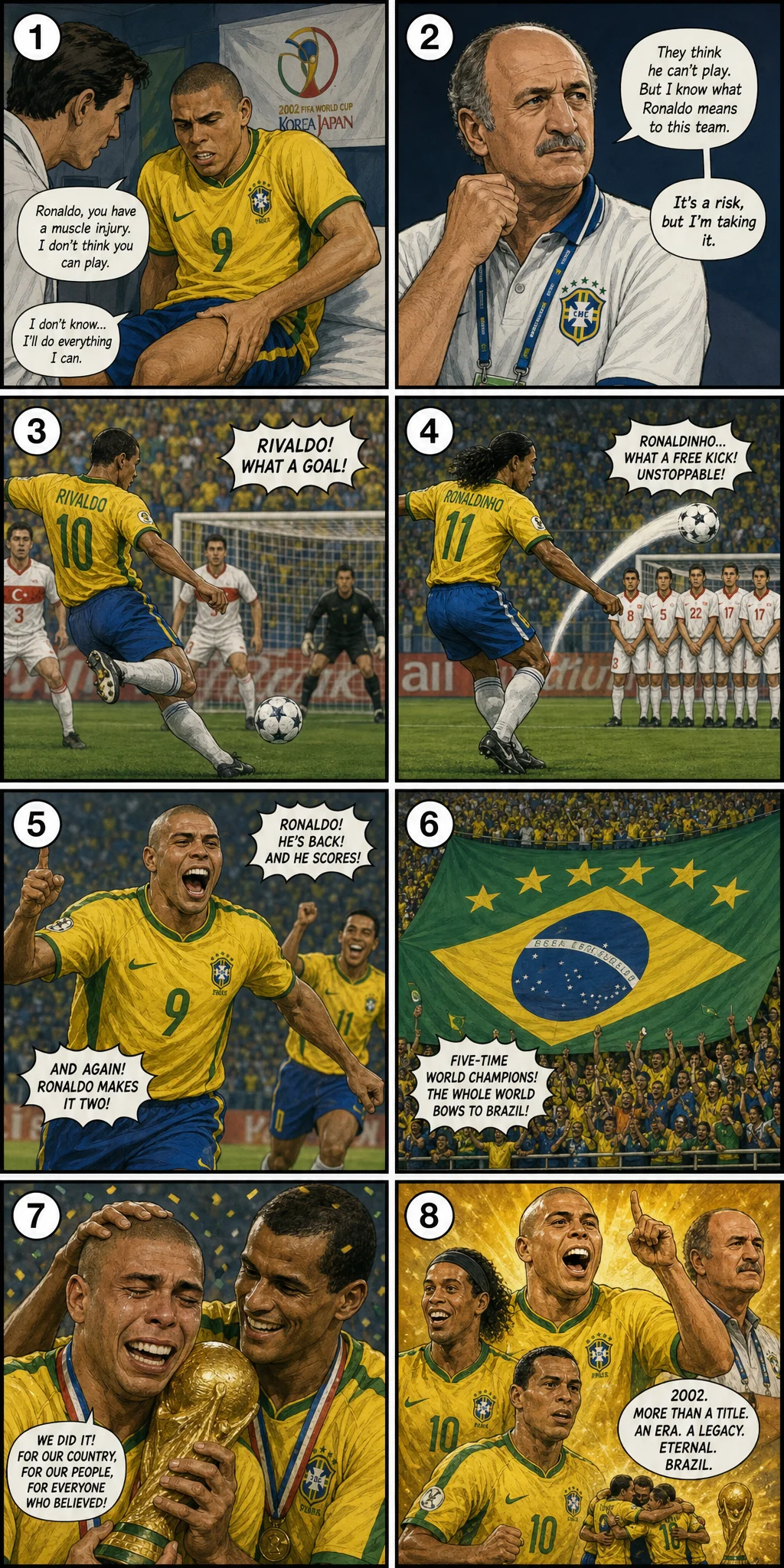
The fifth title came in 2002 as redemption. Ronaldo scored both goals in the final against Germany. Eight goals in the tournament. The terrible haircut -- the shaved head with a triangle of fringe that mothers across the world imitated for their infants -- distracted attention from the deeper story of a man who had rebuilt two shattered knees and one shattered psyche. Brazil had five stars.
Then the fifth wound, Belo Horizonte, July 8, 2014. Germany 7, Brazil 1, in a World Cup semifinal on Brazilian soil. Five goals in nineteen minutes. The camera kept finding that elderly man in the stands, clutching his replica World Cup trophy, weeping uncontrollably. The scoreline became a verb. To be "Brazil-ed" meant to suffer collapse of such total, existential nature that recovery was not a physical question but a psychological one. David Luiz, on his knees on the turf after the final whistle, apologizing to the entire nation through a television camera, has joined the permanent iconography of Brazilian football alongside the dancing of 1970 and the weeping of 1950.
That is the Brazilian condition. Five stars on the shirt. Five wounds in the soul. And a sixth chapter, in 2026, waiting to be written. Whether it becomes a sixth star or a sixth wound, one thing is certain: Brazil will be there. They have never missed a tournament. They never will.