

Thirteen Goals in Six Matches: The Record That Will Never Fall
I first heard about Just Fontaine in a bar in Toulouse — not a football bar, just a bar, the kind of place where old men play belote in the corner and the proprietor keeps a bottle of Armagnac behind the counter for the regulars who have earned it. F
Published: June 6, 2026
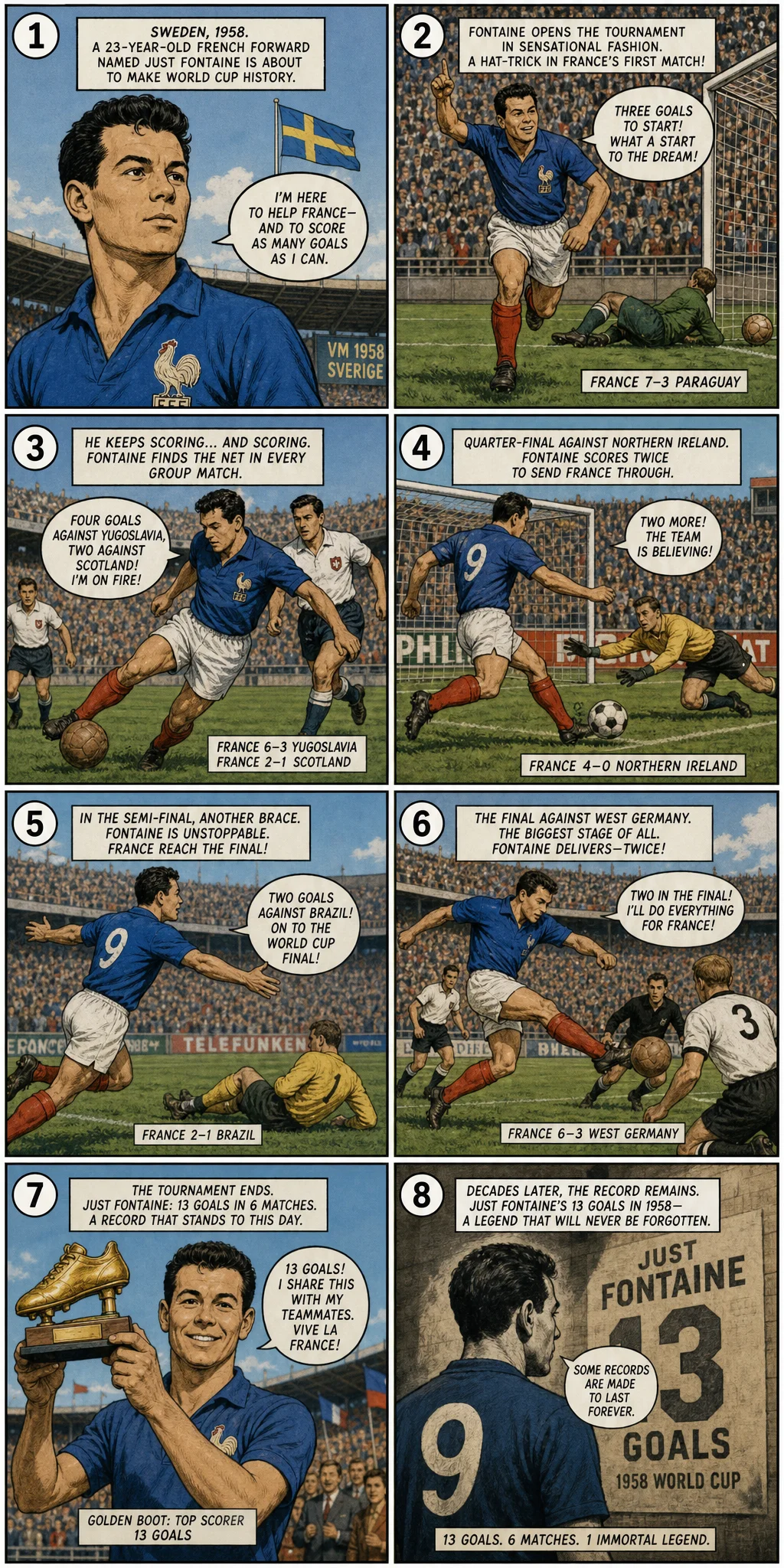
Comic content and match statistics are for entertainment purposes only and may contain inaccuracies. For Accurate Data, please refer to the reference's official website.
# Thirteen Goals in Six Matches: Just Fontaine and the Summer That Refuses to End
I first heard about Just Fontaine in a bar in Toulouse — not a football bar, just a bar, the kind of place where old men play belote in the corner and the proprietor keeps a bottle of Armagnac behind the counter for the regulars who have earned it. Fontaine's name came up because someone had mentioned Kylian Mbappe, and the old man nearest the window — seventy-five if he was a day, with the weathered face of someone who had spent a lifetime watching football in stadiums without roofs — put down his glass and said, very quietly: "Mbappe? Thirteen goals. Fontaine scored thirteen."
The room went silent. Not because anyone disagreed. Because the number, spoken aloud in a bar in the southwest of France, carries a weight that statistics on a screen cannot convey. Thirteen goals in six matches. A record that has stood since 1958, surviving every assault from the greatest goalscorers the sport has produced. Gerd Muller's ten in 1970. Ronaldo's eight in 2002. Mbappe's eight in 2022. Lionel Messi's seven in the same tournament. The record does not simply belong to Fontaine. It belongs to a specific historical moment — the Swedish summer of 1958 — that has been permanently sealed by the subsequent evolution of football. Modern analysis, with its expected goals models and its pressing intensity metrics and its understanding of the physical toll that tournament football exacts on attacking players, suggests the record will never be broken. The old man in the Toulouse bar would put it more simply. "They don't make summers like that anymore."
Fontaine was France's third-choice striker when the squad departed for Sweden. Not second-choice. Third. The starter, Rene Bliard, was a powerful centre-forward from Stade de Reims — Fontaine's club teammate, a man whose physical presence and aerial ability had made him the preferred option in France's qualification campaign. Bliard injured his ankle in the final training session before departure. The backup, Stephane Bruey, a quick, wiry forward from Angers, pulled a hamstring in the opening minutes of France's first group match against Paraguay — a match Fontaine started because circumstances, not planning, had placed him on the team sheet. Fontaine scored a hat-trick. The third-choice striker, the emergency option, the skinny Moroccan-born kid with the chain-smoking habit and the running gait that made him look as though he was perpetually trying to avoid low doorframes, had announced himself to the tournament.
The details of Fontaine's physical presence matter because they defied every stereotype of the elite goalscorer. He was not powerful. He was not particularly fast — quick over five metres, the acceleration that matters in the penalty area, but no sprinter. He smoked cigarettes in the tunnel before matches, a habit that modern sports science would classify as competitive self-sabotage but which Fontaine treated as a pre-match ritual, the way other players crossed themselves or touched the turf. His running style was awkward — shoulders hunched, arms pumping at angles that suggested he had never been coached in biomechanics and had figured out locomotion on his own. And yet, when the ball arrived in the penalty area, everything made sense. The body position. The first touch. The finish — right foot, left foot, head, Fontaine scored with every available surface, a completeness of finishing technique that suggested a player who had spent his entire career preparing for moments that he had never expected to arrive.
The goals accumulated through a combination of genuine quality and structural conditions that modern football has eliminated. Four goals against defending champion West Germany in the third-place match — a fixture that no contemporary elite striker plays with full competitive intensity, rotation having become universal in consolation matches, the third-place game now treated as an opportunity to give squad players World Cup minutes rather than as a competitive contest. But Fontaine played the third-place match as though it were the final, because Fontaine played every match as though it were the final. His consistency — he scored in all six of France's matches that summer — is the aspect of the record that modern analysis finds most difficult to explain. To score in every match of a World Cup campaign requires not merely finishing quality but the physical capacity to maintain attacking intensity across a tournament schedule that contemporary sports science has demonstrated imposes cumulative fatigue that degrades shooting accuracy, decision-making speed, and explosive movement. Fontaine, who had no access to recovery protocols or nutrition science or the load management strategies that modern players take for granted, simply kept scoring. The body, treated not as a machine to be optimized but as an instrument to be deployed, did what was asked of it.
The penalties deserve specific discussion because they reveal something about the goalkeeping standards of 1958 that modern viewers struggle to process. Fontaine converted penalties with a technique — a short run-up, a side-foot placement to the goalkeeper's left, no deception, no stutter-step, no analysis of goalkeeper tendencies — that contemporary keepers, trained on penalty analytics databases that catalogue every penalty a striker has ever taken and every directional preference a goalkeeper has ever shown, would read instantly. But 1958 goalkeepers, operating in an era before systematic penalty scouting existed — before video analysis, before the data science that has transformed penalty saving from an intuitive art into a probabilistic discipline — could not anticipate what they could not study. Fontaine's penalties were not brilliantly taken. They were taken in an era when goalkeepers had no mechanism for anticipating them.
The defensive conditions of 1958 football are the structural factor that makes the record permanently unassailable. Defensive marking was primarily individual rather than collective — a centre-back followed his assigned striker, and when Fontaine made runs that pulled his marker into unfamiliar spaces, the defensive structure had no compensating mechanism. The concept of the defensive block — a compact unit of eight or nine players organized in coordinated horizontal and vertical lines, compressing the space between the lines to deny attacking players the pockets in which modern strikers operate — did not exist. Defenders defended. Attackers attacked. The space between these two activities was Fontaine's domain, and he occupied it with the instinct of a player who understood, at some level beneath conscious tactical analysis, exactly where the space would appear and exactly when to arrive in it.
Mbappe's eight goals in 2022 represent the closest approach since Ronaldo's eight in 2002. To appreciate the magnitude of the gap between eight and thirteen, consider the arithmetic: to score thirteen goals, a player must average more than two goals per game across an entire World Cup — group matches against motivated defensive opponents who have spent months preparing specifically to contain the tournament's most dangerous attackers, knockout matches against elite defensive systems whose entire tactical organization is designed to prevent exactly this kind of individual accumulation, and the final itself against the tournament's best remaining team, operating at peak competitive intensity. In the modern era, a striker who scores twice in a World Cup final has produced a career-defining performance. Fontaine would have needed that performance, and the equivalent of it in five other matches, to reach thirteen.
Fontaine watched the subsequent decades from a distance — coaching briefly, managing briefly, then settling into the role of French football's living monument. He appeared at the 1998 World Cup draw in Marseille, the stadium named after a different kind of French hero, and received an ovation that acknowledged something the statistics could not capture: that his record was not merely a numerical outlier but a specific kind of perfection, achieved in a specific kind of summer, by a player who was never supposed to play. The old man in the Toulouse bar, finishing his Armagnac, put it best: "Fontaine didn't break the record. He sealed it. He sealed it so completely that the sport spent the next seventy years making sure nobody else could even touch it."
Thirteen goals. Six matches. The record is a fossil — perfectly preserved, structurally unrepeatable, a monument to a striker who chain-smoked in the tunnel, ran like he was avoiding low doorframes, and scored against every opponent the World Cup placed in front of him. History has no intention of returning it.