

Twenty-Six Matches, One Man, and the Weight of a Nation
I remember the exact moment I understood what Lothar Matthaus was. It was not the 1990 final, though that was the obvious answer — the captain lifting the trophy in Rome, the last West German World Cup. It was the 1998 quarterfinal against Croatia in
Published: June 6, 2026
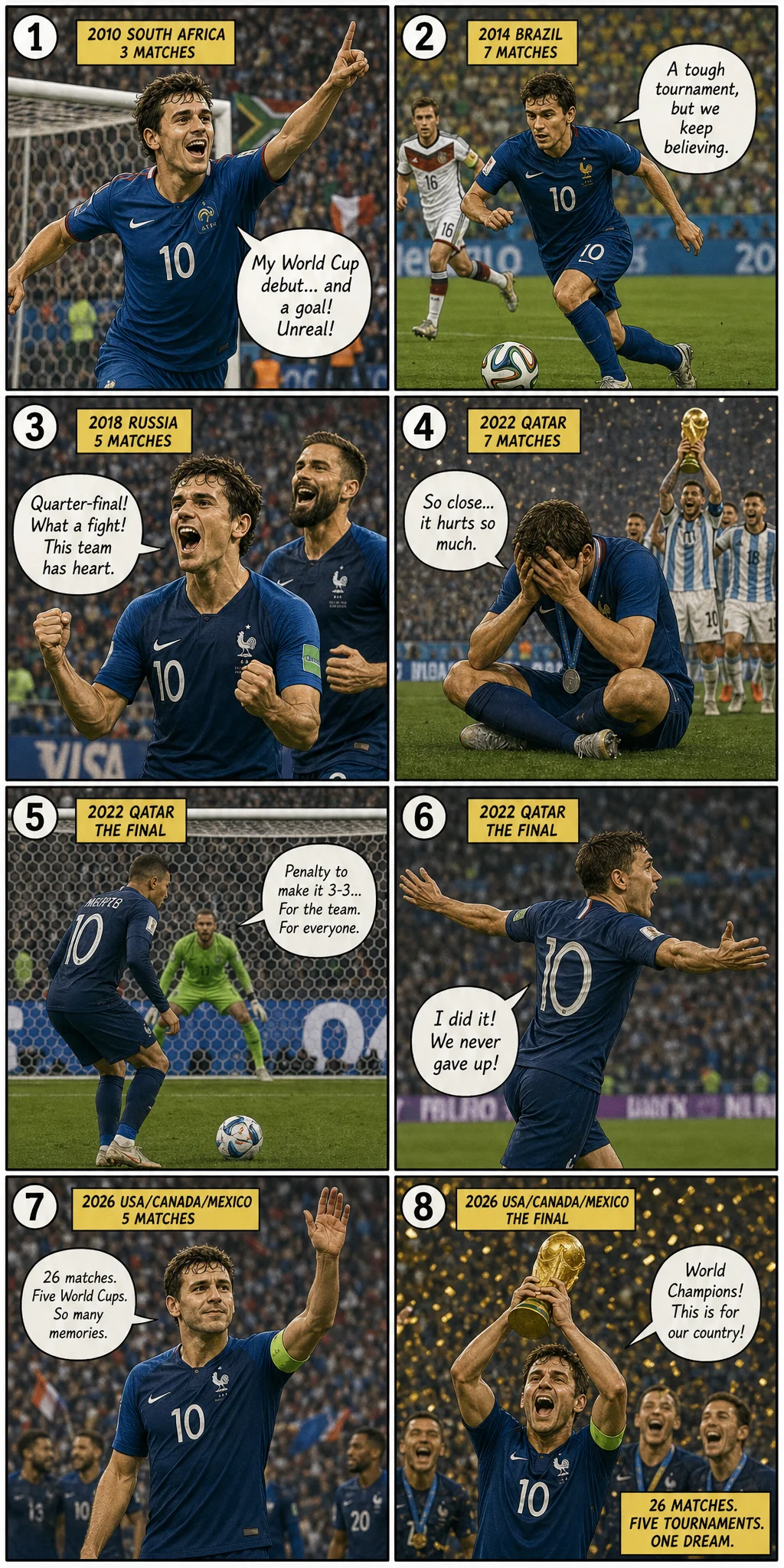
Comic content and match statistics are for entertainment purposes only and may contain inaccuracies. For Accurate Data, please refer to the reference's official website.
# Twenty-Five World Cup Matches: Lothar Matthaus and the Price of Refusing to Leave
I remember the exact moment I understood what Lothar Matthaus was. It was not the 1990 final, though that was the obvious answer — the captain lifting the trophy in Rome, the last West German World Cup. It was the 1998 quarterfinal against Croatia in Lyon. Matthaus was thirty-seven. He started as a central defender, the fifth different position across five World Cups — box-to-box midfielder in 1982, attacking midfielder in 1986, deep-lying playmaker in 1990, sweeper in 1994, central defender in 1998. Germany lost 3-0. Christian Worns was sent off. And yet the most compelling figure on the pitch was the thirty-seven-year-old German, organizing a backline crumbling around him, covering more ground than teammates a decade his junior.
Twenty-five World Cup matches. The record stood alone until Lionel Messi tied it in 2022 after five tournaments of sustained brilliance. Paolo Maldini reached twenty-three. Diego Maradona stopped at twenty-one. Cristiano Ronaldo accumulated twenty-two. Matthaus got there first, through a mechanism contemporary football has made impossible: the simple, stubborn refusal to accept that the international career was finished.
The five tournaments deserve individual accounting. The 1982 version was a twenty-one-year-old from Borussia Monchengladbach — raw, aggressive, already demonstrating the competitive intensity that would define his career. West Germany fell to Italy in the semifinals, Paolo Rossi's resurrection consuming everything. The 1986 version was the midfield engine of a team that reached the final, losing to Maradona's Argentina. Franz Beckenbauer, the manager, assigned Matthaus to mark Maradona — a decision second-guessed for decades but reflecting a fundamental truth: when the opposition's most dangerous player needed neutralizing, Matthaus was the instrument.
The 1990 version was the masterpiece. Captain, deepest midfielder, penalty taker, emotional engine — Matthaus was everywhere, all the time, with an intensity that approached intimidation. The tournament opened with a 4-1 demolition of Yugoslavia, Matthaus scoring twice, the second a run from deep midfield concluded with a shot struck with the outside of his right foot. The final featured his personal assignment on Maradona, the man against whom he had been measured his entire career. Maradona, carrying an ankle injury, was invisible. Matthaus was omnipresent. The image that endures is not a goal. It is Matthaus after the final whistle, holding the trophy in the Stadio Olimpico, understanding — in the way athletes sometimes understand things before the rest of the world does — that this was the peak.
The 1994 version was a different player. Matthaus at thirty-three, transitioned from midfield to sweeper — the positional evolution that required the humility to acknowledge the previous version was no longer available. The libero tradition Beckenbauer had elevated was being eliminated by the offside trap and zonal marking. Matthaus played it anyway, compensating for declining physical capacity with three decades of accumulated tactical intelligence. Germany exited in the quarterfinals to Bulgaria — Yordan Letchkov's diving header, the moment that ended an era.
The 1998 version was the final act. Recalled after a two-year absence following a falling-out with manager Berti Vogts — a dispute about leadership and the tension that develops when a player of Matthaus's stature refuses a subordinate role. The recall was pragmatic: Germany's defensive options were depleted, and the thirty-seven-year-old remained the best available option. The 3-0 defeat to Croatia was not his fault. It was the natural endpoint of a generation that had achieved everything and was discovering achievement grants no immunity from decline.
The record's durability is a function of structural changes Matthaus could not have anticipated. Five tournaments require a career spanning at least sixteen years at the elite level. Modern players, with fifty-match club seasons and financial demands that pay orders of magnitude more than Matthaus ever earned, do not maintain international careers across that duration. Messi tied the record because Messi is the exception that proves every structural rule.
Matthaus won the Ballon d'Or in 1990, collected seven Bundesliga titles, a UEFA Cup, and 150 caps for Germany. But the record is his monument. Twenty-five matches, five World Cups, positions shifting as the body slowed and the mind compensated. The body eventually breaks. The will, in Matthaus's case, never did.
Matthaus's legacy lives in the tension between what he achieved and how he is remembered. He won everything available to a European footballer of his era — the World Cup, the European Championship in 1980, the Ballon d'Or, seven Bundesliga titles, a UEFA Cup, Serie A with Inter. Yet his personality — the bluntness, the self-regard, the specific refusal to soften his edges for public consumption — divided opinion in a way that the achievements alone would not predict. German football, in particular, has never quite settled on a consensus about Matthaus. Was he the greatest German player of the post-Beckenbauer era, a warrior whose competitive intensity powered every team he played for to heights they would not otherwise have reached? Or was he a self-interested mercenary whose club career was a series of transfers dictated by personal ambition rather than institutional loyalty? The debate continues, and it probably reflects something uncomfortable about how we evaluate athletes — our insistence that greatness be accompanied by likability, our discomfort with competitors who refuse to perform humility. Matthaus never performed humility. He performed excellence. Twenty-five World Cup matches, five tournaments, five positions. The record speaks for itself, and it speaks in a voice that does not care whether you find it agreeable. The monument stands, twenty-five matches across five World Cups and sixteen years. The argument continues. That, perhaps, is exactly how Lothar Matthaus would have wanted it.
There is another dimension to Matthaus's record that rewards consideration. In an era before squad rotation, before sports science managed every minute of player workload, before "load management" entered the football lexicon, he played twenty-five World Cup matches across sixteen years. Each match was a full ninety minutes — often more, given the extra-time possibilities of knockout football. The physical toll of those matches, accumulated across five tournaments, across five different positions, across the specific arc of a body aging from twenty-one to thirty-seven, is incalculable by modern standards. Modern players are protected, monitored, and substituted. Matthaus was not. He played because he could play, because his body allowed it and his will demanded it, and he kept playing long after his contemporaries had accepted the end. The record is not merely a monument to longevity. It is a monument to a specific kind of athletic endurance that modern football has rendered obsolete. The body eventually breaks. The will, in the case of Lothar Matthaus, simply never did.