

Eight Matches to Be King: The Extra Step on the Staircase
Every World Cup champion in history played seven matches or fewer to win the tournament. Uruguay in 1930 played four. Brazil in 1970 played six. Argentina in 2022 played seven — the standard format since 1998: three group-stage matches followed by th
Published: June 6, 2026
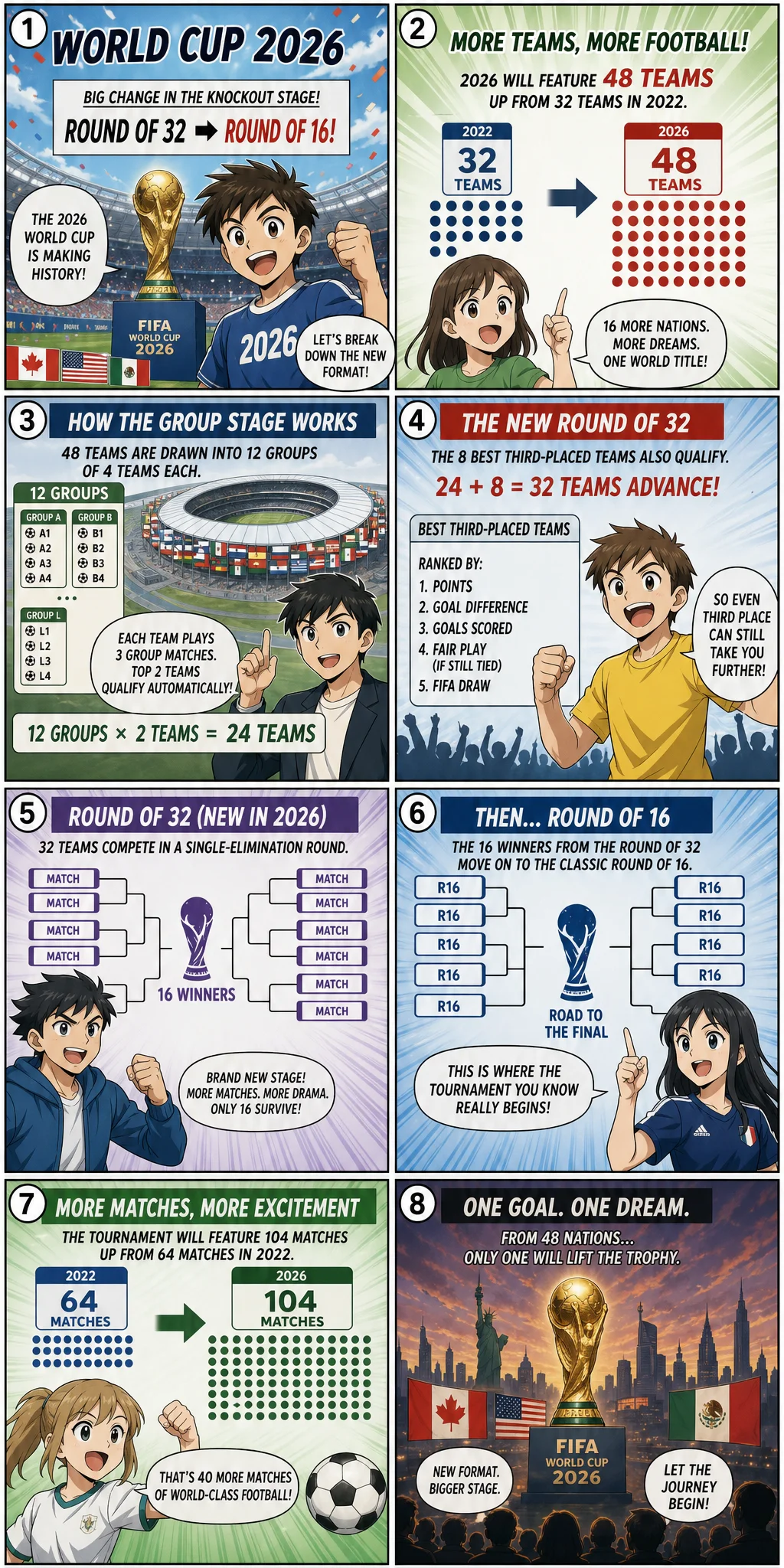
Comic content and match statistics are for entertainment purposes only and may contain inaccuracies. For Accurate Data, please refer to the reference's official website.
Every World Cup champion in history played seven matches or fewer to win the tournament. Uruguay in 1930 played four. Brazil in 1970 played six. Argentina in 2022 played seven — the standard format since 1998: three group-stage matches followed by the round of sixteen, quarterfinal, semifinal, and final. The 2026 champion will become the first in history to require eight victories: three group matches plus five knockout rounds, the additional round-of-thirty-two match transforming the tournament's fundamental calculus.
The practical difference between seven matches and eight appears modest — one additional game, roughly two hours of football plus extra time and penalties if required. But the implications radiate through every aspect of tournament preparation: squad construction, tactical planning, recovery protocols, and the specific physical demands placed on the bodies of the players who carry their nations deepest into the competition. In a seven-match tournament, a coach could reasonably ride a core of thirteen or fourteen trusted players through the knockout stage, rotating only when forced by injury or suspension. Argentina in 2022 demonstrated the viability of this approach: eight players started every knockout match, and Lionel Scaloni's substitutions were notably conservative even by the cautious standards of World Cup knockout football. The system worked — barely — because seven matches allowed a thin rotation to survive. Eight matches breaks that calculation.
The mathematics of squad management in an eight-match tournament are unforgiving. An additional match at elite knockout intensity means an additional ninety-plus minutes where the accumulated fatigue of previous rounds manifests not as general tiredness but as specific, localized muscle damage that increases injury risk exponentially. Yellow-card accumulation across five knockout rounds rather than four transforms what was previously a manageable disciplinary consideration into a genuine strategic variable. Squad depth transitions from competitive advantage to tournament prerequisite. Four reliable center-backs — enough to cover two starters, one rotation option, and one injury replacement — becomes essential rather than desirable. Four central midfielders capable of starting a World Cup semifinal becomes the minimum viable allocation for a position covering more ground than any other. The teams that enter 2026 having constructed squads two-deep at every position possess an advantage that compounds with every passing round. The teams that arrive with a brilliant starting eleven and a thin bench will be exposed by the tournament's new length. The eighth match, played at MetLife Stadium on July 19, will crown a champion who has navigated more tournament football than any predecessor. That standard becomes permanent.
To appreciate the magnitude of the shift from seven to eight matches, it is worth examining what each additional knockout round demands from the human body. A World Cup knockout match is not merely another ninety minutes of football. It is ninety minutes played at an intensity that exceeds even the Champions League final, because the stakes — national pride, historical legacy, the weight of an entire country's expectations — amplify physiological output in ways that sports science is only beginning to measure. Research on cortisol levels in footballers during high-stakes matches has demonstrated hormonal responses that far exceed those observed in routine competitive fixtures. The immune system suppression that follows such matches lasts longer, increasing susceptibility to the minor illnesses that can derail a player's tournament. The psychological recovery — the ability to reset mentally after the emotional expenditure of a knockout victory — requires time that the eight-match format does not provide. A team that wins its round-of-thirty-two match in extra time, expending 120 minutes of physical effort and an ocean of emotional energy, must be ready to compete at the same intensity four or five days later in the round of sixteen. The teams that win knockout matches in regulation — ninety minutes, no extra time, no penalties — accumulate an advantage that compounds with each passing round, not simply in physical freshness but in the psychological reserves that tournament football depletes as surely as it depletes glycogen.
Yellow-card accumulation rules introduce a strategic dimension to the eight-match tournament that no previous champion has navigated. Under FIFA regulations, a player who receives two yellow cards across the tournament is suspended for the following match. Those yellow cards are reset after the quarterfinals, meaning a player who receives a yellow card in the semifinal cannot be suspended for the final — but a player who receives a second yellow in the quarterfinal will miss the semifinal, the most consequential suspension short of a final ban. In a seven-match tournament, a single yellow card in the group stage followed by a second in the round of sixteen was the classic path to an unwanted suspension. In an eight-match tournament, the additional knockout round means an additional match during which a player carrying a yellow card must play with calculated restraint. A central defender on a yellow card in the round of thirty-two faces the prospect of playing four more knockout matches — including the semifinal — while one mistimed tackle away from suspension. The psychological burden of playing under that constraint, in matches where holding back is itself a competitive disadvantage, creates a dilemma that coaches have never faced in previous World Cup formats.
Coaches will need to make calculations about yellow-card management that verge on actuarial science. Do you rest a key player carrying a yellow card in a round-of-thirty-two match against an opponent you expect to beat, accepting the risk of an upset in exchange for clearing the suspension threat before the tournament's decisive phase? Or do you play your strongest team in every knockout match, trusting that your players can compete at full intensity without crossing the disciplinary line? The answer depends on squad depth, opponent quality, and the specific position of the cautioned player — a striker can manage the risk more easily than a defensive midfielder whose job requires tackling — but the existence of the question is itself a product of the eight-match format. Previous champions navigated seven matches with yellow-card risks that were manageable by intuition and common sense. The 2026 champion will navigate eight matches with yellow-card risks that demand systematic analysis and strategic planning.
The historical record of champions provides a useful baseline for understanding what eight matches demands. Since the tournament standardized around seven matches for the champion in 1998, no winner has gone through the knockout stage without at least one match that tested the limits of their squad depth. France in 2018 navigated a round-of-sixteen epic against Argentina that went to the final minutes before a 4-3 result was secured. Spain in 2010 played four consecutive 1-0 victories in the knockout stage, each requiring maximum concentration and defensive discipline until the final whistle. Italy in 2006 survived a semifinal against Germany that went to extra time at 0-0 before two goals in the final minutes of the additional period. These champions prevailed across seven matches. The eight-match champion of 2026 will need to survive one more test of this magnitude, and the cumulative effect of surviving seven knockout tests rather than six will be visible in the legs of the players who line up for the final at MetLife Stadium.
The tactical implications extend into squad selection before the tournament begins. FIFA expanded squad sizes from twenty-three to twenty-six players for Qatar 2022, a temporary accommodation of the compressed schedule that has been extended for 2026. But twenty-six players in an eight-match tournament may still prove insufficient for the demands of the format. A coach selecting a twenty-six-man squad for a seven-match tournament could allocate approximately eighteen outfield players to cover ten starting positions, a ratio of 1.8 players per position that provided reasonable coverage for injury, suspension, and fatigue. In an eight-match tournament, that ratio may need to shift closer to 2.0 — twenty outfield players for ten starting positions — and the composition of the additional players matters as much as their number. The traditional tournament squad structure — two players for every position, plus three goalkeepers — may need to evolve toward a model where certain high-demand positions (full-back, central midfield) carry three genuine options rather than two-plus-an-emergency-cover. The squads that national team coaches announce in the weeks before the tournament will be scrutinized not simply for the quality of the starting eleven but for the depth of the twenty-six, and the scrutiny will be sharper and more consequential than in any previous World Cup.