

Twelve Groups, Eight Third-Placed Teams, and a Global Excel Meltdown
The forty-eight-team World Cup format introduces a qualification mechanism unprecedented in tournament history: the eight best third-placed finishers from sixteen three-team groups will advance to the knockout stage alongside all group winners and ru
Published: June 6, 2026
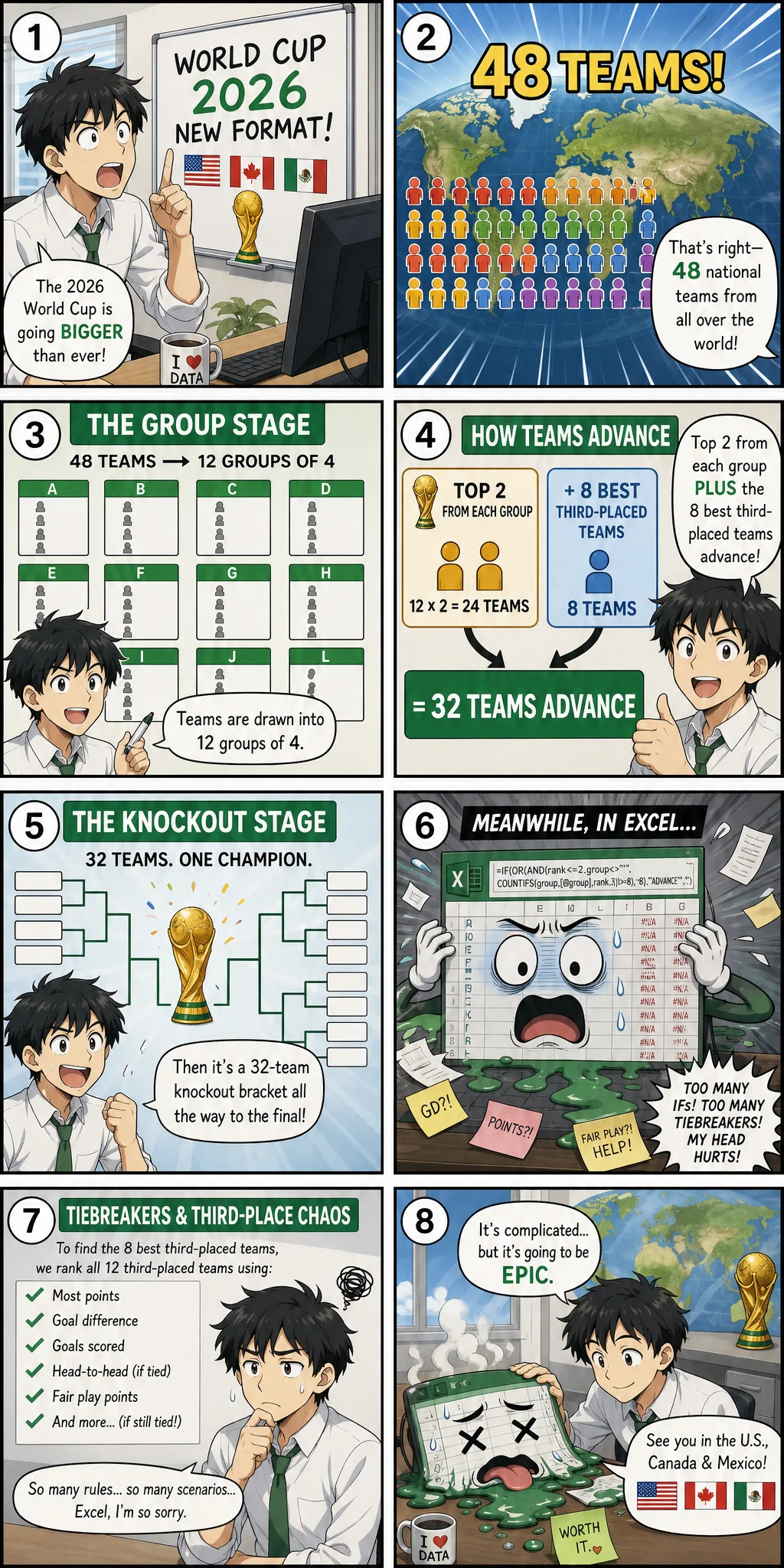
Comic content and match statistics are for entertainment purposes only and may contain inaccuracies. For Accurate Data, please refer to the reference's official website.
The forty-eight-team World Cup format introduces a qualification mechanism unprecedented in tournament history: the eight best third-placed finishers from sixteen three-team groups will advance to the knockout stage alongside all group winners and runners-up. This shadow competition — running parallel to the group stage itself — creates mathematical dynamics that will define the tournament's decisive moments and potentially determine which nations advance and which go home.
Cross-group comparison between teams that have never faced each other or common opponents introduces an irreducible element of arbitrariness. A team earning four points against strong opposition in a difficult group could be eliminated while a team earning three points against weaker opposition advances. The tie-breaking criteria — applied sequentially from points through goal difference, goals scored, fair play points, and ultimately a drawing of lots — are logically coherent and practically absurd. FIFA's tournament planners privately dread a scenario never before realized in men's World Cup history: two third-placed teams finishing with identical records across all criteria, requiring a literal draw of lots to determine which nation continues and which goes home.
The mechanism also creates strategic incentives that the thirty-two-team format's symmetrical structure was specifically designed to prevent. A team knowing a specific result guarantees qualification as one of the eight best third-placed finishers may approach its final group match with fundamentally different objectives than a team playing for group victory. Simultaneous scheduling of group finales minimizes explicit collusion but cannot eliminate the tacit understanding that develops when both teams recognize a specific scoreline serves mutual interests. The fear haunting every three-team group format remains the 1982 "Disgrace of Gijón," when West Germany and Austria produced precisely the result both required to advance at Algeria's expense. FIFA's safeguards have improved. The underlying structural incentive toward mutually beneficial outcomes persists.
To understand the mathematical dynamics of the third-place qualification system, it is helpful to consider the structure in detail. Sixteen groups of three teams each means that every group will produce a third-placed finisher. From these sixteen third-placed teams, exactly eight will advance. The remaining eight — along with all sixteen fourth-placed finishers, who are eliminated automatically — will go home. This means that finishing third in your group, which in every previous World Cup format meant automatic elimination, now offers a genuine path to the knockout stage. The psychological effect on teams that lose their opening match is transformed. Rather than facing virtual elimination, a team that loses its first group match can still advance by winning its second — or potentially even by drawing, depending on the goal difference calculus and the performance of third-placed teams in other groups. The format injects hope into situations where previous World Cups offered only despair, and the competitive consequences of that hope will play out across every group-stage fixture.
The tie-breaking hierarchy that governs third-place qualification is a masterpiece of bureaucratic precision that will almost certainly produce moments of genuine sporting injustice. The criteria, applied in sequence until the teams are separated, are as follows: points obtained in the group stage; goal difference across all group matches; goals scored across all group matches; fair play points, calculated according to the FIFA disciplinary code where yellow cards, indirect red cards, and direct red cards carry different point values; and, finally, drawing of lots by the FIFA Organizing Committee. The jump from fair play points — a metric of sporting conduct — to drawing of lots — a metric of pure chance — is so stark that it has inspired dark humor among tournament organizers. The scenario they most fear is this: two third-placed teams finish with identical points, identical goal difference, identical goals scored, and identical fair play records. In that circumstance, a World Cup campaign ends not on the pitch but in a conference room, decided by the mechanical randomness of a drawn ball or a flipped coin. The probability of this scenario is low; the consequences, should it occur, are enormous.
The historical precedent that haunts the three-team group format is the 1982 World Cup in Spain. That tournament featured a second group stage with three-team groups, and in Group 2, West Germany faced Austria in the final match knowing that a West German victory by one or two goals would send both Germanic nations through at Algeria's expense. West Germany scored in the tenth minute. For the remaining eighty minutes, both teams played what can only be described as an arranged truce — passes rolled gently between defenders, no tackles contested with conviction, a mutual understanding that the result on the scoreboard was the result both sides needed. The "Disgrace of Gijón" prompted FIFA to mandate simultaneous kickoffs for all final group-stage matches, a reform that remains in place for 2026. But simultaneous kickoffs prevent only the most explicit form of collusion — the kind where one team scores early and both teams agree to stop trying. They cannot prevent a subtler form of strategic calculation, where a team enters its final group match knowing the exact scoreline required from other groups and calibrates its approach accordingly. The third-place qualification mechanism amplifies this strategic dimension: teams will know, before they kick off their final group match, what result they need to finish among the eight best third-placed teams. The information asymmetry between groups playing at different times is not a flaw in the format; it is an inherent feature of any format where qualification depends partly on results in other groups.
The debate among football theorists about the optimal approach to a three-team group has produced competing schools of thought that will be tested empirically for the first time in 2026. The aggressive school argues that in a group where only two matches are played — each team plays exactly two group-stage fixtures — a victory in the opening match effectively guarantees advancement, and the optimal strategy is to treat the opening match as a must-win at all costs. The conservative school counters that in a format where third place offers a genuine qualification path, the risk of losing the opening match is mitigated, and teams should approach it with tactical caution rather than desperate aggression. The analytical school — favored by the growing cadre of data-driven coaching staffs — argues that the format creates a probabilistic optimization problem where the optimal strategy depends on the specific opponents, the expected goal difference of competitors in other groups, and the evolving picture of third-place qualification as the group stage unfolds. The tournament will serve as a massive real-world experiment in which of these schools proves most effective, and the results will shape tactical orthodoxy for every subsequent forty-eight-team tournament.
The eight third-placed teams that advance will, by definition, be among the weaker teams in the knockout stage. They enter the round of thirty-two having finished behind two other teams in their group. Historically, third-placed teams that have advanced in twenty-four-team formats — when four best third-placed finishers progressed from six groups — have occasionally produced deep tournament runs. Argentina finished third in their group in 1990 and reached the final. Italy finished third in their group in 1994 and reached the final. The presence of eight third-placed teams rather than four in the 2026 knockout stage creates the mathematical possibility that a genuine World Cup contender — a team that underperformed in a difficult group but possesses the quality to compete with anyone — could advance through the back door and cause havoc in the knockout rounds. The format does not simply produce more matches. It produces more possibilities, and among those possibilities is the scenario that tournament traditionalists most fear and romantics most anticipate: a team that barely survived the group stage, riding the momentum of its improbable survival, carving a path through the knockout rounds that no pundit predicted and no algorithm could have forecast.