

The Foxborough Traffic Nightmare: When the World Cup Meets American Suburbia
Gillette Stadium, host of six World Cup matches in 2026 including a quarterfinal, is not located in Boston. It is located in Foxborough, Massachusetts — a town of approximately eighteen thousand residents situated forty-eight kilometers southwest of
Published: June 6, 2026
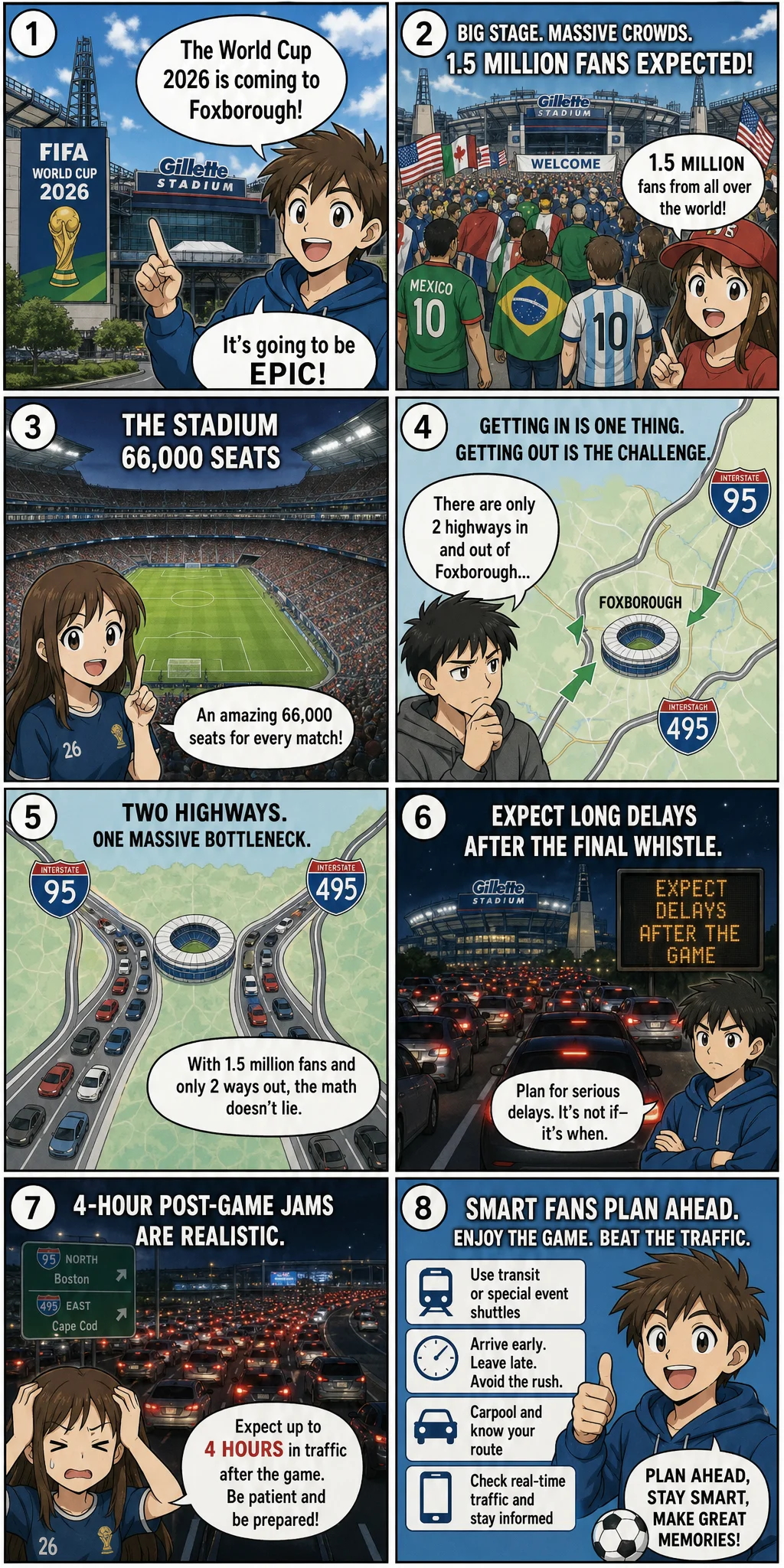
Comic content and match statistics are for entertainment purposes only and may contain inaccuracies. For Accurate Data, please refer to the reference's official website.
Gillette Stadium, host of six World Cup matches in 2026 including a quarterfinal, is not located in Boston. It is located in Foxborough, Massachusetts — a town of approximately eighteen thousand residents situated forty-eight kilometers southwest of downtown Boston and accessible primarily via Route 1, a suburban highway with two lanes in each direction on its best days, one lane when construction season arrives, and a traffic pattern that has been the subject of dark comedy among New England Patriots fans for two decades. On World Cup matchdays, seventy thousand supporters will attempt to reach a stadium surrounded by parking lots via a road designed for approximately twenty thousand vehicles. Transportation engineers have been modeling this scenario with professional fascination and, one suspects, some private despair. The Foxborough situation is not an anomaly. It is the most extreme example of a pattern that repeats across multiple 2026 venues, and it exposes a fundamental tension between the infrastructure assumptions of American professional sport and the cultural expectations of global football.
The NFL's stadium model, which defines eleven of the sixteen World Cup venues, is built around the automobile. NFL stadiums are located in suburbs, surrounded by vast parking lots, connected to population centers by highways rather than by public transit, because the NFL's business model depends on season ticket holders — overwhelmingly local, overwhelmingly car-owning, overwhelmingly accustomed to driving to sporting events as a matter of routine — arriving by private vehicle, parking, and spending hours in parking lots before and after the match in the American ritual known as tailgating. The parking lot is not an afterthought in NFL stadium design. It is part of the revenue model, generating income through parking fees, and part of the experience, providing space for the pre-game socializing that substitutes for the pub culture and street atmosphere of European football. The system works for the NFL and its domestic audience. It has never been tested at the scale of a World Cup, where the audience is overwhelmingly international, largely carless, and culturally conditioned to expect urban stadiums reachable by foot, by metro, by the dense public transit networks that define European and South American matchday experience.
The cultural friction between these two models will become visible during the 2026 tournament. A supporter arriving from Buenos Aires or London or Lagos does not expect to rent a car to attend a football match. They expect to take a train from the city center, to walk through neighborhoods whose bars and cafes are filled with supporters in their national colors, to approach the stadium through streets that belong temporarily to football rather than to traffic. This experience — the pre-match pilgrimage that is as fundamental to World Cup culture as the match itself — does not exist at Gillette Stadium, at AT&T Stadium in Arlington, at Levi's Stadium in Santa Clara, at MetLife Stadium in the Meadowlands of New Jersey. These stadiums are islands in seas of asphalt, accessible only by vehicle, surrounded by parking rather than by pubs, connected to their nominal host cities by distances that make walking impossible and public transit impractical. The World Cup atmosphere that defines the tournament in collective memory — the streets of Rio de Janeiro, the plazas of Madrid, the fan zones of Berlin — happens between the city center and the stadium. When the stadium is forty-eight kilometers from downtown Boston and the space between them is a suburban highway, that atmosphere cannot form.
Organizers are not oblivious to the problem. Temporary bus rapid transit systems, shuttle networks, and park-and-ride facilities are being deployed at every car-dependent venue. Special-event train services will operate from Boston to Foxborough on matchdays, supplementing the single existing commuter rail line with additional capacity and frequency. Ride-share pickup zones, pedestrian corridors, and designated supporter walking routes are being integrated into venue transportation plans. These measures will move people to and from the stadiums. What they cannot do is create the urban football culture that the World Cup depends on for its atmosphere and its identity. A shuttle bus from a suburban mall to a stadium parking lot is efficient. It is not romantic. It will never produce the spontaneous eruption of national anthems in a city square, the impromptu drum circles in a metro station, the sense that an entire city has become temporarily possessed by football. The World Cup is not just a series of matches. It is a month-long festival of collective identity, and festivals need cities.
Whether the gap between the automotive infrastructure and the pedestrian culture becomes a crisis or merely an inconvenience depends on how well the organizers have prepared for the incompatibility. The 1994 World Cup, hosted entirely in the United States, confronted similar challenges and produced a tournament that functioned logistically despite its car-dependent venues. But 1994 was a smaller tournament with fewer international supporters and lower expectations for the fan experience. 2026 is the largest World Cup ever staged, with the most international audience in tournament history, arriving in a country whose sporting infrastructure was designed for a different sport's entirely different audience. The tension between what the World Cup expects and what American stadiums provide will be one of the tournament's defining operational challenges. The parking lots will fill. The shuttle buses will run. The matches will be played. But the supporter walking to Gillette Stadium from downtown Boston will not exist, because that walk is forty-eight kilometers long and most of it is a highway. That distance — between what the World Cup promises and what the infrastructure delivers — is the gap the organizers have spent years trying to close. Some gaps are measured in kilometers. Some are measured in culture.