

Three Hosts, Zero Qualifiers, and a Test That Was Skipped
The United States, Canada, and Mexico qualified automatically for the 2026 World Cup as host nations — a privilege as old as the tournament itself, dating to Uruguay's automatic entry in the inaugural 1930 edition, and one that has survived every ref
Published: June 6, 2026
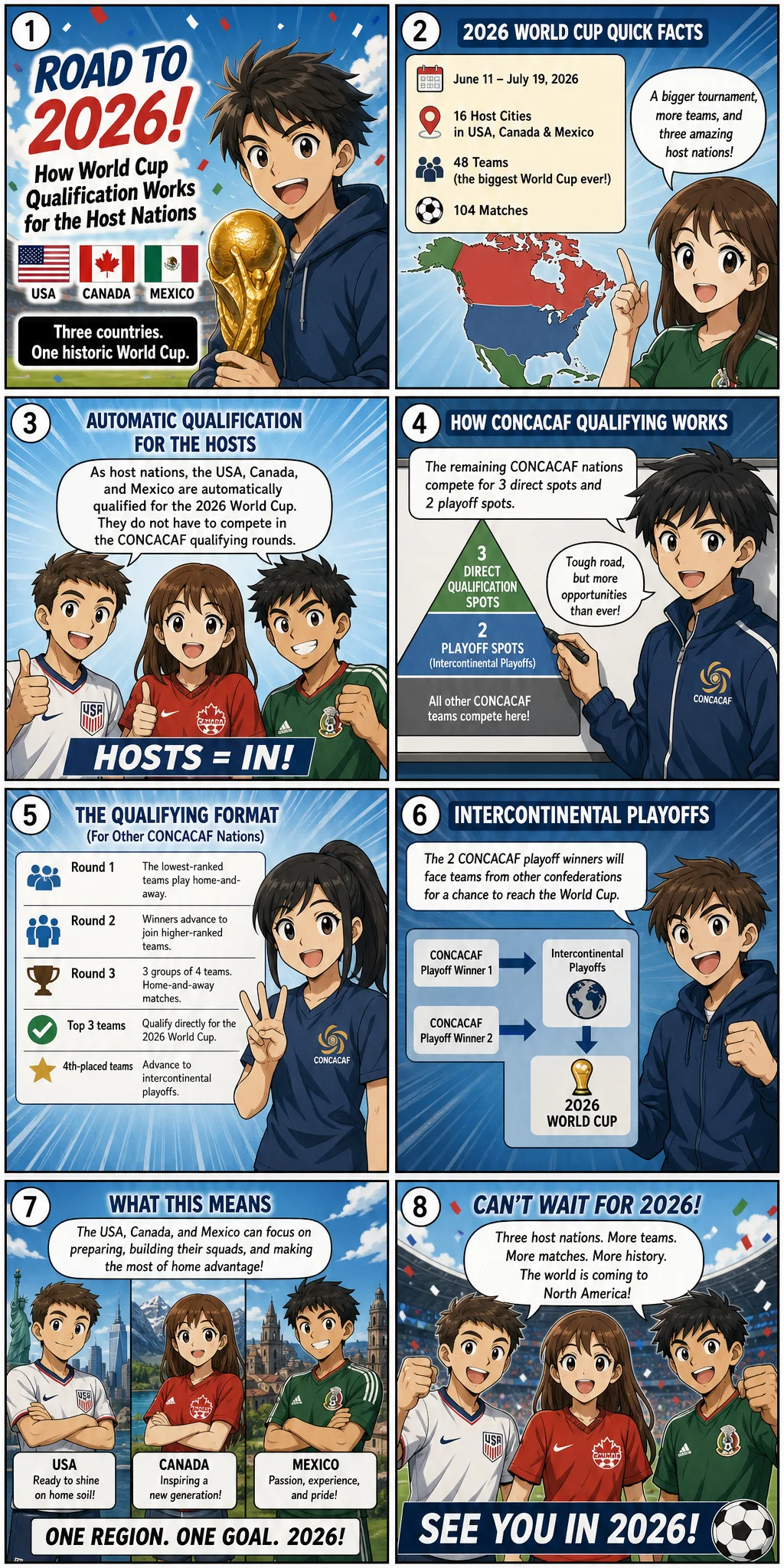
Comic content and match statistics are for entertainment purposes only and may contain inaccuracies. For Accurate Data, please refer to the reference's official website.
The United States, Canada, and Mexico qualified automatically for the 2026 World Cup as host nations — a privilege as old as the tournament itself, dating to Uruguay's automatic entry in the inaugural 1930 edition, and one that has survived every reform attempt, every governance crisis, every wave of modernization that has swept through FIFA since the Havelange era. The logic is straightforward enough that it has never required elaborate defense: a World Cup without its hosts playing would be a party without anyone greeting guests at the door, a festival whose organizers declined to attend, a national investment in stadium infrastructure and security and civic preparation that produced no national team to justify it. The competitive implications, however, are rarely examined with the attention they deserve, and those implications arrive in 2026 multiplied by three — the first time three host nations have entered the same tournament without playing a competitive qualifying match between them.
The core problem is competitive rust, and it is a problem that friendlies cannot solve. Host nations entering a World Cup without having played a competitive match in eighteen months to two years — the gap between the 2024 Copa America or Gold Cup and the tournament's June 2026 opening — arrive with a specific kind of unpreparedness that only fixtures of genuine consequence can address. Friendlies simulate tournament conditions the way training-ground exercises simulate combat: the shapes are correct, the movements are rehearsed, the tactical patterns are familiar, but the intensity that determines outcomes when the scoreline matters and the stakes are elimination is absent. Players who have not experienced the physiological stress of a competitive international fixture — the elevated heart rate, the adrenaline saturation, the cognitive narrowing that high-stakes competition produces — for nearly two calendar years will encounter that stress for the first time in a group-stage match that determines their tournament's trajectory. No amount of training-camp preparation can replicate the experience of needing a result when the world is watching and the result is permanent.
For the United States, the concern is real but mitigated by talent depth and European club experience. The American player pool has reached a level where most of the starting eleven compete weekly in the Premier League, Serie A, the Bundesliga, and La Liga — environments where competitive intensity is a daily condition rather than a tournament-specific state. Christian Pulisic at AC Milan, Weston McKennie at Juventus, Tyler Adams at Bournemouth, Antonee Robinson at Fulham, Tim Weah at Juventus — these players face high-stakes football every weekend, in stadiums that demand performance under pressure, against opponents who punish any relaxation of competitive focus. The transition from club intensity to international intensity is not seamless, but it is a smaller gap for the American squad than for previous iterations that were built primarily from Major League Soccer players experiencing a summer tournament as the peak of their competitive calendar. The risk for the United States is not individual preparation but collective cohesion — the integration of players from twelve different club systems into a single tactical unit that has not been tested in matches that matter.
For Mexico, the concern is familiarity breeding complacency. The Mexican national team has more tournament experience than any CONCACAF nation, has participated in every World Cup since 1994, and enters its co-hosted tournament with the accumulated institutional knowledge of three decades of consecutive qualification. The danger is not that Mexico's players will be overwhelmed by the occasion — El Tri has played in enough occasions that the nerves are at least partially immunized — but that the absence of competitive qualifying will allow tactical and psychological patterns to fossilize without the corrective pressure that competitive results provide. Mexico's recent tournament performances have been consistent in one respect: consistent underachievement relative to talent. The 2026 tournament, on home soil, with the Azteca's altitude advantage and the nation's expectations reaching levels not seen since 1986, represents either the culmination of a generation's work or the definitive disappointment that exposes structural limitations no amount of hosting privilege can conceal.
For Canada, the concern is the most acute and the least discussed. Canada's player pool is thinner than its co-hosts', its top-level club experience more concentrated in a smaller number of elite players, its tournament pedigree limited to the 2022 World Cup — the nation's first in thirty-six years — at which Canada failed to win a match despite performances that exceeded expectations among informed observers. A Canadian team that had played a full CONCACAF qualifying campaign would have entered 2026 with the competitive rhythm that only the eight-team hexagonal or its successor format can provide: hostile away matches in Central America, tactical problem-solving against varied opposition, the cumulative experience of needing results across a multi-month qualifying calendar. Instead, Canada enters its first home World Cup having played exclusively friendlies for two years, asking Alphonso Davies, Jonathan David, and a supporting cast of Major League Soccer and European second-division professionals to produce tournament readiness from memory rather than from recent experience.
The historical record on host auto-qualification is instructive but inconclusive. Host nations have won six of twenty-two World Cups, a success rate significantly above random expectation and largely attributable to the home advantage that the 2026 hosts will enjoy: familiar environments, supportive crowds, logistical familiarity, the absence of international travel. South Korea reached the semifinals in 2002, exceeding all pre-tournament projections, powered by home support that appeared to add half a goal per match to the team's performance. Germany reached the semifinals in 2006. Russia reached the quarterfinals in 2018. England won in 1966 on home soil. France won in 1998 on home soil. But hosts have also underperformed dramatically: South Africa became the first host eliminated in the group stage in 2010. Qatar lost all three matches in 2022. The auto-qualification advantage is real but non-guaranteed, and the competitive rust that accompanies it is a tax that some hosts pay and others evade. The 2026 hosts — three nations with vastly different talent profiles, tournament experiences, and preparation challenges — will pay different amounts of that tax. The tournament will determine which payments were affordable and which were not.