

Hungary 9-0 South Korea: Forty Hours of Flying, Ninety Minutes of Nightmare
The 1954 World Cup group stage produced the most lopsided scoreline between a European power and an Asian debutant in tournament history. Hungary 9, South Korea 0. The numbers registered as shocking in 1954 and have not lost their capacity to startle
Published: June 6, 2026
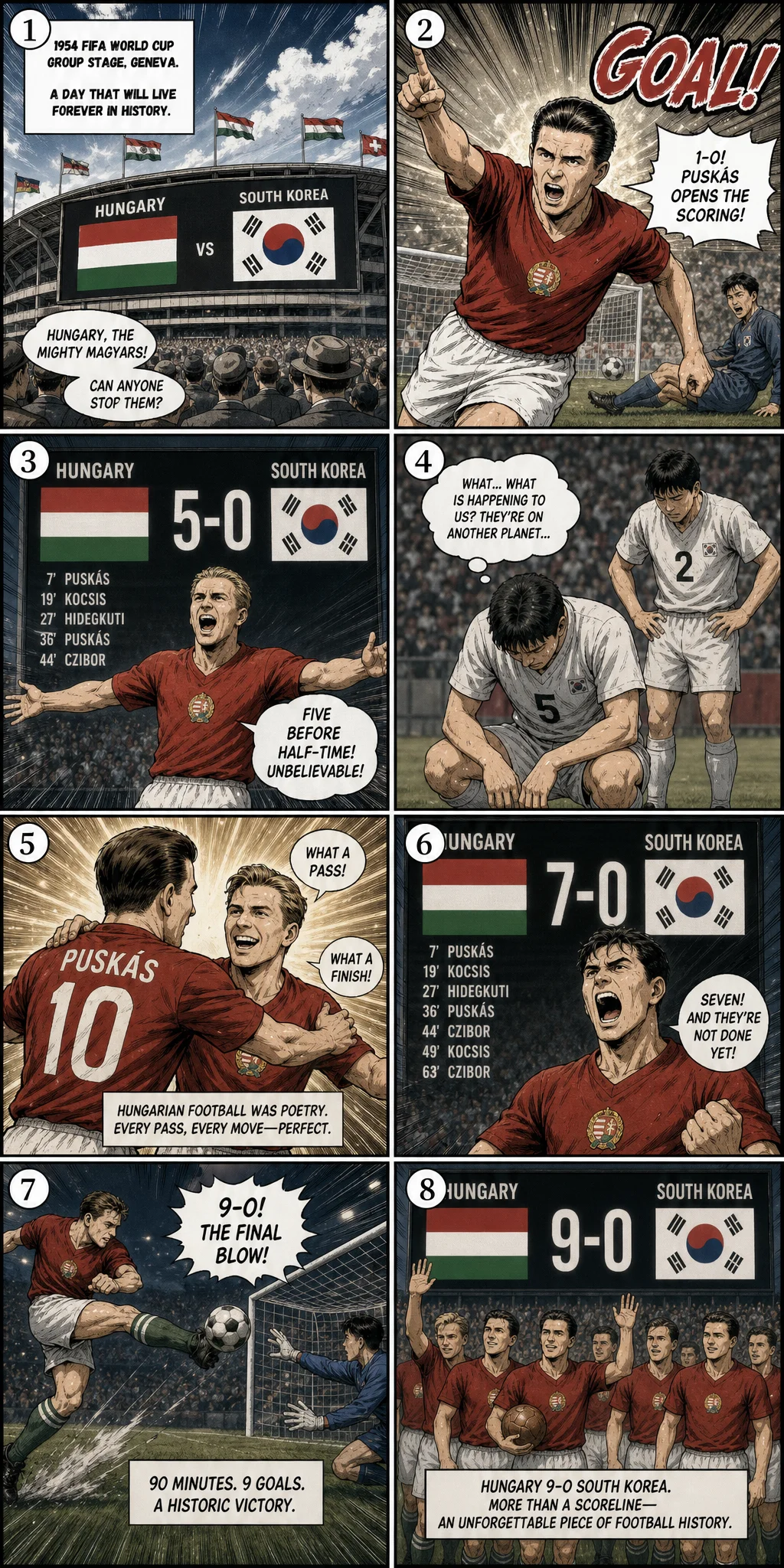
Comic content and match statistics are for entertainment purposes only and may contain inaccuracies. For Accurate Data, please refer to the reference's official website.
# Hungary 9-0 South Korea: The Day Jet Lag Lost a Football Match
The 1954 World Cup group stage produced the most lopsided scoreline between a European power and an Asian debutant in tournament history. Hungary 9, South Korea 0. The numbers registered as shocking in 1954 and have not lost their capacity to startle across seven decades of football evolution. But the scoreline, as football scores so often do, conceals far more than it reveals. The 9-0 was not primarily a football result. It was what happens when the logistics of global sport fail catastrophically, and the failure is measured in goals rather than in the hours of sleep that were denied to the athletes who conceded them.
South Korea's squad traveled nearly forty-eight hours from Seoul to Zurich via propeller aircraft, navigating multiple stopovers across a route that no modern athlete would be asked to endure. No pressurized cabin — the technology existed but was not standard on the aircraft servicing trans-Asian routes in 1954. No provisions for athlete nutrition, hydration, or the basic physiological requirements of humans preparing to compete at the highest intensity their sport demands. No accommodation for sleep — the players arrived in Switzerland less than twenty-four hours before kickoff, having not slept properly in two days, having not eaten properly in two days, having spent forty-eight hours in conditions that modern sports science would classify as a medical situation requiring intervention, not an athletic baseline for World Cup competition.
The South Korean players had never encountered a European pitch. They had never experienced the specific behavior of European footballs under 1954 conditions — the weight, the trajectory, the way the ball moved through air that was cooler and denser than anything their bodies had been trained to expect. They had never faced anything approaching the tempo, intensity, and tactical sophistication of the Mighty Magyars, the greatest attacking team in football history to that point, the side that had revolutionized the sport through the deep-lying centre forward Nandor Hidegkuti, the prolific scorer Sandor Kocsis, and the incomparable Ferenc Puskas. The Korean players were not deficient as footballers. They were athletes who had been placed in an impossible competitive situation by an institutional failure that their federation lacked the resources and the knowledge to prevent.
Hungary scored nine and could have scored fifteen. Puskas and Kocsis did what Puskas and Kocsis did against every opponent in 1954: they found space that the defensive system could not protect, received the ball in positions that the defenders could not anticipate, and finished with the efficiency of players who had been doing exactly this against exactly this level of opposition for years. The goals accumulated not because the Korean defenders were incompetent but because they were operating at a physiological deficit that made competence impossible. A defender who has not slept in two days cannot react to a through-ball at the speed that elite football requires. A goalkeeper who has spent forty-eight hours in a vibrating metal tube at altitude cannot track the flight of a shot with the precision that his training has developed. The 9-0 was not football inequality. It was asking exhausted athletes to compete against the best team on earth.
Modern sports science would classify the Korean squad's physiological state at kickoff as requiring rest, not competition. The 1954 football world lacked the vocabulary to understand this. It had only the scoreline, and the scoreline was transmitted globally as evidence of Asian football's competitive inadequacy. The 9-0 stood for seven decades as a football result when it was, in reality, a predictable consequence of logistics — the specific cruelty of a sport that had not yet developed the infrastructure to protect its participants from the physical demands of global competition. The record endures. The lesson behind it has been learned, slowly and incompletely, by the institutions that govern the sport. The Korean players who suffered that afternoon in Switzerland deserve to be remembered not as victims of a football mismatch but as athletes who were failed by the infrastructure that was supposed to support them, and who competed anyway, because competition was the only response available.
The Hungary team that inflicted this scoreline deserves contextualization because it was not merely any opponent — it was arguably the greatest international team that had ever been assembled. The Mighty Magyars, coached by Gusztav Sebes, had revolutionized football through tactical innovations that the rest of the world was only beginning to understand. The deep-lying centre-forward — Hidegkuti dropping into midfield to create numerical superiority while the inside forwards pushed into the space he vacated — was a concept so alien to the defensive systems of the 1950s that opponents simply could not process it. The 1953 match at Wembley, where Hungary demolished England 6-3 on English soil, the first foreign team to defeat England at home, had announced the Magyars to the world as something unprecedented. The 7-1 victory over England in Budapest the following year confirmed that Wembley was not a fluke. This was the team that South Korea, jet-lagged and physiologically devastated, was asked to oppose. The mismatch between the greatest team in the world and an exhausted Asian debutant was not a football contest. It was the kind of institutional failure that the governing bodies of sport are supposed to prevent, and the 9-0 scoreline is not a record of competitive inadequacy but of institutional negligence.
The specific footballing context of the 1954 tournament adds another layer of tragedy to the Korean experience. The 1954 World Cup employed a format that was peculiar even by the experimental standards of early tournament organization: each group contained two seeded teams and two unseeded teams, and the seeded teams did not play each other. The format was designed to prevent the early elimination of favored nations, ensuring that the tournament's commercial and competitive interests were protected. The consequence, for South Korea, was that their two group matches were against the seeded teams: Hungary, the best team in the world, and Turkey, a European power that had reached the quarterfinals in 1950. There was no match against the other unseeded team, West Germany — the team that would eventually win the tournament — because the format prohibited it. South Korea was placed in the group specifically to serve as opposition for the seeded teams, and the format ensured that they would face the strongest possible opponents while being denied the competitive opportunity of facing a peer. The structure of the tournament was as hostile to Korean competitiveness as the logistics of their travel. The scoreline records a football result. The format that produced it records a tournament designed to protect the powerful at the expense of the weak.
The long-term consequences of the 9-0 defeat for South Korean football are more complex than the simple narrative of humiliation and recovery would suggest. The immediate aftermath was, as expected, devastating — a national embarrassment that reinforced every stereotype about Asian football's competitive inadequacy, a scoreline that would be cited for decades as evidence that Asian nations did not belong at the World Cup. But the longer arc of Korean football history tells a different story. The 9-0 was not the end of Korean football ambition; it was, in a perverse way, the beginning. The humiliation of 1954, compounded by the specific knowledge that the defeat was produced by logistics rather than football, motivated the investment in football infrastructure that would eventually produce the Korean teams of 2002 and beyond — the fitness, the organization, the specific competitive qualities that Asian football had not possessed in 1954. The players who lost 9-0 in Switzerland could not have imagined, as they endured the specific misery of exhausted competition against the world's best team, that their suffering would contribute to the eventual emergence of Korean football as a genuine World Cup force. History works in ways that the people living through it cannot perceive. The 9-0 was a humiliation. It was also a foundation, and the structure built upon it — the Hyundai-sponsored youth academies, the K-League's development, the specific investment in the physical dimension of football that the 9-0 had exposed as deficient — would eventually produce a Korean team that reached the World Cup semifinals on home soil in 2002, the best result by any Asian nation in tournament history. The 9-0 players did not live to see that semifinal — most of them, obscure figures in Korean football history, passed away without recognition or acknowledgment. But the seeds they planted in Swiss soil, watered by exhaustion and humiliation, eventually produced a harvest that exceeded anything the Mighty Magyars could have imagined when they scored their nine goals.