

Yugoslavia 9-0 Zaire: The First African Dream, Shattered
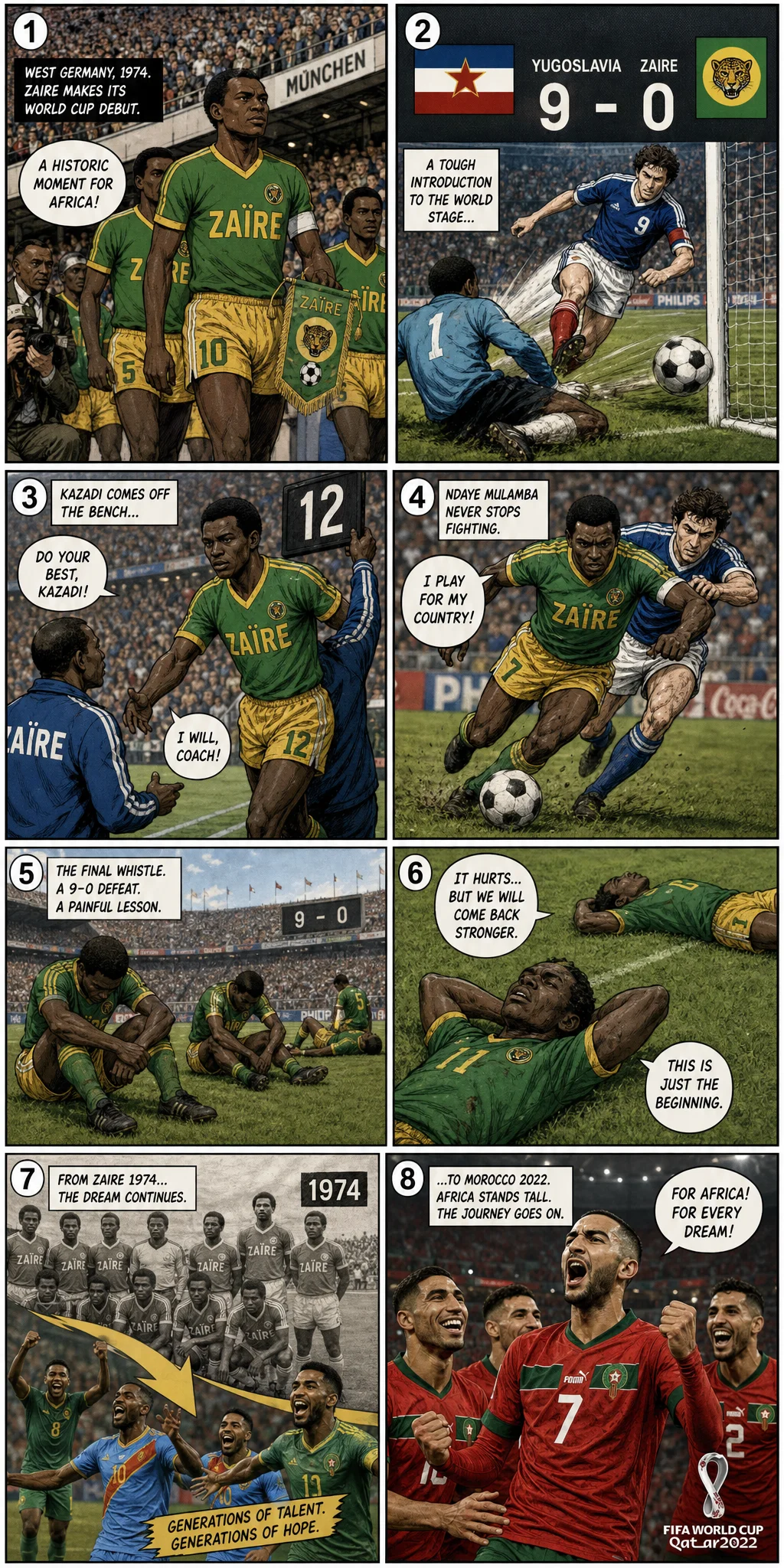
The 1974 World Cup group match between Yugoslavia and Zaire carries the ignominious distinction of Africa's heaviest defeat in tournament history. 9-0. The scoreline remains shocking, a number that suggests competitive inadequacy on a scale that inte
Published: June 6, 2026
Comic content and match statistics are for entertainment purposes only and may contain inaccuracies. For Accurate Data, please refer to the reference's official website.
# Yugoslavia 9-0 Zaire: The Scoreline That Hid Institutional Betrayal
The 1974 World Cup group match between Yugoslavia and Zaire carries the ignominious distinction of Africa's heaviest defeat in tournament history. 9-0. The scoreline remains shocking, a number that suggests competitive inadequacy on a scale that international football's structures are supposed to prevent. But the scoreline, as World Cup scores so often do, conceals more than it reveals. The circumstances that produced Yugoslavia's nine goals against Zaire constitute one of the most damning indictments of institutional football governance in the sport's modern era, and the story behind the score deserves to be as widely known as the score itself.
Zaire arrived in West Germany in 1974 as the first sub-Saharan African nation to qualify for a World Cup. The significance of this achievement resonated far beyond football. African independence movements of the 1950s and 1960s had produced new nations whose political sovereignty was not yet matched by institutional presence in global institutions, including sport. Zaire's qualification was celebrated across an entire continent as a pan-African achievement — Julius Nyerere, Tanzania's philosopher-president, was among the African leaders who publicly hailed it as evidence that Africa could compete on the world's most important stages. The squad carried the hopes of a continent. What the squad did not carry was the institutional support required to transform those hopes into competitive reality.
Zaire's football federation, operating under the authoritarian government of President Mobutu Sese Seko, had promised the players substantial bonus payments for World Cup qualification — the financial incentive that represented, for athletes from a nation where professional football salaries were modest by global standards, the primary motivation for participating in a tournament from which their team had no realistic expectation of advancing. The bonuses never materialized. The federation seized its players' passports upon arrival in West Germany, ostensibly to prevent defections but practically to control athletes who were increasingly aware that the promises made to them were not going to be honored. By the time Zaire faced Yugoslavia in their second group match, the squad was psychologically fractured — athletes who had been exploited by their own federation, carrying the weight of continental expectations, and competing without the financial security that had been contractually promised.
Yugoslavia scored nine goals against an opponent that had essentially ceased to function as a competitive unit. The goals were not products of Yugoslav brilliance — though the Yugoslav team of 1974 was genuinely talented, featuring players who would form the spine of the nation's football for a decade. The goals were products of a defensive collapse that reflected institutional rather than athletic failure. Players who have been denied their promised compensation, whose passports have been confiscated, and who are representing a federation that has betrayed them do not defend with the commitment that elite competition requires. The 9-0 was not a football result. It was the scoreboard manifestation of institutional corruption.
The enduring image from Zaire's 1974 campaign — defender Mwepu Ilunga breaking from the defensive wall to kick the ball away before a Brazilian free kick could be taken — was portrayed globally as comic naivety, the image of an African footballer who did not understand the rules of the sport he was playing. Ilunga, in a rare interview decades later, revealed the truth: the act was deliberate protest. A footballer using the only platform available to him to draw international attention to the corruption and exploitation that had hollowed out his team's World Cup experience from within. The gesture that the world laughed at was an act of resistance, and the laughter reflected the world's refusal to understand what it was seeing. The 9-0 scoreline records a football result. The story behind it records the betrayal of athletes by the institutions that were supposed to protect them, and the story matters more than the score.
The political context of Zaire's World Cup participation is essential to understanding why the 9-0 defeat was not simply a football mismatch but a manifestation of the specific dysfunction of the Mobutu regime. Mobutu had seized power in 1965 through a military coup, renaming the country from Congo to Zaire as part of his "authenticité" campaign — a cultural nationalist project that sought to erase colonial influence while simultaneously enriching the president and his inner circle through the systematic extraction of the nation's mineral wealth. Football was central to Mobutu's political project: the national team, the Leopards, was presented as evidence of Zaire's emergence as a modern nation, and the 1974 World Cup qualification was celebrated through state-controlled media as a Mobutu achievement rather than a sporting one. The players who qualified for the World Cup were not athletes representing a football federation; they were political props in a regime that used them for legitimacy and discarded them when they became inconvenient. The bonus payments that were promised and withheld, the passports that were confiscated, the specific exploitation of athletes who had no institutional protection — these were not aberrations within the Mobutu system. They were the system operating exactly as it was designed to operate, extracting value from its citizens and distributing the proceeds to the regime's beneficiaries. The 9-0 was not merely a football humiliation. It was the predictable consequence of a political system that treated its athletes as resources to be exploited rather than representatives to be supported.
The Yugoslav team that scored the nine goals was itself a product of a political system that was, in a different way, as dysfunctional as Zaire's — a multi-ethnic federation held together by Josip Broz Tito's authoritarian leadership, whose football team reflected the ethnic tensions that would eventually tear the nation apart. The 1974 Yugoslavia squad featured players from Serbia, Croatia, Bosnia, and the other constituent republics, and the tensions between these ethnic groups were managed rather than resolved, suppressed rather than addressed. The team that dismantled Zaire would, within two decades, be impossible — the nations that composed it having descended into the wars that followed Yugoslavia's dissolution, the footballers who had shared a dressing room becoming citizens of mutually hostile states. The 9-0 was a football result produced by one political construct against another, and the subsequent history of both nations — Zaire becoming the Democratic Republic of Congo after Mobutu's eventual overthrow, Yugoslavia fragmenting into seven successor states after a decade of catastrophic warfare — reveals the match for what it was: a contest between two nations that existed only through the specific political arrangements of their historical moment, both destined to be transformed beyond recognition within the lifetimes of the players who contested it.
The broader significance of the 9-0 defeat for African football is complex and contested. On one reading, the result confirmed every European prejudice about African football's competitive inadequacy — the scoreline deployed as evidence that African nations did not belong at the World Cup, that their participation diminished the tournament's competitive standards, that the institutional investment required to make African football competitive was not justified by the returns. On another reading, the result exposed the specific institutional failures — the corruption, the exploitation, the absence of the support structures that European and South American footballers took for granted — that prevented African football from competing on equal terms, and the exposure, however painful, was necessary for reform. The truth is more complicated than either reading allows. The 9-0 was simultaneously evidence of competitive inadequacy and evidence of the institutional failures that produced that inadequacy, and the African football institutions that emerged in subsequent decades — the improved governance structures, the investment in youth development, the specific attention to the support systems that the Zaire players lacked — were shaped, in part, by the specific trauma of that afternoon in Gelsenkirchen. The 9-0 was a humiliation. It was also a catalyst, and the African football teams that subsequently competed at World Cups — Algeria in 1982, Cameroon in 1990, Senegal in 2002, Ghana in 2010, Morocco in 2022 — represent the harvest of reforms that the humiliation helped to motivate. The Zaire players who suffered the 9-0 did not benefit from those reforms. But the suffering they endured contributed to the conditions that made subsequent African achievements possible, and the specific injustice of their experience — athletes who gave everything and received nothing, who were betrayed by the institutions that were supposed to support them, whose names are forgotten while their scoreline is remembered — deserves acknowledgment that the historical record has rarely provided.