

West Germany 3-8 Hungary: Tactical Setup of the 1954 World Cup
Sepp Herberger did not try to win. That is the essential fact about the 1954 World Cup group match between West Germany and Hungary, and every other fact about that match follows from it. Herberger, the West German coach, fielded a reserve side again
Published: June 6, 2026
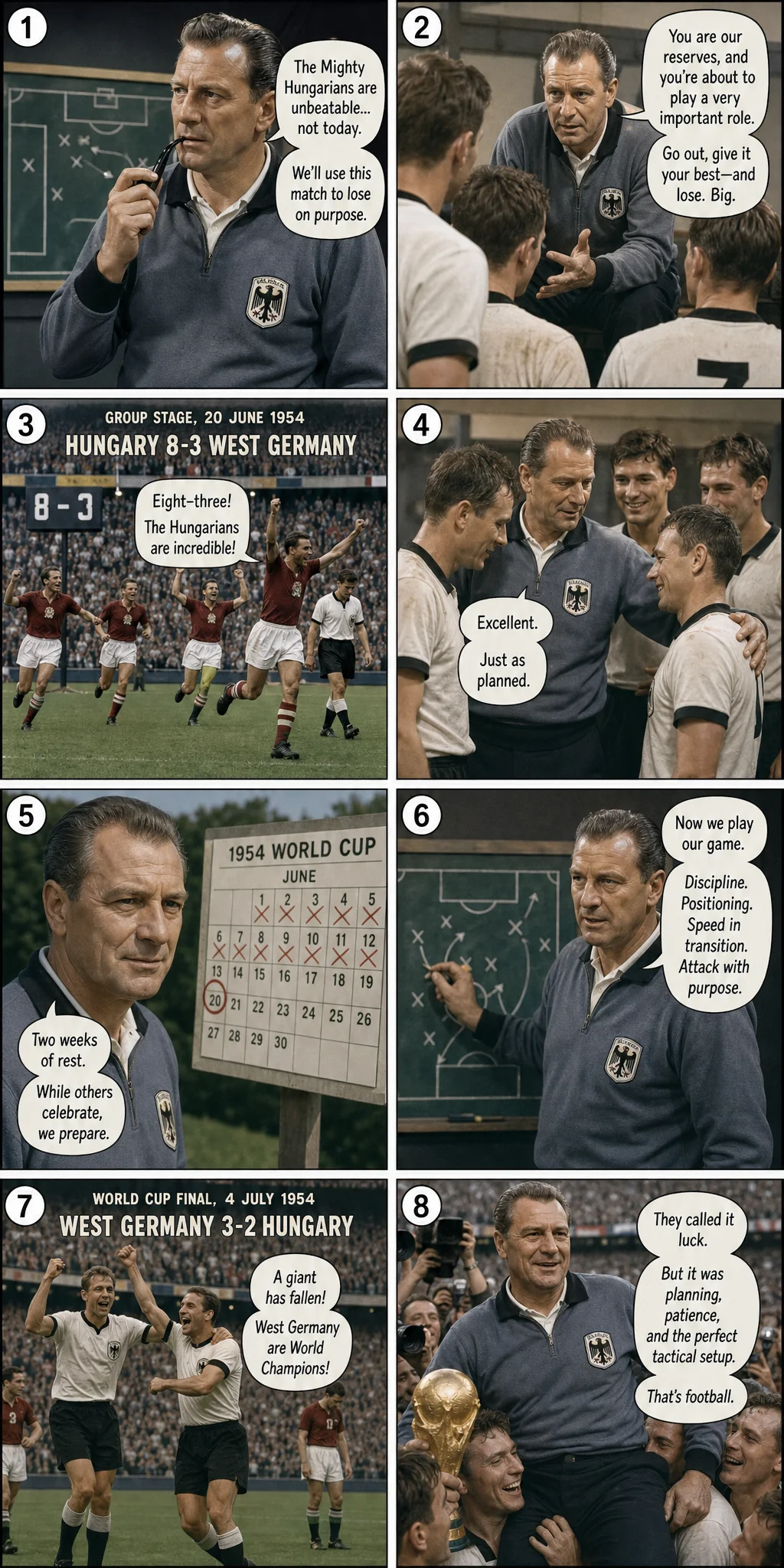
Comic content and match statistics are for entertainment purposes only and may contain inaccuracies. For Accurate Data, please refer to the reference's official website.
# The Deliberate Massacre That Won a World Cup: West Germany 3-8 Hungary, 1954
Sepp Herberger did not try to win. That is the essential fact about the 1954 World Cup group match between West Germany and Hungary, and every other fact about that match follows from it. Herberger, the West German coach, fielded a reserve side against the greatest team in the world and accepted an 8-3 defeat. The decision was not defeatism. It was a cold, unsentimental calculation of tournament mathematics that remains, seven decades later, the most strategically cynical decision in World Cup history — and one of the most successful.
The format of the 1954 tournament created a specific competitive incentive that Herberger recognized and exploited. The group stage featured four teams per group, but with seeded and unseeded teams that did not play each other. The top two teams from each group advanced to the knockout phase. West Germany had already qualified for the quarterfinals by defeating Turkey — their required opponent in the seeded format. The match against Hungary, the seeded team in the group, was essentially a dead rubber for West Germany regardless of the result. But it was not a dead rubber for Hungary, who needed to maintain their seeding position, and it was not a dead rubber for the tournament bracket, where group position determined knockout path.
Herberger understood that losing heavily to Hungary would place West Germany on the easier side of the knockout bracket — avoiding Brazil, the other tournament favorite, until the final. Winning or drawing would place them on the harder path. He fielded a team of reserves, instructed them to conserve energy rather than compete at full intensity, and accepted the 8-3 defeat with the calm of a man who had already calculated the outcome and found it satisfactory. The Hungarian players, understandably, interpreted the result as evidence of German inferiority. Puskas scored. Kocsis scored. Hidegkuti orchestrated. The Mighty Magyars did what the Mighty Magyars did against every opponent in 1954, and the Germans did not resist. The 8-3 did not reflect the relative quality of the two teams — it reflected Herberger's decision that relative quality was irrelevant in a match whose outcome did not matter.
Three weeks later, West Germany and Hungary met again in the final. The circumstances were different: rain — the Fritz-Walter-Wetter that the German captain's war-damaged body thrived in — a pitch that neutralized Hungarian technical superiority, and a German team that was now at full strength and fully motivated. Puskas played through the ankle injury sustained in the group match. Germany scored three, Hungary scored two, and the Miracle of Bern entered football mythology. The West German team that had lost 8-3 to the same opponent in the group stage was world champion.
The historical debate about Herberger's decision has never been settled, because the decision occupies an uncomfortable space between strategic genius and competitive cynicism that football culture has no vocabulary to resolve. Herberger did not cheat. He exploited a format incentive that the tournament's designers had created, and the exploitation was entirely within the rules. But the exploitation created a competitive distortion — the team that deliberately lost a group match became world champion — that undermines the fundamental premise of tournament competition: that every team is trying to win every match. The 8-3 group-stage defeat was not a failure. It was a prerequisite of success, the most German tactical decision in World Cup history, a calculated sacrifice of sporting pride on the altar of tournament mathematics. It worked. That is the part that makes it genius rather than cynicism, and it is also the part that has haunted every tournament format discussion since. If the rules create incentives for deliberately losing, the rules are the problem, not the manager who understands them. Sepp Herberger understood the rules of the 1954 World Cup better than anyone. The trophy in the German football museum in Dortmund is the proof.
Herberger himself is one of the more fascinating figures in World Cup history, a coach whose career spanned the pre-war, wartime, and post-war periods of German football and whose tactical innovations — the development of the libero position, the systematization of counter-attacking football, the specific attention to the psychological dimension of tournament competition — established the template for German tournament football that subsequent generations, including the 1974 and 1990 world champions, would inherit and refine. Herberger was not a romantic figure. His approach to football was analytical, systematic, and unsentimental — the specific combination of qualities that German football culture would institutionalize across subsequent decades. The decision to deliberately lose to Hungary was not, in Herberger's mind, a difficult decision. It was the logical consequence of a clear-eyed analysis of the tournament format and the competitive incentives it created. The Hungarian team was the best team in the world — the Mighty Magyars, the team that had revolutionized football through tactical innovations that the rest of the world was only beginning to understand. West Germany, in Herberger's assessment, could not defeat Hungary at full strength under normal competitive conditions. The path to victory ran not through direct confrontation but through strategic manipulation — the deliberate sacrifice of a match whose outcome did not matter to create conditions where the match whose outcome did matter could be won. The calculation was cold, rational, and entirely successful. It was also, by the standards of sporting ethics that prevailed then and prevail now, deeply uncomfortable — a deliberate manipulation of competitive outcomes that, if widely adopted, would destroy the integrity of tournament competition. Herberger did not care about sporting ethics. He cared about winning, and the 1954 World Cup trophy is the evidence that his approach to the relationship between ethics and victory was, in the specific context of the 1954 tournament, correct.
The 1954 tournament format that enabled Herberger's manipulation was one of several experimental formats that FIFA deployed in the early decades of World Cup organization, before the standardized group-stage-plus-knockout format was established. The seeded-teams-did-not-play-each-other provision was designed to protect the tournament's commercial interests — ensuring that the favored teams would not eliminate each other in the group stage, maintaining the competitive narrative through the knockout rounds. The unintended consequence was the creation of strategic incentives that undermined the competitive integrity the format was designed to protect. Herberger was not the only manager who recognized these incentives, but he was the manager who exploited them most successfully, and the 1954 tournament's legacy — alongside the Miracle of Bern, alongside the Hungarian tragedy of the best team never to win a World Cup — includes the specific lesson that tournament formats create incentives, and those incentives will be exploited by the participants who understand them best. Every subsequent World Cup format revision — the expansion to twenty-four teams, the introduction of simultaneous kickoffs after the Disgrace of Gijón, the expansion to thirty-two teams and then to forty-eight — has been shaped, in part, by the recognition that the format of a tournament determines the behavior of its participants, and that formats must be designed to align competitive incentives with competitive integrity. The 1954 World Cup was the tournament that taught this lesson, and Herberger's deliberate defeat was the teaching moment.
The Hungarian perspective on the 8-3 group-stage victory and the 3-2 final defeat provides the necessary counterpoint to the German narrative of strategic genius. For Hungary, the 1954 World Cup was not a triumph of German tactical intelligence but a tragedy of Hungarian misfortune — the best team in the world, the Mighty Magyars who had revolutionized football and established a standard of attacking excellence that no subsequent team has matched, defeated in the final by a combination of circumstances that no tactical preparation could have anticipated. The rain that fell in Bern during the final — the Fritz-Walter-Wetter, named for the German captain whose war-damaged body functioned best in wet conditions — neutralized the technical advantage that Hungarian football was built upon, turning the pitch into a surface where precise passing was impossible and physical confrontation was decisive. Puskas played through the ankle injury that a German player had inflicted during the group-stage match, his mobility compromised, his effectiveness diminished, the best player in the world reduced to a diminished version of himself at the moment when Hungarian football needed him most. The goal that was disallowed in the final minutes — a Hungarian equalizer that the linesman ruled offside, a decision that remains controversial seven decades later — represents the specific margins by which great teams are separated from their rewards. Hungary in 1954 was the best team in the world, and the World Cup final was the match where being the best team in the world was not sufficient. The 1954 tournament belongs, in Hungarian football memory, to the category of what might have been — the greatest team never to win the World Cup, the lost generation whose brilliance was acknowledged by everyone except the scoreboard that recorded the final result.
The broader significance of the 1954 World Cup for tournament football extends beyond the specific narrative of the Miracle of Bern and the Hungarian tragedy. The tournament established patterns that would define World Cup competition for subsequent decades: the tension between format design and competitive behavior, the specific role of luck — weather, injuries, refereeing decisions — in determining outcomes that are subsequently attributed to tactical or psychological factors, the capacity of a single tournament to define the historical reputation of entire football generations. The 1954 final was not simply a football match. It was the moment when West Germany, a nation still reconstructing its identity after the catastrophe of the Second World War, was reintroduced to the global community through the specific mechanism of sporting triumph — the Miracle of Bern as narrative of national redemption, the specific symbolism of a German team winning the World Cup nine years after the end of the war. The political dimension of the victory was inescapable and has been extensively analyzed; the football dimension — Herberger's tactical cynicism creating the conditions for victory, the deliberate sacrifice of a group match enabling the triumph in the final — is equally significant and carries lessons about tournament competition that remain relevant for every subsequent World Cup. The 8-3 defeat was not a failure. It was a prerequisite of success, and the specific relationship between failure and success — the understanding that sometimes you must lose to win — is the most uncomfortable lesson that the 1954 World Cup has to teach.