

Germany 7-1 Brazil: The Twenty-Nine Minutes That Silenced a Nation
Belo Horizonte. July 8, 2014. World Cup semifinal. Brazil versus Germany. By the twenty-ninth minute, Germany led 5-0. Five goals in eighteen minutes — four of them between the twenty-third and twenty-ninth — a sequence so devastating, so incomprehen
Published: June 6, 2026
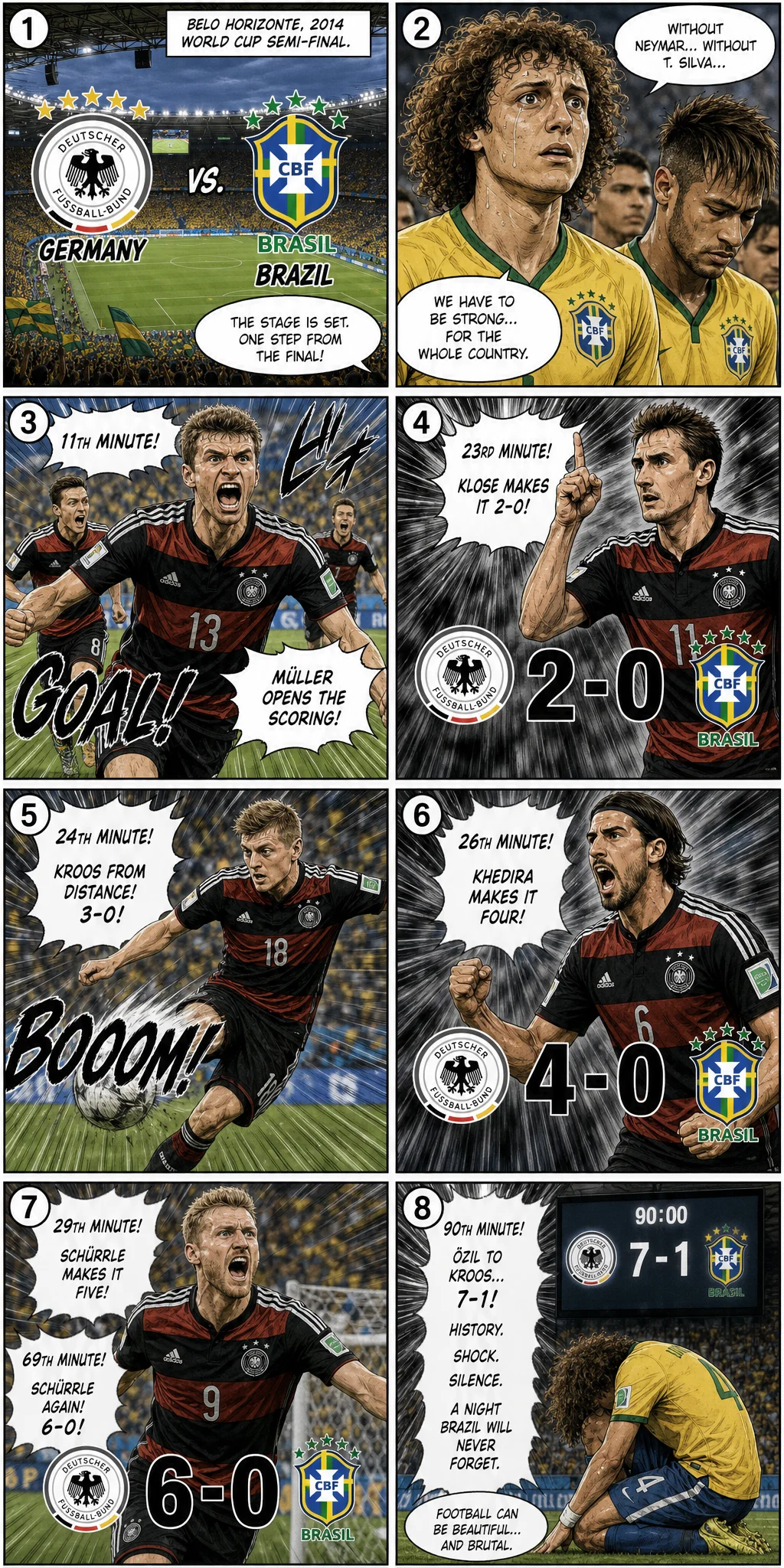
Comic content and match statistics are for entertainment purposes only and may contain inaccuracies. For Accurate Data, please refer to the reference's official website.
# Germany 7-1 Brazil: The Twenty-Nine Minutes That Changed Football
Belo Horizonte. July 8, 2014. World Cup semifinal. Brazil versus Germany. By the twenty-ninth minute, Germany led 5-0. Five goals in eighteen minutes — four of them between the twenty-third and twenty-ninth — a sequence so devastating, so incomprehensible within the context of a World Cup semifinal involving the most successful nation in tournament history playing on home soil, that the Brazilian television commentary reportedly fell silent for extended stretches of the second half. The silence was not technical failure. It was the sound of an entire football culture discovering, in real time, that it possessed no vocabulary for what it was witnessing.
The tactical post-mortem that followed — and it has now been conducted for more than a decade, by analysts with access to every touch, every pass map, every positional data point from that afternoon — identified everything Brazil had done incorrectly. David Luiz's positional anarchy, the centre-back who played as though defending was an optional component of his job description, whose wandering from his assigned position created the spaces that Thomas Muller exploited for the opening goal. The absence of Thiago Silva through yellow-card accumulation, removing the one Brazilian defender with the authority and the tactical intelligence to organize a backline against the most efficient attacking machine in the tournament. The naive pressing that left oceans of space between midfield and defense — oceans that Muller, Miroslav Klose, Toni Kroos, and Sami Khedira navigated with the practiced ease of a training exercise, as though the Brazilian midfield had been removed from the pitch. Luiz Felipe Scolari's emotional management of a squad that had been carrying the accumulated weight of a nation's expectations — the expectation of winning a home World Cup, the specific pressure of exorcising the ghost of the 1950 Maracanazo — had produced a team that was psychologically brittle, and the brittleness shattered the moment Germany scored the second goal.
All of these explanations are correct. All of them are insufficient. The 7-1 was not fundamentally a tactical failure, though the tactical failures were comprehensive. It was a psychological collapse — an entire team, carrying the accumulated weight of a nation's sixty-four-year-old football trauma, disintegrating under pressure that no tactical system could have withstood. The Brazilian players were not outplayed in the conventional sense of the term. They were overwhelmed by something that tactics cannot measure: the specific terror of a team discovering, in the most public forum available, that it is not good enough, and that the discovery is being televised to a billion people.
Klose's goal — a tap-in from four yards, the sixteenth World Cup goal that broke Ronaldo's all-time scoring record — was scored in the stadium where Ronaldo had become a global icon. The symbolism was so heavy it bordered on mythological. The German striker whose entire career was defined by spatial intelligence and positional anticipation breaking the record of the Brazilian striker whose entire career was defined by athletic explosiveness and technical brilliance, in the Brazilian striker's country, in the World Cup semifinal. Football does not write narratives this neat. Except when it does, and when it does, the narratives become permanent.
The 7-1 does not function as a football result. It functions as a case study in collective emotional collapse, televised to a billion people, permanently inscribed in both nations' football consciousness. For Germany, it was a monument that became a tomb — the victory so complete, so aesthetically devastating, that German football spent the next eight years admiring its own reflection and failed to recognize that the reflection was aging. The 2018 group-stage exit, the 2022 group-stage exit, the specific institutional complacency that the 7-1 enabled — the victory was so definitive that it convinced German football it had solved the tournament, and the conviction was precisely the problem. For Brazil, it was a scar that joined the Maracanazo in the national catalogue of football suffering — a wound that the 1950 generation carried and that the 2014 generation now shares. The 7-1 was not a match. It was a reckoning, and neither nation has fully recovered from it.
The eighteen-minute sequence that defined this match — from Thomas Muller's opening goal in the eleventh minute to Sami Khedira's fifth goal in the twenty-ninth minute — deserves forensic analysis because it represents the most concentrated destruction of an elite football team in the history of the sport. The sequence cannot be adequately captured by describing the goals individually because the goals were not individual events; they were the progressive collapse of a defensive structure that had never been designed to withstand the specific pressure Germany applied. Muller's opener came from a corner kick — the most basic set-piece failure, David Luiz losing his marking assignment and Muller volleying home from eight yards with no Brazilian defender within three meters. The goal was simple and avoidable, and its simplicity was the warning that Brazil failed to heed. Klose's goal, the record-breaker, came from a sequence that began with Muller receiving the ball in central midfield — the space that Brazil's pressing had vacated — and ended with Klose, on his second attempt after Julio Cesar saved his first shot, tapping into an empty net. The third goal, Kroos's first, came twenty-three seconds after the restart: a German passing sequence that moved the ball from midfield to the Brazilian penalty area as though the Brazilian defenders had been replaced by training cones, Kroos's finish from the edge of the area struck with the precision of a player who had been given unlimited time and space. The fourth goal, Kroos's second, came ninety seconds later: a Brazilian defensive giveaway in midfield, Khedira intercepting and feeding Kroos, a one-two with Muller that eliminated the entire Brazilian backline, Kroos walking the ball into the net. The fifth goal, Khedira's, came two minutes after that: another German passing sequence, another Brazilian defensive collapse, Khedira arriving unmarked at the edge of the six-yard box to finish. Five goals in eighteen minutes. The Brazilian players were not competing. They were disintegrating, and the disintegration was visible on their faces, in their body language, in the specific posture of athletes who had stopped believing that the contest they were participating in was winnable.
The psychological dimension of the Brazilian collapse deserves to be understood not as moral failure — the easy narrative that the Brazilian players lacked character, lacked resilience, lacked the specific qualities that champions possess — but as the predictable consequence of the psychological pressure that had been accumulating around the Brazilian national team for the entire tournament. Brazil had entered the 2014 World Cup carrying the specific burden of hosting the tournament on home soil for the first time since the 1950 Maracanazo, and the burden was not metaphorical. The Brazilian media, the Brazilian public, and the Brazilian football establishment had constructed a narrative in which winning the World Cup on home soil was not merely a sporting ambition but a national obligation — the specific requirement of exorcising the ghost of 1950 through the specific mechanism of winning in 2014. Every Brazilian player who took the field in every match of the tournament was carrying this burden, and the accumulated weight of it was visible in the emotional fragility that characterized Brazilian performances throughout the knockout stage. The tears during the national anthem before every match. The emotional collapse after Neymar's tournament-ending injury in the quarterfinal against Colombia — the player who was carrying the nation's expectations most visibly, removed from the tournament by a knee to the back, his teammates holding his shirt aloft as though mourning a death rather than an injury. The specific hysteria that surrounded every Brazilian victory, the sense that each win was a survival rather than an achievement. The Brazilian players who collapsed against Germany were not weak. They were exhausted — physically by the demands of tournament football, psychologically by the demands of a nation that had invested its entire emotional identity in their performance — and the exhaustion manifested, in those eighteen minutes, as the most devastating collective collapse in football history.
The aftermath of the 7-1 for German football is a cautionary tale about the dangers of institutional complacency, and the German football establishment's failure to recognize those dangers is itself a significant institutional failure. The victory was so complete, so aesthetically devastating, so seemingly definitive in its demonstration of German football's structural superiority, that the German football establishment interpreted it as validation of its entire institutional model — the youth development system, the tactical education, the specific approach to tournament football that Joachim Low had refined across a decade of management. The interpretation was understandable; the complacency it generated was catastrophic. The 2018 World Cup campaign — group-stage elimination, the defeat to South Korea that repeated, with almost sadistic precision, the specific humiliation that German football had inflicted on Brazil — was a direct consequence of the institutional arrogance that the 7-1 had enabled. The German football establishment had convinced itself, on the basis of one extraordinary performance, that its model was permanently correct rather than temporarily successful, and the conviction prevented the self-examination that all successful institutions must periodically undertake. The 2022 World Cup campaign — another group-stage elimination, another defeat to an Asian opponent, another demonstration that the model had stopped working — compounded the failure. The 7-1 was German football's greatest triumph. It was also the beginning of its institutional decline, and the decline would not be arrested until the appointment of Julian Nagelsmann and the specific acknowledgment that the model that produced the 7-1 had been superseded by football's ongoing evolution.
For Brazil, the 7-1 joined the Maracanazo in the national catalogue of football trauma, and the specific relationship between these two catastrophes — separated by sixty-four years, connected by the specific geography of the Mineirao stadium in Belo Horizonte, the city where the 1950 team had been based — created a narrative of national football suffering that no other football culture can match. The Brazilian response to the 7-1 was characteristically diverse: the immediate public grief, the specific mourning of a nation that had invested its emotional identity in its football team and had that investment catastrophically invalidated; the analytical response, the tactical post-mortems and institutional reforms that attempted to extract lessons from the failure; the cultural response, the jokes and memes and gallows humor that Brazilian culture deploys to process trauma that cannot be processed through solemnity alone. The 7-1 is now a permanent feature of Brazilian football identity — the scar that will never fully heal, the reference point that every subsequent Brazilian team carries into every subsequent tournament. The 1950 Maracanazo was supposed to be the definitive Brazilian football trauma. The 2014 Mineirazo demonstrated that trauma can be compounded, that a nation can experience multiple definitive catastrophes, and that the specific burden of Brazilian football — the expectation of beauty and victory, the impossibility of meeting both expectations simultaneously — is a burden that no generation can escape.