

Netherlands 5-1 Spain: 2014 Flying Dutchmen End a Dynasty
The first thing you need to understand about Salvador is the heat. Not the polite, European heat that makes you loosen your collar and order a cold drink. Proper, Brazilian heat. The kind that sits on your chest like a heavy blanket and makes every t
Published: June 6, 2026
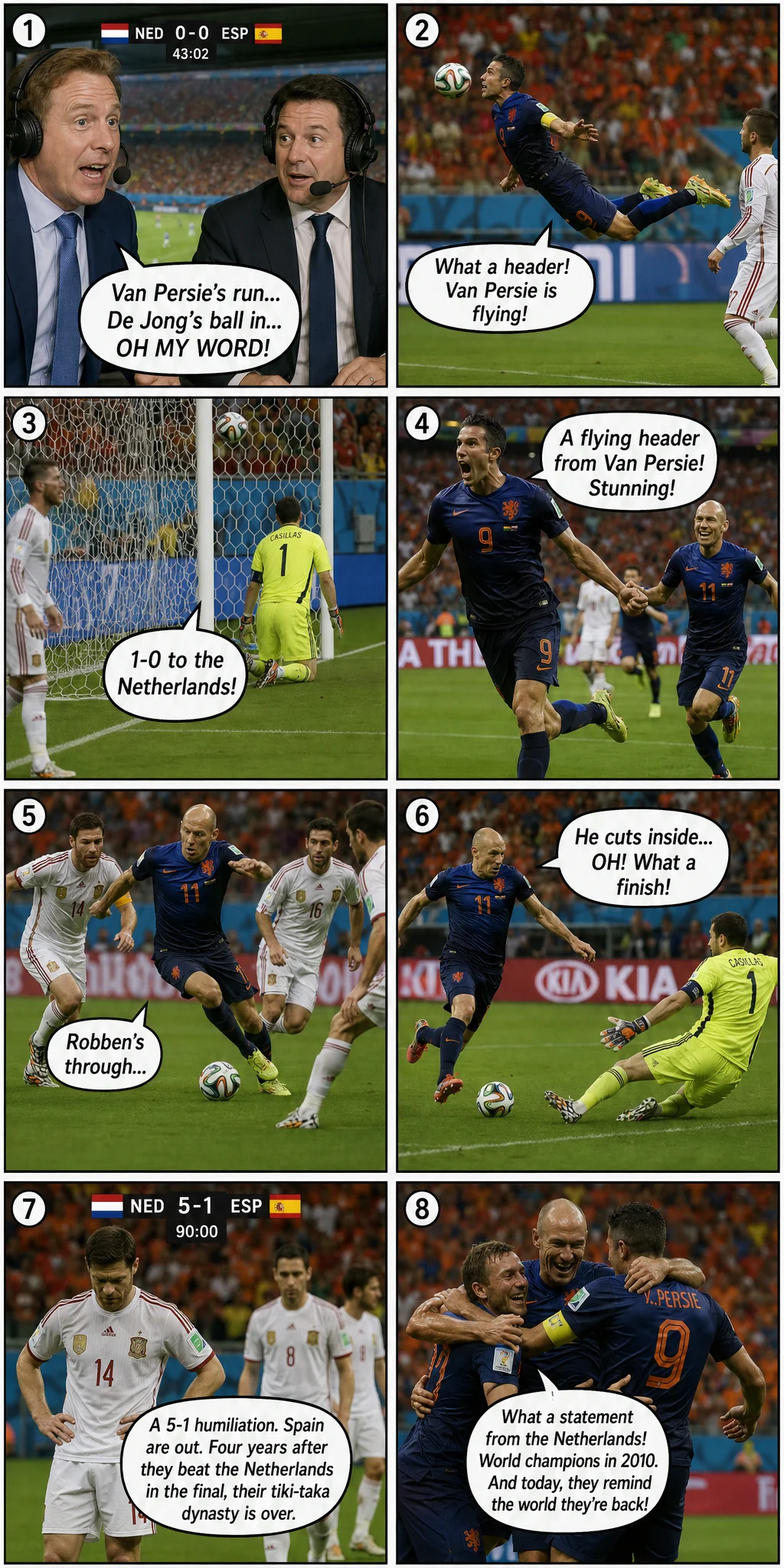
Comic content and match statistics are for entertainment purposes only and may contain inaccuracies. For Accurate Data, please refer to the reference's official website.
The first thing you need to understand about Salvador is the heat. Not the polite, European heat that makes you loosen your collar and order a cold drink. Proper, Brazilian heat. The kind that sits on your chest like a heavy blanket and makes every thought feel slightly underwater. I arrived in Salvador da Bahia a few days before the 2014 World Cup match between Spain and the Netherlands with a notebook full of tactical observations and a head full of expectations. I left with nothing but the image of Robin van Persie suspended in mid-air, horizontal to the earth, a man who had briefly decided that gravity was optional.
The build-up to this match had been dominated by a single word: revenge. Four years earlier, in Johannesburg, Spain had beaten the Netherlands 1-0 in the World Cup final. Andrés Iniesta's extra-time goal, the most important in Spanish football history, had been celebrated with a shirt bearing a tribute to Dani Jarque, the Espanyol captain who had died the year before. It was a beautiful moment. The Dutch remember it differently. They remember Nigel de Jong's kung-fu kick to Xabi Alonso's chest, a challenge so violent it should have come with a health warning. They remember Iker Casillas making saves that defied physics. They remember losing. You never really forget losing a World Cup final.
Spain arrived in Brazil as the defending champions — not just World Cup champions, but back-to-back European champions too. The architects of a possession philosophy that had conquered the sport. Tiki-taka. The word itself had become shorthand for an entire way of thinking about football: pass, move, pass again, never lose the ball. Between 2008 and 2012, this philosophy had produced one of the most dominant eras in international football history. Xavi, Iniesta, Xabi Alonso, Sergio Busquets — a midfield quartet so technically perfect that opponents often seemed to be playing a different sport. They had made football beautiful, but they had also made it predictable. And predictability, as Louis van Gaal understood, is a vulnerability.
Van Gaal. Let me spend a moment on him, because he deserves it. The Dutch manager was everything Spanish football was not — abrasive where Spain were elegant, confrontational where they were composed, tactical where they were philosophical. He had studied the 2010 defeat obsessively. For four years, he had been preparing a system specifically designed to dismantle Spanish possession football, and he unveiled it in Salvador like a magician revealing his best trick. The Dutch formation was a 5-3-2 that transformed into a 3-4-3 in attack, designed to press Spain high, attack the space behind their full-backs, and treat possession not as strength but as an invitation. Every Spanish pass was a trap. Every moment of control was an opportunity for Dutch chaos.
The match began as expected. Spain scored first. Xabi Alonso, penalty, 27th minute. Calm. Clinical. The defending champions doing what defending champions do. For a brief moment, you could almost hear the narrative forming in press boxes around the world: same old Spain, same old Netherlands, same old story. And then the Dutch equalized, just before halftime, and everything changed.
I have watched Robin van Persie's goal more times than I can count, and it still makes no physical sense. Daley Blind — the son of Ajax legend Danny Blind, a left wing-back with a left foot that could land a pass on a 50-cent coin from 40 yards — looked up and saw Van Persie's run. The pass was perfect. But Van Persie was still 15 yards from goal, the ball was dropping over his shoulder, and Iker Casillas was advancing. The conventional option — bring it down, control it, shoot — was not available. So Van Persie did something that had no name in any coaching manual. He launched himself forward, arms extended like Superman, body horizontal, and headed the ball over Casillas in a slow, looping arc that seemed to take an eternity to cross the line. The Flying Dutchman. That nickname was never more literal. In that moment, Van Persie was not a footballer. He was a bird of prey, suspended in Brazilian air, rewriting what the human body was capable of.
The second half was not a football match. It was a demolition. Arjen Robben — bald, ageless, still running like a man who had stolen something — scored twice, each goal a variation on the same theme: receive the ball, accelerate past confused Spanish defenders, finish with that devastating left foot. The first goal came in the 53rd minute, Robben cutting inside from the right and curling the ball past Casillas with the inevitability of night following day. The second came in the 80th minute, and by then the Spanish defence looked like a building that had been condemned but was still expected to stand. Stefan de Vrij scored from a corner. Van Persie added his second, a simpler finish but still devastating in its efficiency. Five goals. Five-one.
The images that linger are not the goals themselves — remarkable as they were — but the faces. Casillas, the captain, the legend, the man who had lifted every trophy football had to offer, staring into the middle distance with the hollow expression of someone who has just discovered that gravity still applies to him. Xavi, sitting on the bench where he had been substituted, his head buried in his hands, the passing metronome silenced. Vicente del Bosque, the avuncular manager who had guided Spain through their golden era, standing motionless on the touchline like a man watching his own house burn down from across the street.
What died in Salvador that night was not just Spain's 2014 campaign. It was the idea that possession alone was enough. That you could pass a team into submission. That control was the same thing as dominance. The 5-1 scoreline was not the end of Spanish football — Spain would win the Nations League, reach the Euro 2020 semifinals, produce a new generation of talent that included Pedri and Gavi — but it was the end of a particular kind of Spanish football. The kind that believed the ball was an end in itself. The Dutch had demonstrated, with brutal clarity, that possession was vulnerability if you did not know what to do when you lost it.
I walked out of the Arena Fonte Nova that night into Salvador's heavy, tropical darkness. The Dutch fans were singing. The Spanish fans were silent. Somewhere in the distance, drums were playing — samba rhythms that had nothing to do with football and everything to do with Brazil, with life, with the stubborn refusal of joy to be extinguished by defeat. The 2014 World Cup would produce many stories before it ended. Germany's 7-1 demolition of Brazil in the semifinal. Mario Götze's extra-time winner in the final. Lionel Messi's thousand-yard stare as he collected the Golden Ball. But the first great story — the one that announced that this tournament would not follow any script — was written in Salvador, by a Dutch team that had waited four years for revenge and a Spanish team that had finally run out of passes.
Five-one. The dynasty ended not with a whimper but with a header that defied gravity and a bald Dutchman who never stopped running. Arrivederci, tiki-taka.