

Austria 7-5 Switzerland: 1954 World Cup's Craziest Attack
Twelve goals in a single World Cup match. Let that number settle for a moment. Twelve. In an era of defensive organization, tactical periodization, and gegenpressing, the idea of twelve goals in ninety minutes feels like a typo. A statistical error.
Published: June 6, 2026
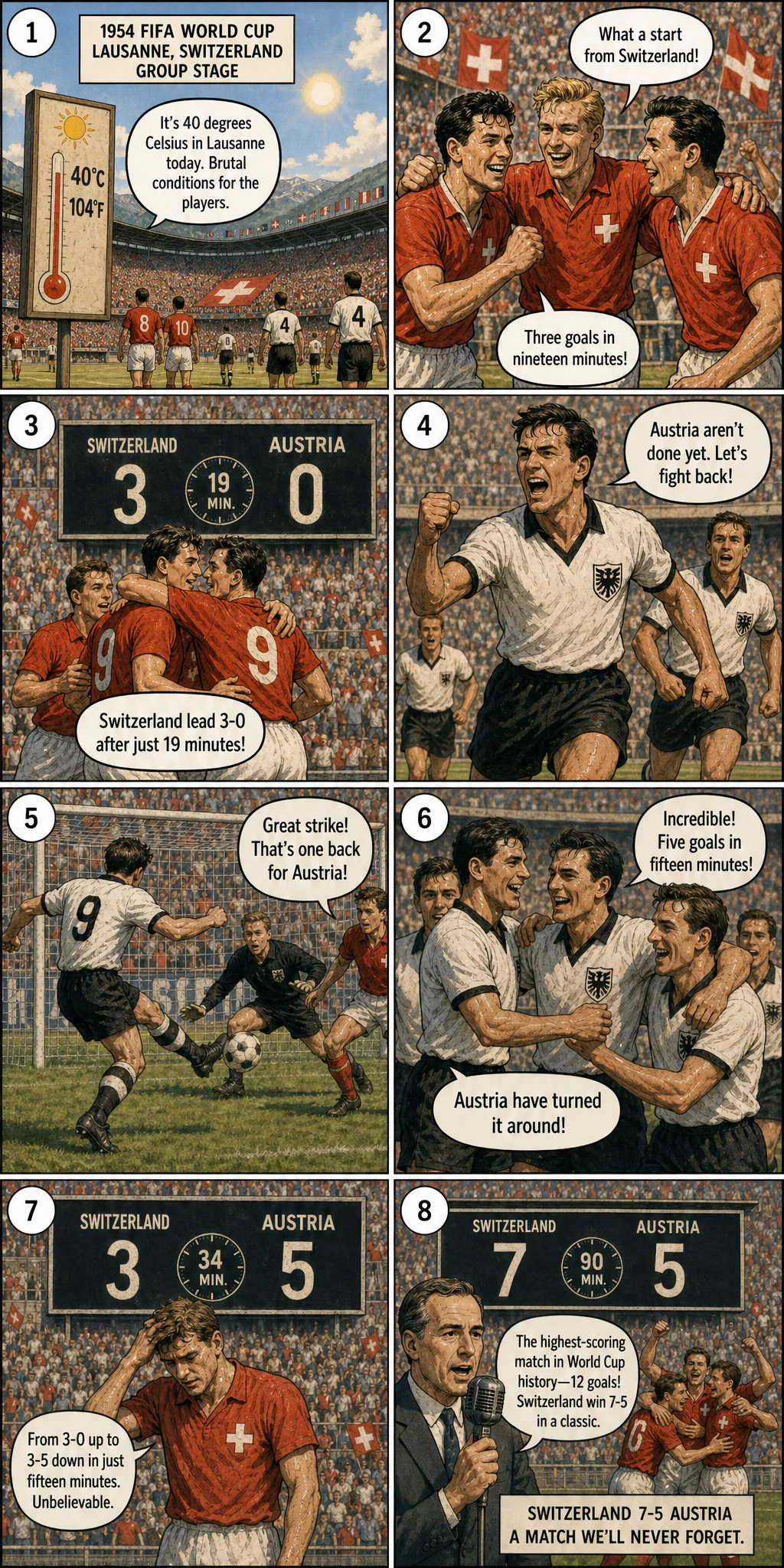
Comic content and match statistics are for entertainment purposes only and may contain inaccuracies. For Accurate Data, please refer to the reference's official website.
Twelve goals in a single World Cup match. Let that number settle for a moment. Twelve. In an era of defensive organization, tactical periodization, and gegenpressing, the idea of twelve goals in ninety minutes feels like a typo. A statistical error. Something that belongs to a different sport entirely. And in a sense, it does. The 1954 World Cup quarterfinal between Austria and Switzerland belongs to a version of football that no longer exists — a game played by men who considered hydration a sign of weakness, substitutes a bureaucratic inconvenience, and defensive positioning an optional activity for the faint-hearted.
I was in Vienna a few years ago, researching a piece on Austrian football's golden age, when I first heard the full story of that quarterfinal. Not the sanitized, Wikipedia version that tells you the scoreline and the scorers and calls it history. The real version. The one told by old men in smoky coffee houses over melange and apfelstrudel, their voices dropping to a conspiratorial whisper when they got to the good parts. "You have to understand," one of them told me, his eyes gleaming behind thick spectacles, "it was forty degrees. Forty. We thought someone was going to die."
The 1954 World Cup was hosted by Switzerland, a country chosen largely because it had remained neutral during the war and FIFA was headquartered in Zurich. The tournament format was, by modern standards, bewildering — seeded teams played only two group matches, unseeded teams played two, but none of the seeds played each other. It was designed to protect the big nations from early elimination, and it produced scorelines that would be unthinkable today. Which brings us to Lausanne, June 26th, 1954. Austria versus Switzerland. A place in the semifinal at stake. The temperature at kickoff was hovering around thirty-eight degrees Celsius and climbing. The pitch, watered before the match in a desperate attempt to keep the surface playable, had been baked hard as concrete by halftime.
Austria were one of the tournament favourites — or as close to favourites as existed in an era before systematic tournament preparation. Manager Walter Nausch had built a side around the brilliant Ernst Ocwirk, a midfielder so elegant that the Viennese press called him "Clockwork" because his movements seemed to operate on some higher, mechanical precision. Ernst Stojaspal and Theodor Wagner provided the attacking threat. This was an Austria side that played with a kind of operatic flair — Vorarlberg meets Vienna Philharmonic, all crescendo and no diminuendo. They had beaten Scotland and Czechoslovakia to reach this stage, scoring freely and defending, well, optionally.
Switzerland were hosts, which in 1954 meant something different than it does today. No sophisticated training camps, no sports scientists monitoring every metric. Just a team of part-timers and semi-professionals who had grown up playing football on alpine pitches where the thin air meant the ball travelled further and every sprint felt like running through water. They had beaten Italy in the group stage — a genuine shock — and had eliminated their neighbours in a replay. The nation was behind them. The stadium in Lausanne was packed, a heaving mass of red and white flags under a sun that seemed personally offended by the concept of shade.
The first twenty-two minutes produced four goals. Let me write that again, because it deserves to be read slowly. Twenty-two minutes. Four goals. Austria scored three of them, through Wagner, Körner, and Wagner again in a period of play so chaotic that Swiss defenders appeared to be moving in slow motion while the Austrians operated on fast-forward. It was 3-0, and the match was barely old enough to have a narrative. The Swiss fans, to their eternal credit, did not go quiet. They got louder. They sang harder. They waved their flags with the desperate energy of people who had decided that patriotic enthusiasm could substitute for defensive organization.
And then something remarkable happened. Switzerland scored. Robert Ballaman, their centre-forward, a man whose name I love simply because it sounds like a typographical error that became a person. Then they scored again. Josef Hügi — another wonderful Swiss name, all economy and no flourish — made it 3-2. The stadium erupted. The Swiss, who had been dead and buried at 3-0, were suddenly alive, suddenly believing, suddenly capable of anything. Hügi scored again to make it 3-3. Three goals in six minutes. The momentum had swung so violently that Austrian players were looking at each other with the bewildered expression of men who had entered the wrong theatre and were watching the wrong play.
Austria scored twice more before halftime through Ocwirk and Probst. 5-3 at the break. Twelve goals in a typical World Cup match would be remarkable. Twelve goals in a half of football was something closer to madness. Players stumbled into the dressing rooms, their shirts soaked through, their faces the colour of cooked lobster. There were no substitutions in 1954. You played until you could not play anymore, and then you kept playing.
The second half was not football. It was an experiment in human endurance. The temperature had now reached forty degrees — some reports say forty-two, but the precise number hardly matters once you have crossed the threshold where the human body begins to malfunction. Wagner scored his third for Austria. 6-3. Ballaman scored his second for Switzerland. 6-4. Probst made it 7-4 for Austria. And then, in the final ten minutes, with players from both sides barely able to run — staggering between sprints like boxers in the twelfth round — Hügi completed his hat-trick. 7-5.
The referee, a man whose name has been lost to history but who deserves a statue somewhere, considered abandoning the match at least twice. The heat was dangerous. Players were cramping visibly on the pitch. The medical facilities consisted of, at best, a bucket of cold water and some stern encouragement. But the match continued, because that was what matches did in 1954. They continued until the whistle blew, regardless of whether anyone was still standing.
The final whistle, when it came, was less a conclusion than a mercy. Austria 7, Switzerland 5. Twelve goals. The highest-scoring match in World Cup history. A record that has stood for more than seventy years and will almost certainly never be broken. Modern football does not permit the conditions that produced it — the heat exhaustion, the absence of substitutions, the defensive organization that would embarrass a competent Sunday league team. The 1954 quarterfinal is not just a scoreline. It is a monument to a different way of playing football. To a sport where the only tactical instruction was "attack" and the only defensive strategy was hope.
I finished my melange in that Viennese coffee house and asked the old man what he remembered most clearly about that day. He thought for a long moment, stirring his coffee with the absent-minded precision of someone who had been doing it for seventy years. "The noise," he said eventually. "The noise never stopped. Not for one minute. Twelve goals, and every single one of them was celebrated like a final." He paused. "We don't make noise like that anymore."
He was right. We make better tactics, better athletes, better analysis. But we don't make noise like 1954. Some things, once lost, don't come back. Some records are not measurements. They are time capsules.