

Russia 6-1 Cameroon: 1994 World Cup Salenko Five Goals Win Golden Boot
The most statistically anomalous performance in World Cup history belongs to a man most football fans have forgotten. His name is Oleg Salenko. On June 28th, 1994, in Palo Alto, California, he scored five goals in a single World Cup match against Cam
Published: June 6, 2026
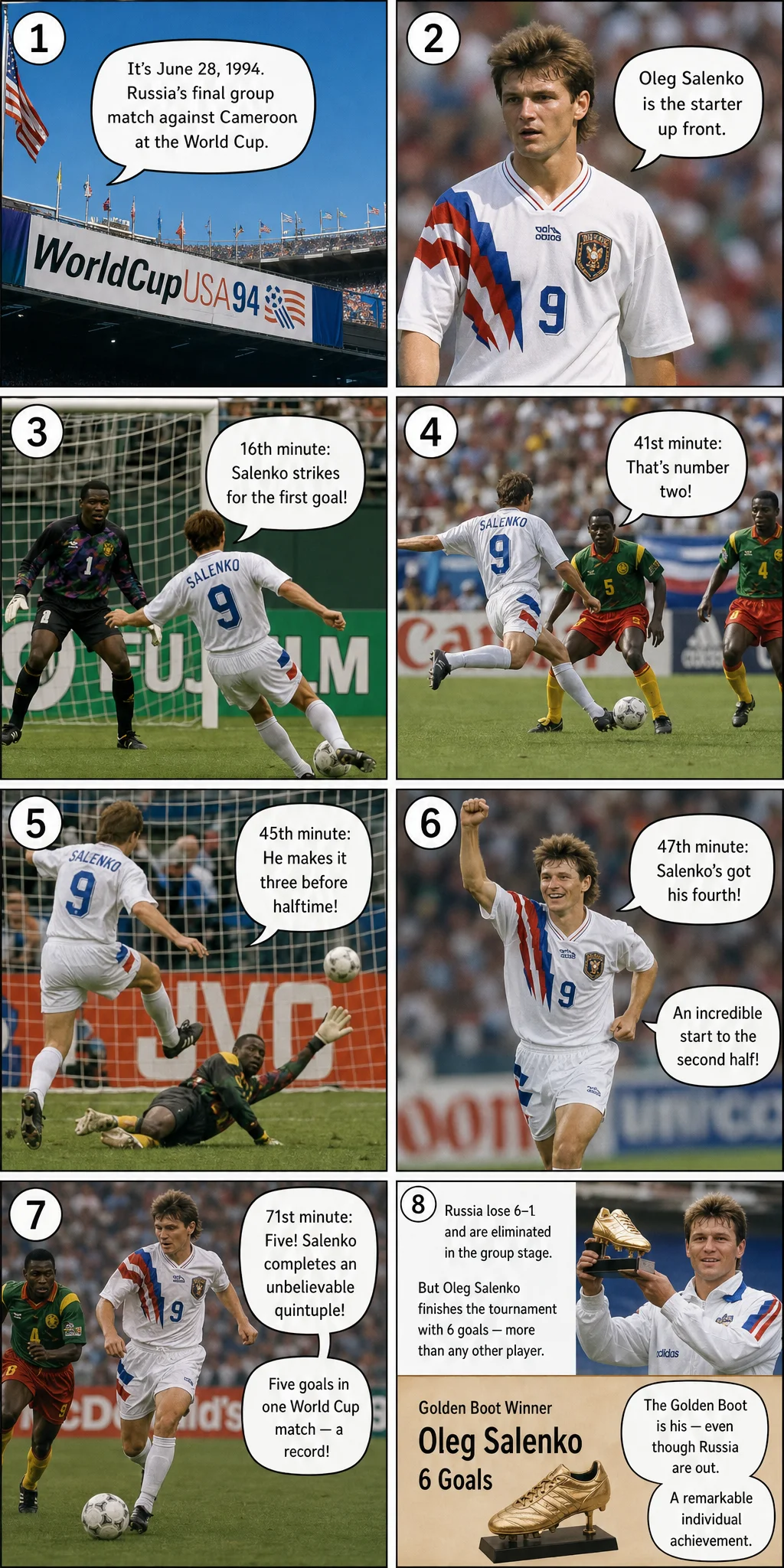
Comic content and match statistics are for entertainment purposes only and may contain inaccuracies. For Accurate Data, please refer to the reference's official website.
The most statistically anomalous performance in World Cup history belongs to a man most football fans have forgotten. His name is Oleg Salenko. On June 28th, 1994, in Palo Alto, California, he scored five goals in a single World Cup match against Cameroon. Russia won 6-1. Both teams were already eliminated. The match meant nothing. And yet — and this is what I find myself returning to, every time I think about the 1994 World Cup — Salenko walked away from that tournament as the joint Golden Boot winner with six goals, tied with Hristo Stoichkov. Six goals in three matches. Russia eliminated in the group stage. He never scored another World Cup goal. He never played for a major European club. His entire international legacy rests on one match, one afternoon, one eruption of goalscoring that defies every statistical law football has.
I became fascinated with Salenko's story years ago, not because of the goals themselves — though five in one match is absurd, unprecedented, shared with only one other player in men's World Cup history — but because of what the performance says about the nature of records. We treat records as monuments. Solid. Permanent. Objective measures of achievement. But Salenko's Golden Boot is not a monument. It is a mirage. An optical illusion produced by the peculiar circumstances of a meaningless group stage match, a Cameroonian team that had effectively stopped playing, and a striker who happened to be in the right place at the wrongest possible time.
Let me set the scene. The 1994 World Cup was held in the United States, a country that was still learning what football was and why it mattered. The tournament was played in vast American football stadiums, under a summer sun that turned the artificial turf of the Pontiac Silverdome into a health hazard. Russia arrived as a team in transition — the Soviet Union had dissolved three years earlier, the Russian football federation was barely functional, and the squad was a collection of players who had never quite adjusted to the post-Soviet reality. Their manager, Pavel Sadyrin, was a respected figure who had won the Soviet league with Zenit Leningrad, but his relationship with the squad had deteriorated to the point where several key players had refused to travel to the tournament.
Cameroon, by contrast, arrived with the glow of 1990 still faintly visible around them. The Indomitable Lions had reached the quarterfinals in Italy four years earlier — Roger Milla's corner-flag dance, the victories over Argentina and Colombia, the moment when African football announced itself to the world. But the 1994 team was not the 1990 team. Milla, at forty-two, was still on the squad — the oldest outfield player in World Cup history — but the magic had faded. The squad's preparation had been disrupted by a dispute over bonus payments. The players had initially refused to board the plane to the United States until the Cameroonian government intervened. They arrived in America fractured, distracted, and already looking forward to going home.
Russia and Cameroon had both lost their first two group matches. Russia had been beaten by Brazil and Sweden, respectable defeats against superior opposition. Cameroon had drawn with Sweden — a creditable result — before being demolished by Brazil. When they met in Palo Alto, at Stanford Stadium, on a Tuesday afternoon, neither team had any mathematical possibility of advancing. The match was a dead rubber. The worst kind of dead rubber: the kind played in near-empty stadiums, with the press box half-vacant, with television audiences that had already switched their attention to the knockout bracket. Nobody cared. Nobody was watching. And into this vacuum of competitive meaning walked Oleg Salenko.
The first goal came in the 15th minute. A free kick from the edge of the area. Salenko struck it cleanly, the ball dipping over the wall and past Joseph-Antoine Bell, the Cameroonian goalkeeper who was, at that point, already wondering what he had done to deserve this afternoon. 1-0 Russia. The second goal came in the 41st minute — a header from a corner, Salenko rising between two Cameroonian defenders who seemed to be marking each other rather than the Russian striker. 2-0 Russia. As the teams walked off at halftime, Salenko had two goals, and nobody had yet realized what was about to happen.
The second half was not a football match. It was a statistical anomaly wearing a football match's clothing. Cameroon's defence — which had been one of the tournament's most organized units in 1990 — had disintegrated. Players were not tracking runs. Tackles were not being made. The goalkeeper was not diving for shots that would have been savable in any competitive context. Cameroon had stopped playing, not in the physical sense — their bodies were still on the pitch — but in the spiritual sense. They had mentally checked out of the tournament, and their bodies were simply waiting for the paperwork to be processed.
Salenko scored his third in the 73rd minute. A penalty, dispatched with the minimum of fuss. 3-0 Russia. The fourth came in the 75th minute — two minutes later, the Cameroonian defence having apparently decided that conceding goals was less effort than preventing them. 4-0 Russia. The fifth came in the 81st minute. A tap-in from close range, the kind of goal that would not normally be worth describing, except that it was Salenko's fifth, and five goals in a World Cup match is the kind of thing that happens once every few decades and then never again.
Cameroon scored through Roger Milla — of course it was Milla, who else, the forty-two-year-old legend scoring what would be his final World Cup goal, a moment of grace in an afternoon of chaos. 5-1. Salenko scored his fifth, and the final score was 6-1 Russia. The match ended. The players trudged off. The tournament continued as if nothing unusual had happened. And nothing unusual had happened, really, except that Oleg Salenko had scored five goals in a World Cup match and nobody who was not already in the stadium seemed to notice.
Here is where the story gets strange, even by the standards of football's capacity for strangeness. Salenko's six goals in the 1994 World Cup — five against Cameroon, one against Sweden — made him the tournament's joint top scorer. Hristo Stoichkov, the Bulgarian genius who had carried his team to the semifinals, who had scored against Germany in the quarterfinals and Italy in the semifinals, who had been the most electrifying attacking player in the tournament — Stoichkov also scored six goals. The Golden Boot was shared between them. Stoichkov earned his goals through seven matches of sustained excellence against elite opposition. Salenko earned his through three matches, one blowout, and a Cameroonian defence that had given up. The trophy does not distinguish between these contexts. It never has. A goal is a goal. Five goals in a meaningless group stage match count the same as five goals across a championship-winning campaign. The Golden Boot is blind to narrative, and in its blindness lies both its honesty and its absurdity.
Salenko never scored another World Cup goal. Russia did not qualify for 1998, 2002, or 2006 — not until 2018, when they were hosts. Salenko's club career was a similar anti-climax: spells at Dynamo Kyiv, Valencia, Rangers, and a series of smaller clubs in Turkey and Poland. He was a good footballer — good enough to play at a high level, good enough to represent his country. But five goals in a World Cup match? That is Pelé territory. Gerd Müller territory. The territory of players whose names are carved into the sport's history. Salenko's name is there too, carved next to the record, but it feels different. It feels like someone made a mistake in the engraving and never corrected it.
I think about Salenko sometimes when I watch the Golden Boot being awarded at the end of modern World Cups. Harry Kane in 2018, six goals, mostly against Panama and Tunisia. James Rodríguez in 2014, six goals, the golden boy of an overachieving Colombian team. Kylian Mbappé in 2022, eight goals, the hat-trick in the final finally giving him the trophy he deserved. Every Golden Boot is a product of circumstance as much as quality. The draw matters. The opponents matter. The stage at which your team is eliminated matters. Salenko's Golden Boot is merely the most extreme example of a principle that applies to all of them: context is everything, and records record only the outcome, never the story behind it.
Five goals. One match. A Golden Boot shared with Stoichkov. Oleg Salenko did not change football. He did not build a legacy. He did not have a career that would fill the opening paragraph of a Wikipedia entry. But for one afternoon in Palo Alto, in front of a half-empty stadium, against a Cameroon team that was already thinking about the flight home, he did something that only one other man in the history of men's World Cups has ever done. That is not greatness. It is something else — something stranger, something more interesting, something that only football, with its infinite capacity for the improbable, could produce.