

Portugal 6-1 Switzerland: 21-Year-Old Ramos Replaces Ronaldo and Scores Hat-Trick (2022)
Fernando Santos did something on December 6th, 2022, that most international managers spend their entire careers avoiding. He dropped Cristiano Ronaldo. Not rested him. Not managed his minutes. Dropped him. For a World Cup round of sixteen match. Aga
Published: June 6, 2026
Comic content and match statistics are for entertainment purposes only and may contain inaccuracies. For Accurate Data, please refer to the reference's official website.
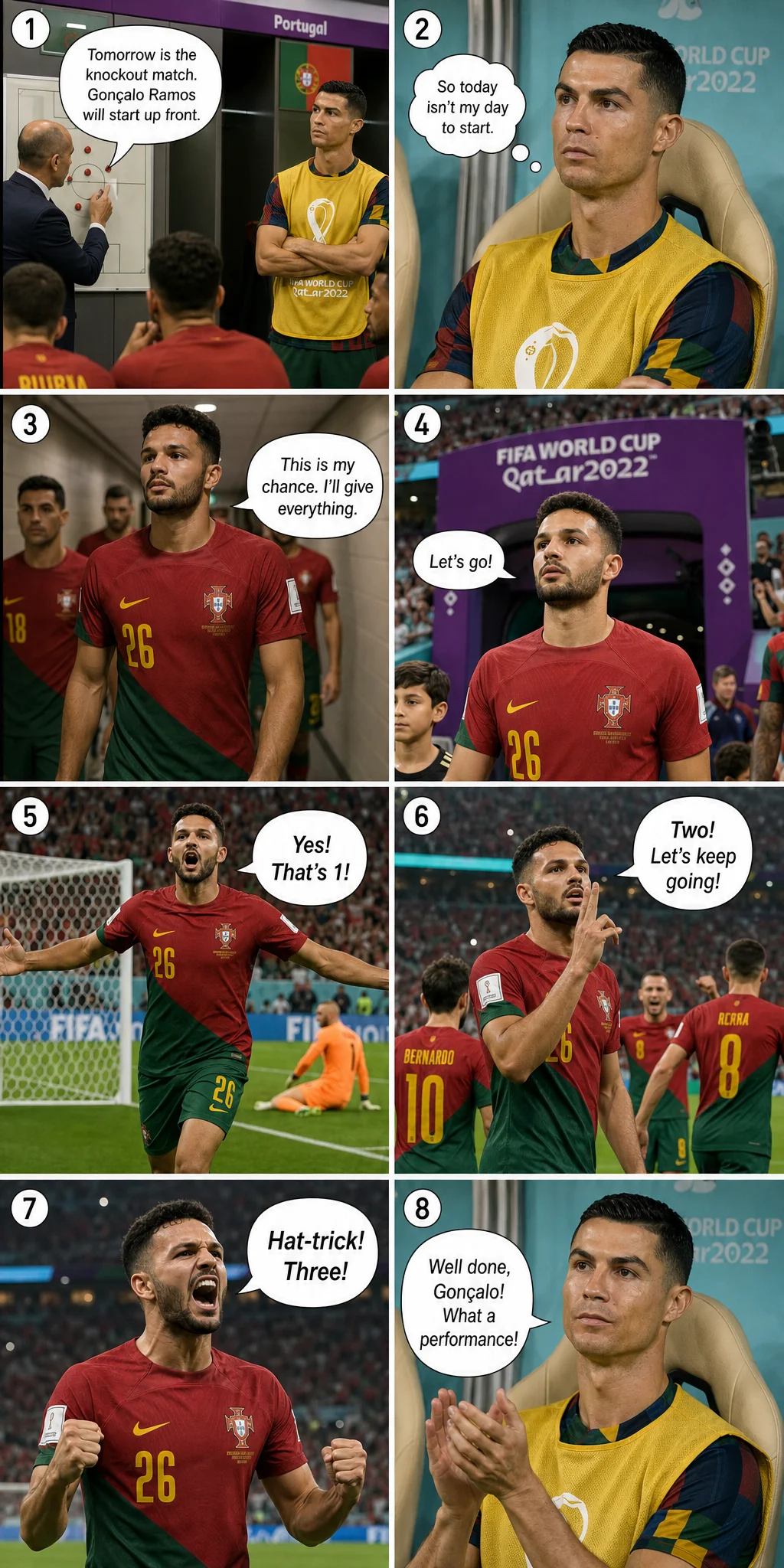
Fernando Santos did something on December 6th, 2022, that most international managers spend their entire careers avoiding. He dropped Cristiano Ronaldo. Not rested him. Not managed his minutes. Dropped him. For a World Cup round of sixteen match. Against Switzerland. And the man he chose to replace the most famous Portuguese athlete in history was a twenty-one-year-old named Gonçalo Ramos who, until that moment, had played a grand total of thirty-three minutes of international football. It was either the bravest decision in World Cup history or the stupidest. Forty-five minutes later, Ramos had scored a hat-trick, and Santos looked like the smartest man in Qatar.
I have thought about that decision a lot in the years since. Not just the decision itself — which was remarkable — but what it revealed about the psychology of international football, about the weight of legacy, about the difficulty of letting go. Santos had managed Portugal since 2014. He had won the European Championship in 2016, the nation's first major trophy. He had won the Nations League in 2019. He had built his entire tenure around Ronaldo — the system, the tactics, the culture, all designed to maximize the output of a player who had scored more international goals than anyone in history. And then, at the World Cup, in a knockout match, he looked at his team sheet and decided: not today.
The context, as always, matters. Portugal had navigated their group — Ghana, Uruguay, South Korea — with the kind of functional efficiency that wins tournaments but does not win admirers. Two wins, one defeat, qualification secured before the final match. But the performance against South Korea had been a warning. Ronaldo, substituted in the sixty-fifth minute, had reacted poorly — gesturing at the bench, muttering as he walked off, the body language of a man who could not understand why the game was continuing without him. The Portuguese press, which had spent two decades treating Ronaldo as a national monument rather than a footballer, began to ask questions they had previously considered unaskable. Was he still undroppable? Should he be?
Santos, to his eternal credit, answered the question definitively. When the team sheet was released an hour before kickoff against Switzerland, Ronaldo's name was not on it. The Lusail Stadium press box — where I was sitting, surrounded by journalists who had covered Ronaldo for years — went quiet, then loud, then quiet again. The news spread through the stadium like electricity through water. Ronaldo benched. For a World Cup knockout match. The man who had scored in five different World Cups, the man who had defined Portuguese football for a generation, the man whose face was on every billboard within a fifty-kilometre radius of Doha — sitting on the bench, wearing a substitute's bib, watching.
Ramos, the replacement, was not a household name. He played for Benfica, had scored fourteen goals that season, and was considered a promising prospect rather than a finished product. His style was different from Ronaldo's — less explosive, less theatrical, but more complete. He could hold the ball up, link play, press from the front. He was a modern centre-forward in a way that Ronaldo, at thirty-seven, could no longer be. The question was not whether Ramos was a better player than Ronaldo. The question was whether Ramos, in this match, against this opponent, was a better fit for the team Santos wanted to field. Santos had decided he was.
The match began, and within seventeen minutes Ramos had scored his first World Cup goal. João Félix — the eternally promising Félix, whose career reads like a novel that keeps threatening to become interesting without ever quite managing it — played a pass into the left channel. Ramos received it with his back to goal, turned in one motion, and smashed a shot past Yann Sommer at the near post. The angle was impossible. The power was absurd. The ball went through Sommer — through him, not past him — as if the Swiss goalkeeper was made of air. 1-0 Portugal. Ramos wheeled away, arms spread, face a mask of joy and disbelief. Somewhere on the Portuguese bench, Ronaldo's expression was unreadable. Perhaps that was the point.
The second goal came in the 51st minute. A cross from the right. Bruno Fernandes, the provider. Ramos, arriving at the near post, steered the ball into the net with the composure of a man who had been doing this at World Cups for a decade rather than for fifty minutes. 3-0 Portugal — Pepe had scored the second from a corner, the old warrior adding another chapter to his improbable story — and the match was effectively over. Switzerland, well-organized and stubborn but fatally limited, had no answer to Portugal's movement. The Swiss defence, which had been one of the tournament's most reliable units, looked like a wall that had been built on sand.
The third goal was the one I remember most clearly. The 67th minute. A through ball from Félix — his best moment in a Portugal shirt, perhaps his best moment ever — splitting the Swiss defence. Ramos was through, one-on-one with Sommer, the stadium holding its breath. Most strikers, in that position, would have shot early. Would have panicked. Would have remembered that they were a twenty-one-year-old making their first World Cup start and done something stupid. Ramos did none of these things. He waited. He waited for Sommer to commit, for the goalkeeper to go to ground, for the angle to open. And then he chipped the ball over Sommer's outstretched body with the delicacy of a man placing an egg on a shelf. The ball floated into the net. 4-0. Hat-trick. First World Cup start. Thirty-three minutes of previous international experience. The most complete centre-forward performance Portugal had produced since Eusébio.
Rafael Leão, coming off the bench, added a fifth — a curling finish that bent around Sommer like a question mark. Switzerland scored a consolation through Manuel Akanji, a goal that preserved dignity but changed nothing. The final score was 6-1, the most emphatic World Cup knockout victory Portugal had ever recorded, and Ronaldo had watched all of it from the bench.
He did come on, eventually. The 74th minute. The Lusail Stadium rose — not as one, exactly, but in sections, the applause rippling through the crowd like a stadium wave. Ronaldo jogged onto the pitch with the expression of a man who was being asked to smile for a photograph he had not agreed to pose for. He touched the ball a few times. He had a goal disallowed for offside — his run fractionally too early, the margins that had once favoured him now working against him. He did not sulk. He did not gesture at the bench. He played, and then he walked off, and the cameras followed him because the cameras always followed him.
The aftermath of the match was, in its way, more interesting than the match itself. The Portuguese press — which had spent the previous week asking whether Santos was making a mistake — now asked whether Ronaldo would ever start for Portugal again. The answer, it transpired, was yes: Ronaldo started the quarterfinal against Morocco, Portugal lost 1-0, and Santos's moment of bravery was reinterpreted as a moment of hesitation. The manager was sacked after the tournament. Ronaldo moved to Saudi Arabia. The Ramos gambit, which had seemed like the beginning of a new era, turned out to be the end of an old one — the final, glorious, unsustainable flash of a Portugal team that could have been something different but chose, in the end, to be what it had always been.
And yet the hat-trick remains. Three goals in a World Cup knockout match, by a twenty-one-year-old making his first start, in a stadium built for the most important matches in the sport's calendar. You can argue about what it meant — about whether it was a passing of the torch or a temporary aberration, about whether Ramos was the future or merely a footnote. But you cannot argue about what happened. Gonçalo Ramos, on December 6th, 2022, scored a hat-trick in the World Cup round of sixteen against Switzerland. For ninety minutes, Portugal looked like a team that had finally freed itself from the gravity of its own history. What happened next is another story. What happened in Lusail was a reminder that football, at its best, is about the courage to imagine something different. Santos imagined it. Ramos delivered it. The rest is politics.