

The Story of Jerseys: How Colours and Numbers Became Legends
The football jersey has evolved from simple woolen stripes into a billion-dollar canvas of national identity, fabric innovation, and cultural symbolism. This feature traces the story from first international kits through polyester revolutions, iconic designs burned into memory, the commercial forces shaping modern jerseys, and why what players wear has become inseparable from how nations are remembered at the tournament.
Published: June 8, 2026
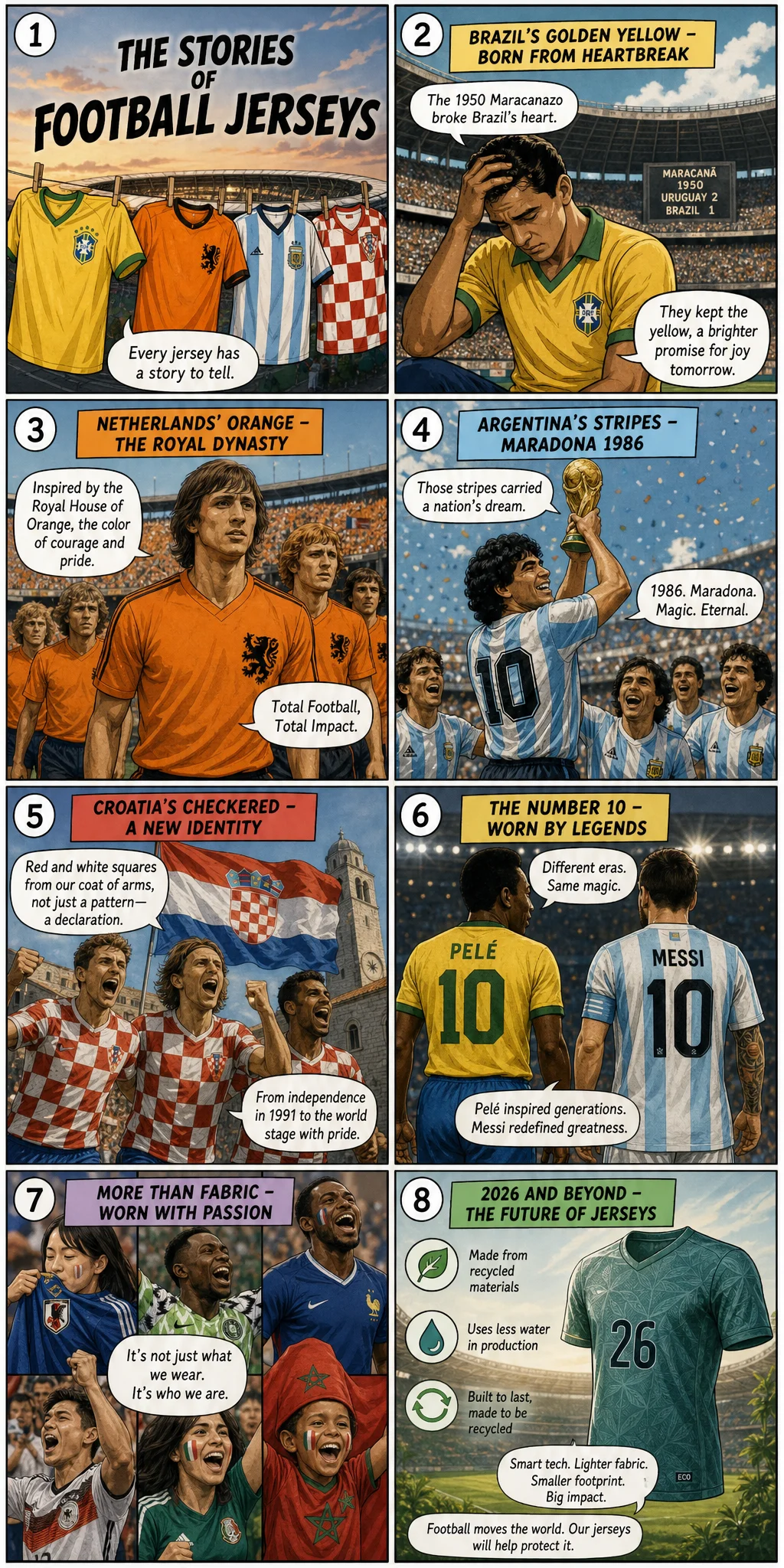
Comic content and match statistics are for entertainment purposes only and may contain inaccuracies. For Accurate Data, please refer to the reference's official website.
The Story of Jerseys: How Colours and Numbers Became Legends
The football jersey is the only item of clothing that grown men and women weep over. No other garment carries the weight of a nation's dreams, the memory of a grandfather's loyalty, or the precise coordinates of a moment in history -- Uruguay 1930, white shirts with blue trim, the first silhouette of a world champion. The jersey is at once the most disposable item of mass-produced sportswear and the most sacred object in the secular religion of football. How it arrived at this strange dual identity is a story that begins not with Adidas or Nike but with the Victorian class system, the invention of the sewing machine, and a Hungarian statistician who never kicked a ball in his life.
In the beginning, there were no numbers, and there were barely colours. The first codified team uniforms emerged in English public schools during the 1860s -- not for the benefit of spectators but so that schoolboys could distinguish friend from foe in the chaos of twenty-two bodies chasing a single leather sphere. The colours chosen were often the colours of the school house or the local aristocratic family: Eton's light blue, Harrow's dark blue, the thin stripes of Charterhouse. When these schoolboys graduated and formed the first football clubs, they carried the habit with them. Blackburn Rovers took their blue-and-white halves from the shirts worn by the pupils of Malvern College who had introduced the game to the Lancashire mill town. The jersey, from its very origin, was a marker of class, education, and belonging -- a tribal banner before anyone thought to call it that.
Numbers arrived much later, and from a profoundly unlikely source. In 1928, as the first World Cup was being planned, the numbering of players one through eleven according to their positions was proposed -- the attribution is disputed among historians, with some pointing to the Hungarian coach Arpad Csanadi, others to the Austrian manager Hugo Meisl. The idea was not aesthetic but functional: referees and spectators needed to identify players from a distance. What Csanadi and his contemporaries could not have foreseen was that they were creating a vocabulary. The number ten was not yet the number ten -- it would take the intervention of a Brazilian teenager named Pele, then an Argentine chain-smoker named Maradona, then a slender Frenchman named Zidane, to transform that digit into a job description, a burden, an expectation, a myth. By the time a Croatian with a gift for geometry named Modric received the number ten for Real Madrid, the digit had accumulated so much cultural weight that it practically glowed on the back of the shirt.
The evolution of materials mirrors the evolution of the game itself. The heavy cotton jerseys worn by the Uruguayans in 1930 absorbed rain like a sponge: by the end of a wet match, players carried an extra two kilograms on their backs. The 1950s brought synthetic blends, and by 1970, when Brazil dazzled the world in Mexico, their iconic yellow shirts were made from a lightweight polyester that shimmered under the Azteca sun. Each advance in textile engineering corresponded to an advance in how the game was played: lighter shirts for faster players, tighter cuts for the pressing systems that would emerge in the 1970s, moisture-wicking fabrics for the high-tempo, high-sweat intensity of the modern Champions League. The 2010 World Cup introduced shirts made from recycled plastic bottles -- eight bottles per jersey, Nike announced -- and suddenly the football shirt became an environmental statement as well as a tribal one. By 2026, the journey is complete: jerseys will contain embedded microchips transmitting biomechanical data in real time, the cotton strip of 1930 having evolved into a wearable computer that reports its wearer's every sprint and heartbeat to a coaching staff on the sideline.
The sponsors came in the 1970s, and with them the first great moral panic about the desecration of the sacred colours. When Eintracht Braunschweig placed the Jagermeister stag on their shirts in 1973 -- the first Bundesliga club to do so -- purists howled. Within a decade, every major club in Europe had a corporate logo emblazoned across the chest, and the jersey had completed its transformation from amateur emblem to commercial billboard. Yet the strange alchemy of football meant that even the most crassly commercial shirt could acquire deep emotional meaning. A Manchester United fan who wore the classic Sharp-sponsored shirt of the 1990s was not celebrating a Japanese electronics manufacturer; he was celebrating Eric Cantona's collar, Roy Keane's ferocity, and a period of dominance that coincided with his own youth. The sponsor's logo became inseparable from the memory.
On the pitch, numbers continued their semantic expansion. The 1980s and 1990s saw the rise of the squad number system, decoupling a player's number from his position. David Beckham wore 7 for Manchester United and then 23 for Real Madrid -- the latter chosen in tribute to Michael Jordan, a transatlantic cultural borrowing that would have baffled the Hungarian coaches of 1928. Cristiano Ronaldo turned the number 7 into a global personal brand, trademarking "CR7" and selling underwear, fragrance, and hotels under the banner of a digit. The number had ceased to be a positional indicator and had become a piece of intellectual property, an asset class, a trademark registered in forty countries. The journey from functional identifier to commercial brand was complete.
What endures, beneath the sponsors and the sensors, is the colour. The yellow of Brazil is not any yellow: it is canary yellow, a shade chosen in 1954 by a nineteen-year-old illustrator named Aldyr Garcia Schlee, who won a newspaper competition to design a new shirt after the trauma of the Maracanazo -- the 1950 final defeat that had compelled Brazil to abandon its white shirts forever. The orange of the Netherlands is not a marketing choice but the colour of the House of Orange-Nassau, the Dutch royal family, a relic of a sixteenth-century principality in southern France. Argentina's blue-and-white stripes are the colours of the sky on the day of the May Revolution in 1810, the first step toward independence from Spain. Nigeria's green is the green of its forests and agricultural wealth, chosen at independence in 1960. Every shirt tells a story that long predates the sport, and the genius of the football jersey is that it compresses centuries of history, politics, and identity into eleven rectangles of polyester running across a green field.
The 2026 World Cup will crown a new champion in a new jersey. Somewhere in the stands, a child will buy a replica shirt that will hang in his wardrobe for thirty years -- a talisman of a summer that changed his life, a piece of fabric that becomes a memory. The microchips will log every sprint and every heartbeat, but they will not capture why he wears it. That mystery -- the alchemy by which coloured fabric becomes a second skin, a pledge of allegiance, a container for joy and grief -- remains the oldest and most durable magic of the game. The jersey endures because it is never really about the jersey. It is about what you were wearing the first time football broke your heart, and what you put on the next morning, when it had somehow stitched you back together.