

Mexico 2026: The Opening Ceremony That Shook the Azteca
On June 11, 2026, Shakira, Andrea Bocelli, and the ghosts of Pelé and Maradona converged on the Estadio Azteca for the third opening ceremony in its history — a night of mariachi, fireworks, and 48 flags that launched the biggest World Cup ever played.
Published: June 12, 2026
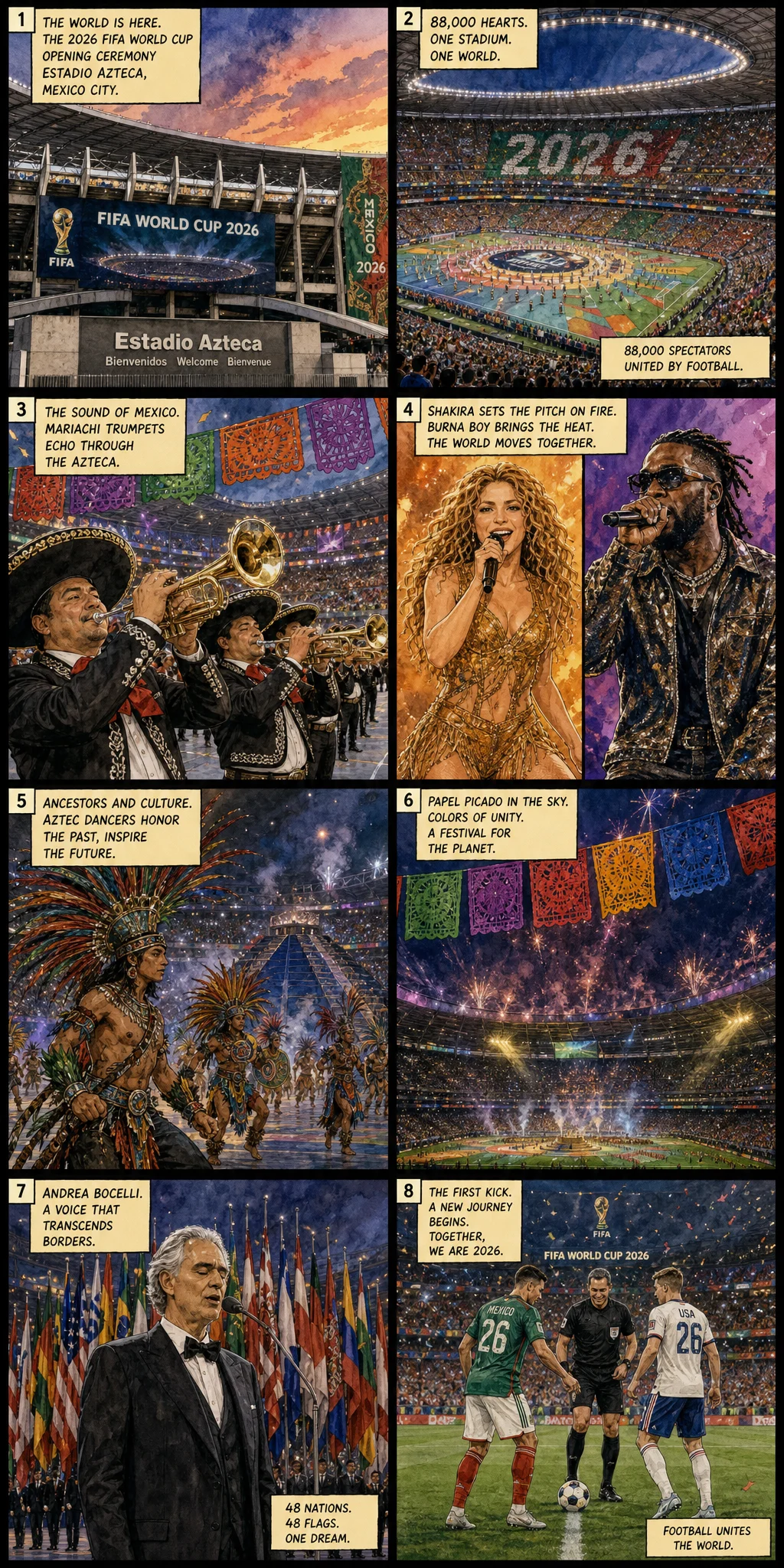
Comic content and match statistics are for entertainment purposes only and may contain inaccuracies. For Accurate Data, please refer to the reference's official website.
Mexico 2026: The Opening Ceremony That Shook the Azteca
On June 11, 2026, at 11:30 in the morning local time, the Estadio Azteca began to hum. Not the hum of eighty-eight thousand voices — that would come later, when Mexico and South Africa walked onto the pitch for the tournament's opening fixture — but something deeper: the low, anticipatory frequency of a stadium that has twice before been asked to declare a World Cup open and understood, in its concrete bones, the weight of the moment. Marco Balich, the Italian creative director whose fingerprints are etched across multiple Olympic opening ceremonies, had been given a brief of almost impossible breadth: honor Mexico's ancient football lineage, celebrate the first forty-eight-team tournament in history, and launch three nations' shared hosting of the world's most-watched sporting event. Somewhere between the mariachi trumpets and the fireworks, he pulled it off.
The ceremony opened with a cascade of papel picado — those delicate, perforated paper banners that adorn every Mexican celebration from village baptisms to national holidays — descending from the stadium roof in sheets of gold, magenta, and turquoise. It was a gesture at once intimate and monumental: the domestic language of Mexican festivity projected onto a global canvas. Dancers in Aztec-inspired regalia moved across the pitch in geometric patterns that evoked the ancient ball game of ōllamaliztli, the pre-Columbian ritual sport played on stone courts — a reminder, for those willing to read the semiotics, that organized competition on this land predates not merely FIFA but the European presence in the Americas altogether. The ceremony understood, as the best opening ceremonies always do, that national identity is not a single story but a palimpsest of competing narratives, and that the World Cup provides a rare occasion when a nation may present all of them simultaneously.
Then came the music — and if the visual language belonged to Mexico's past and present, the sonic landscape was unmistakably global. Andrea Bocelli delivered the official World Cup anthem "DNA" alongside EJAE, David Guetta, and Megan Thee Stallion, an improbable quartet whose combined stylistic range — operatic tenor, electronic production, hip-hop — functioned as an accidental metaphor for the forty-eight-team tournament itself: unwieldy, occasionally dissonant, but possessed of a strange and undeniable coherence when the volume was high enough. Shakira and Burna Boy premiered "Dai Dai," the tournament's official song, and the Azteca — which had swayed to Pelé's Brazil in 1970 and roared at Maradona's audacity in 1986 — now vibrated to Afrobeats and Colombian pop. This was not your grandfather's World Cup ceremony, nor, pointedly, your father's: J Balvin, Alejandro Fernández, Belinda, Danny Ocean, Lila Downs, Los Ángeles Azules, and Maná formed a Latin music block that doubled as a declaration of the Spanish-speaking world's centrality to the global game. South African singer Tyla appeared as a gesture of grace toward Mexico's opening opponent; the tournament, even in its ceremonial preamble, was already practicing the diplomacy of inclusion that its expanded format was designed to embody.
The politics of the moment were inescapable, and to the ceremony's credit, they were not escaped. The Estadio Azteca has been officially renamed "Mexico City Stadium" for the tournament — FIFA's long-standing prohibition on commercial venue names surviving into yet another edition — but no bureaucratic label can strip the venue of its historical aura. This was the stadium where Brazil announced the beautiful game to a color-television audience in 1970, where Maradona conjured the Hand of God and the Goal of the Century in the space of four minutes in 1986, where the world's football imagination has been most consistently reshaped. To host a third opening ceremony here is not merely an administrative decision; it is an acknowledgment that certain places in sport acquire a meaning independent of their physical coordinates, that the Azteca is less a building than a pilgrimage site.
The ceremony's most affecting passage came when the forty-eight participating national flags were carried onto the field by children — a logistical challenge that required nearly as much choreography as the musical performances. The expanded tournament has been criticized, not without justification, as FIFA's institutional greed dressed in the language of inclusivity; the quality of group-stage football, the argument runs, will be diluted by the presence of nations who in previous cycles would have watched from home. Yet watching those forty-eight flags flutter in the thin air of two thousand two hundred meters, the argument felt suddenly abstract, even churlish. A World Cup is not merely a competition to determine the world's best football team; it is, and has always been, a ritual of global belonging, a quadrennial affirmation that the planet's most universal cultural practice can momentarily transcend the divisions it does not heal.
When the formalities concluded — FIFA President Gianni Infantino and Mexican President Claudia Sheinbaum delivering the official welcome from a podium bathed in golden light — the ceremony gave way to its inevitable and necessary dissolution. The pitch cleared, the performers retreated, and on the grass of the Azteca there remained only a ball, a referee, and twenty-two players representing the host nation and South Africa. The ceremony had lasted ninety minutes, roughly the duration of a football match, and like a football match it had contained moments of transcendent beauty alongside passages of mild confusion, flashes of genuine emotion beside instances of orchestrated sentiment. It was, in other words, a faithful reflection of the sport it was inaugurating — imperfect, excessive, occasionally profound, and utterly incapable of being reduced to a simple judgment.
Three nations, three opening ceremonies: the Azteca on June 11, BMO Field in Toronto and SoFi Stadium in Los Angeles on June 12. The tournament will run through July 19, one hundred and four matches spread across sixteen host cities in an unprecedented logistical sprawl. But first, there was this: a stadium that has seen everything football can offer, filling once more with noise and light and hope, eighty-eight thousand people and eight hundred million more watching across the planet, and a single trumpet note hanging in the high-altitude air, waiting — as the world waited — for the whistle that would start it all.