

Group A Power Analysis: Mexico's Fortress, Asia's Ambition, and the Underrated Czechs
Group A delivers immediate drama: Mexico carrying co-host pressure, South Africa's athletic ambition, South Korea's relentless intensity, and Czechia's disciplined organization. This analytical preview examines each team's tactical identity, head-to-head dynamics, likely qualification scenarios, must-watch duels, and why the opening group may produce the round's most unpredictable qualification battle across three high-stakes matchdays.
Published: June 8, 2026
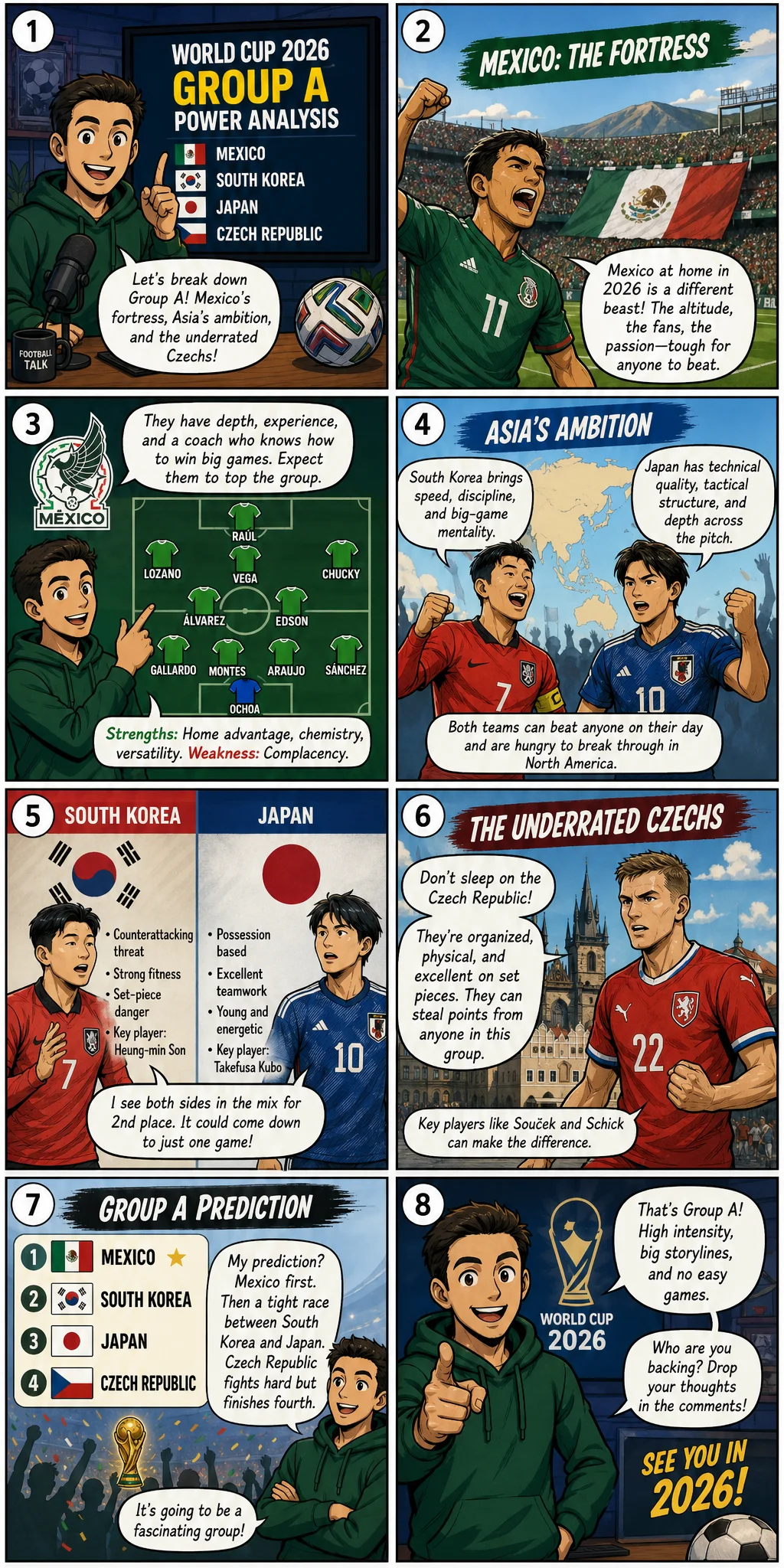
Comic content and match statistics are for entertainment purposes only and may contain inaccuracies. For Accurate Data, please refer to the reference's official website.
Group A: Mexico's Fortress and the Azteca's Opening Match
I first stood inside the Estadio Azteca on a Tuesday afternoon in late autumn, when the stadium was empty and the pitch was being watered by men who moved with the slow precision of groundskeepers who have been doing this work for thirty years. The silence was the first thing that struck me. The second was the altitude -- 2,250 metres above sea level, the air noticeably thinner, my lungs working harder just to climb the steps to the press box. The third was the sheer scale of the place: a concrete bowl that seats over eighty-seven thousand people, built in the 1960s on the lava fields of the Tlalpan borough, a structure so vast that it generates its own microclimate. When the Azteca is full -- and it will be full on the evening of June 11, 2026, for the opening match of the World Cup -- the noise does not simply fill the space. It becomes the space. The sound traps inside the bowl until it is no longer sound but physical force, vibrating through concrete and bone with equal indifference.
Mexico will play that opening match, and the weight of it is difficult to overstate. This is a nation that has hosted two World Cups -- 1970 and 1986 -- and in both cases saw its team exit in the quarterfinals, a ceiling that has become a national neurosis. The quinto partido, the fifth match, the quarterfinal breakthrough: generations of Mexican footballers have been raised with this phrase as both aspiration and burden. Rafa Marquez could not reach it. Hugo Sanchez could not reach it. Cuauhtemoc Blanco, the last truly great Mexican number ten, could not reach it. The 2026 team, led by Edson Alvarez in midfield and Santiago Gimenez in attack, carries the accumulated disappointment of half a century into a tournament played on home soil. The opening match is not merely the first game of the World Cup. It is the first public test of whether this generation is different from all the ones that came before.
The Azteca itself is the group's most formidable participant. It has hosted two World Cup finals -- 1970, when Pele's Brazil played football from another dimension, and 1986, when Maradona played football from another universe. It has witnessed the Hand of God and the Goal of the Century, the coronation of the greatest player of the twentieth century and the consecration of the greatest team. The stadium is not neutral ground in any meaningful sense. Visiting teams must contend not only with eighty-seven thousand Mexican supporters but with the oxygen deficit that at 2,250 metres reduces aerobic capacity by approximately fifteen percent. Teams that try to press high at the Azteca discover, usually around the sixty-fifth minute, that their legs have stopped responding to instructions from their brains. Mexico's players train at altitude by default. Their opponents do not. The home advantage at the Azteca is not psychological. It is physiological, measurable in the oxygen saturation of arterial blood and the lactate accumulation in fatigued quadriceps.
South Korea arrives as Asia's most consistent World Cup performer -- eleven consecutive tournaments, a record of quiet competence that no other Asian nation approaches. Son Heung-min is thirty-three now, playing his fourth World Cup, his face still the most recognisable in Asian football, his game having evolved from explosive winger to complete forward. The supporting cast lacks the star power of the 2002 semifinal generation, but the collective organisation that has become South Korea's institutional identity remains intact. The Czech Republic brings the group's most tactically disciplined unit, a squad built on the defensive organisation that Czech football has produced since the days of the great Masopust. South Africa carries the legacy of 2010, the only African World Cup host, returning to the tournament stage where the vuvuzela once provided the soundtrack to an entire summer.
What makes Group A compelling is not the quality of its participants -- there are stronger groups in this tournament -- but the specific pressure that only an opening match can generate. The first game of a World Cup establishes the emotional architecture of the entire event. A comfortable Mexico victory settles the host nation's nerves and releases a month of accumulated tension. A draw introduces doubt. A defeat is unthinkable in its consequences -- not merely for the standings but for the psychological state of a country that has been waiting for this tournament since 2018, when the joint bid was awarded, and in a deeper sense since 1986, when the Azteca last hosted the world and Maradona last danced across its grass. The opening match will not determine which teams advance from Group A. It will determine the emotional temperature of Mexico's entire tournament. The Azteca, after forty years without World Cup football, will be ready. The question is whether the team that walks out of its tunnel will be ready too.