

Group B Power Analysis: Canada's First Leaf, Swiss Precision, and Two Returning Nations
Group B presents a fascinating collision: Canada's co-host momentum, Bosnia's dragon spirit, Qatar's Asian Cup confidence, and Switzerland's tournament-proven organization. This preview analyzes tactical matchups, travel and climate factors affecting group play, the players deciding qualification, and why this group represents the expanded format's most intriguing balance of pedigree and rising ambition.
Published: June 8, 2026
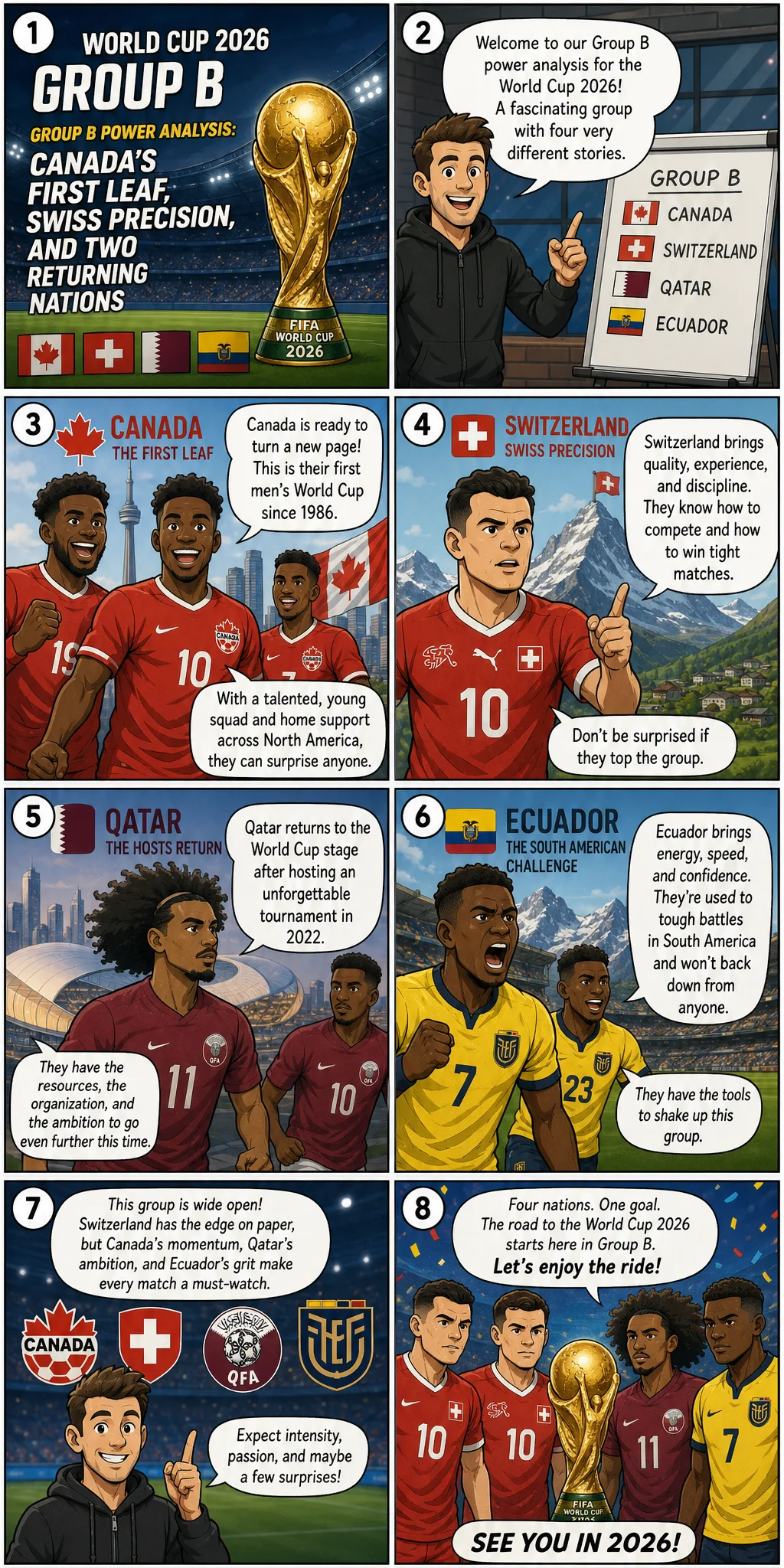
Comic content and match statistics are for entertainment purposes only and may contain inaccuracies. For Accurate Data, please refer to the reference's official website.
Group B: Canada Hosts, Switzerland's Precision, Bosnia's Return
To understand what Canada hosting World Cup football means, you must first understand that this is a country where, for most of the twentieth century, the question "what is the national sport?" could be answered without hesitation and without reference to a round ball. Hockey was not merely the dominant sport; it was a component of national identity, woven into the mythology of frozen ponds and backyard rinks and Saturday nights spent watching the Montreal Canadiens. Football existed on the margins -- played by immigrant communities, watched on television by enthusiasts who understood they belonged to a minority, administered by a federation that lurched from crisis to crisis with the grim regularity of a metronome. The 1986 World Cup appearance, Canada's only previous qualification, was an anomaly produced by a weak CONCACAF region and a moment of organisational competence that proved unsustainable. The team lost all three matches, scored zero goals, and returned home to a country that barely noticed they had been away.
The 2026 Canada is unrecognisable from that 1986 predecessor, and the transformation is the result of forces that extend far beyond sport. Three decades of immigration have reshaped the country's demographics, and with them its football culture. Alphonso Davies, the Bayern Munich left-back who grew up in Edmonton after being born in a Ghanaian refugee camp to Liberian parents, embodies this new Canadian reality: a player whose personal biography spans three continents, whose game was developed in the MLS academy system that Canada's 1986 generation could only dream of, and whose presence on a World Cup pitch in Vancouver or Toronto will represent not merely athletic achievement but a statement about what Canada has become. Jonathan David, born in Brooklyn to Haitian parents and raised in Ottawa, provides the finishing that Davies' creative runs demand. The squad is the most diverse in CONCACAF -- players with roots in Jamaica, Nigeria, Portugal, Chile, the Philippines -- and the diversity is not a talking point but the structural reality of a team assembled from the specific immigration patterns that have defined twenty-first-century Canada.
Switzerland arrives with the institutional consistency that has become its footballing signature. The Swiss have qualified for every major tournament since 2014, and they have advanced from the group stage in each of the last three World Cups -- a record of quiet competence unmatched by any European nation outside the traditional powers. The system, overseen by Murat Yakin, is built on defensive organisation and the technical quality of a midfield anchored by Granit Xhaka, whose career has traced a remarkable arc: from talented but volatile young midfielder at Arsenal to the controlling intelligence of Bayer Leverkusen's historic Bundesliga title, the player who finally learned to channel his intensity into constructive rather than destructive expression. Switzerland will not win the World Cup. But Switzerland will be difficult to beat -- frustrating, disciplined, the kind of opponent that exposes the difference between teams that can create chances and teams that can finish them. In a group where the margins will be thin, the Swiss capacity for drawing the energy out of a match may prove decisive.
Bosnia and Herzegovina's return to the World Cup carries emotional weight that transcends the group's competitive dynamics. The 2014 tournament was the nation's first as an independent state, an achievement that, in the context of the 1990s war and its aftermath, functioned as a form of national catharsis. The current squad lacks the star power of that 2014 generation -- there is no Edin Dzeko, no Miralem Pjanic at his peak -- but the collective spirit that Bosnian football has cultivated through adversity remains intact. The team that takes the field in 2026 carries the memory of a war that ended three decades ago and the hope of a nation still navigating its postwar identity. Football, in Bosnia, has always been more than football. The World Cup stage, for a country of three million people still scarred by the twentieth century's ugliest conflict on European soil, is a platform for something that cannot be captured in a group standings table.
Canada's hosting duties extend across Vancouver's BC Place and Toronto's BMO Field -- two venues that, in a different era, would have been filled for hockey or Canadian football. That they will host World Cup matches, with the world watching, is the most tangible evidence of a transformation that extends beyond the national team. The country that once treated football as a foreign import now hosts the world's biggest sporting event on its own soil, with its own team, in front of its own people. The 36-year wait between World Cup appearances is over. The tournament played on Canadian soil ensures the waiting will never be that long again.