

Group D Power Analysis: United States (co-host), Paraguay, Australia, Turkey
Group D brings together South American heavyweights Uruguay and Ecuador, European dark horse Turkey, and defending champion Argentina — an early candidate for the Group of Death. This detailed preview analyzes every tactical clash, altitude and travel factors, historical rivalries adding emotional charge, and why surviving this group may leave the victors either battle-hardened or physically depleted.
Published: June 8, 2026
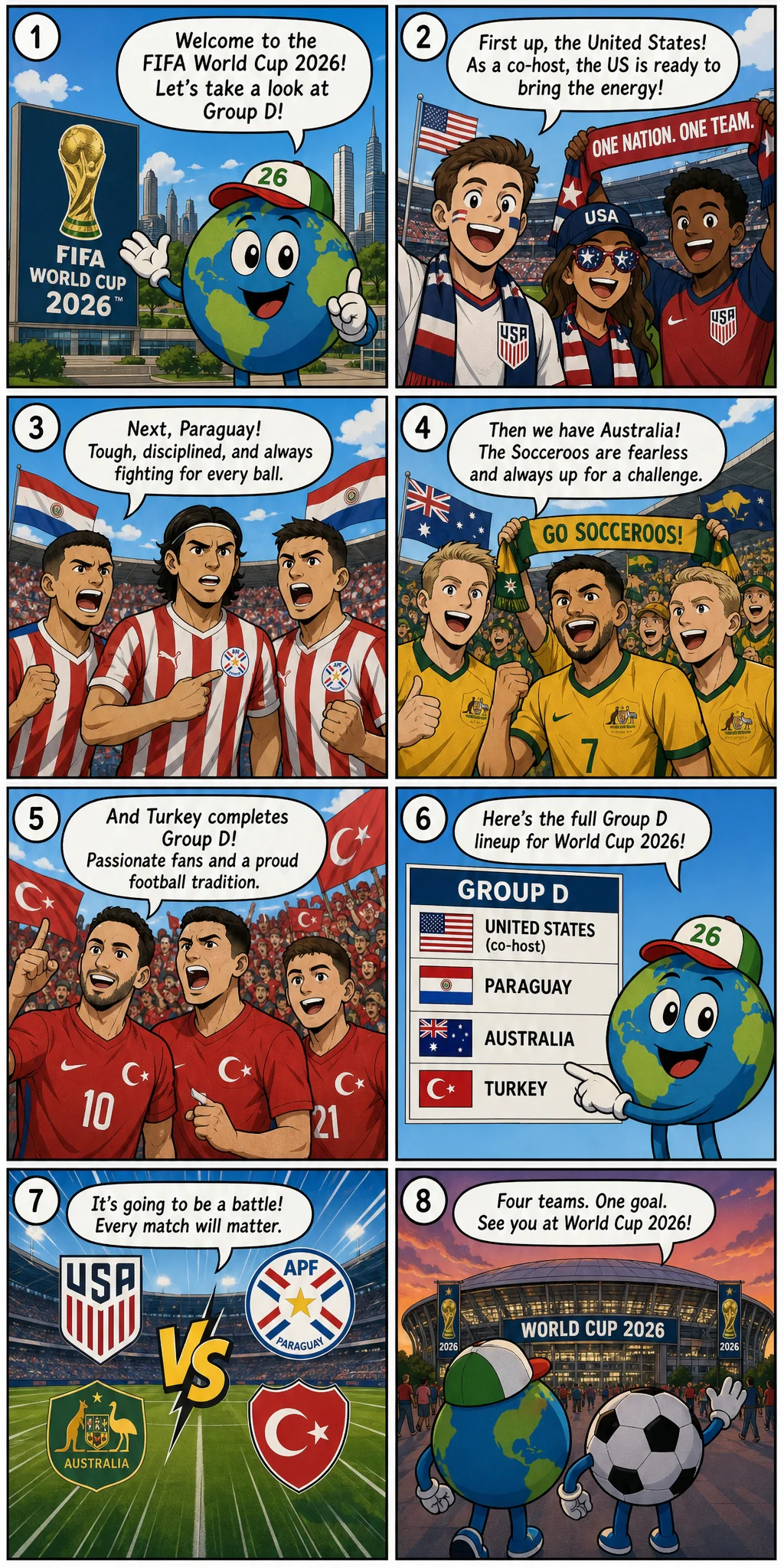
Comic content and match statistics are for entertainment purposes only and may contain inaccuracies. For Accurate Data, please refer to the reference's official website.
Group D: USA Hosts, Paraguay, Australia, Turkey — The Host Pressure Cooker
The United States enters the 2026 World Cup as co-host with a squad deeper than any previous American generation and a set of expectations that no American men's team has ever confronted. The dynamic is unprecedented in the program's history: a World Cup on home soil, a player pool populated by competitors at Europe's elite clubs, and a sports media ecosystem that has spent two years constructing a narrative of imminent breakthrough. The gap between reasonable ambition and public expectation is the space where American tournament campaigns have historically collapsed.
Gregg Berhalter's system, refined across a full World Cup cycle and the 2022 round-of-sixteen appearance, is built around a midfield trio that would start for most European nations. Weston McKennie provides the box-to-box intensity that disrupts opposition buildup and creates second-ball opportunities in transition. Tyler Adams operates as the single pivot, a destroyer whose positional discipline allows the more creative midfielders ahead of him to take risks without exposing the back line. Gio Reyna, when fit -- a qualification that has defined his career more than any tactical attribute -- provides the progressive passing and ball-carrying from central areas that the United States lacked during the conservative 2022 campaign. Christian Pulisic remains the attacking talisman, his movement from the left half-space creating the overloads that Berhalter's system is designed to exploit. Folarin Balogun's emergence as a reliable finisher addresses the most persistent weakness of the American program: the absence of a centre-forward who converts chances at an elite rate.
The tactical question is not whether the United States can create opportunities but whether it can manage the emotional architecture of a home World Cup. Host nations benefit from familiar environments, partisan crowds, and the elimination of transcontinental travel. They also suffer from the specific pressure of performing for an audience that has been told to expect success, in a media environment where context is the first casualty of expectation. The American team that played without burden in 2022 -- young, underestimated, freed by the low expectations of a public still learning the tournament's rhythms -- no longer exists. The 2026 version must play with the weight of a nation that now believes it should win.
Paraguay arrives as South America's most reliably awkward opponent, a team constructed around the defensive discipline that has defined Paraguayan football since the Chilavert era. Gustavo Alfaro's system is not designed to dominate possession or create high-volume chance generation. It is designed to frustrate, to compress space between the lines, to force opponents into the specific impatience that produces rushed passes and counterattacking opportunities. Paraguay is the opponent that every group favourite fears and every neutral ignores: capable of drawing against anyone, unlikely to beat the strongest teams, but perfectly calibrated to eliminate the second-tier contenders who cannot solve a compact low block under tournament pressure.
Australia qualifies with a squad that lacks the star power of the 2006 golden generation but possesses the collective organisation that has become Australian football's institutional identity. Graham Arnold's team presses in a mid-block, defends set pieces with the physicality expected of a squad populated by players from the Championship and lower Premier League, and transitions through the pace of its wide players. Turkey is the group's highest-variance participant: a nation with immense football passion, a domestic league that produces technically gifted attackers, and a persistent inability to translate either into consistent tournament performance. Hakan Calhanoglu, at thirty-two, operates in the twilight of his peak, his set-piece delivery and long-range shooting providing the specific weapons that can unlock a low block when nothing else works.
Group D will not produce the tournament's highest-quality football. It will produce the tournament's most revealing examination of the United States' readiness for the global stage. Host pressure is not a metaphor. It is a measurable variable, and the American team's capacity to absorb it will determine not merely whether it advances but whether the program's developmental trajectory survives contact with the expectations it has generated. The 2026 World Cup asks more of the United States than any previous tournament has asked of an American men's team. The answer will be written across three group-stage matches, each carrying the specific weight of a nation learning, in real time, whether its football ambitions are genuine or merely aspirational.