

Group C Power Analysis: Brazil, Morocco, Haiti, Scotland
Group C pits Brazil's pursuit of a sixth star against Morocco's continental pride, Haiti's improbable fairy tale, and Scotland's rekindled belief — narratives so rich no screenwriter would invent them. This preview dissects tactical identities, group-stage matchups, knockout-round implications, and the possibility this group produces the tournament's biggest shock before the knockout rounds begin.
Published: June 8, 2026
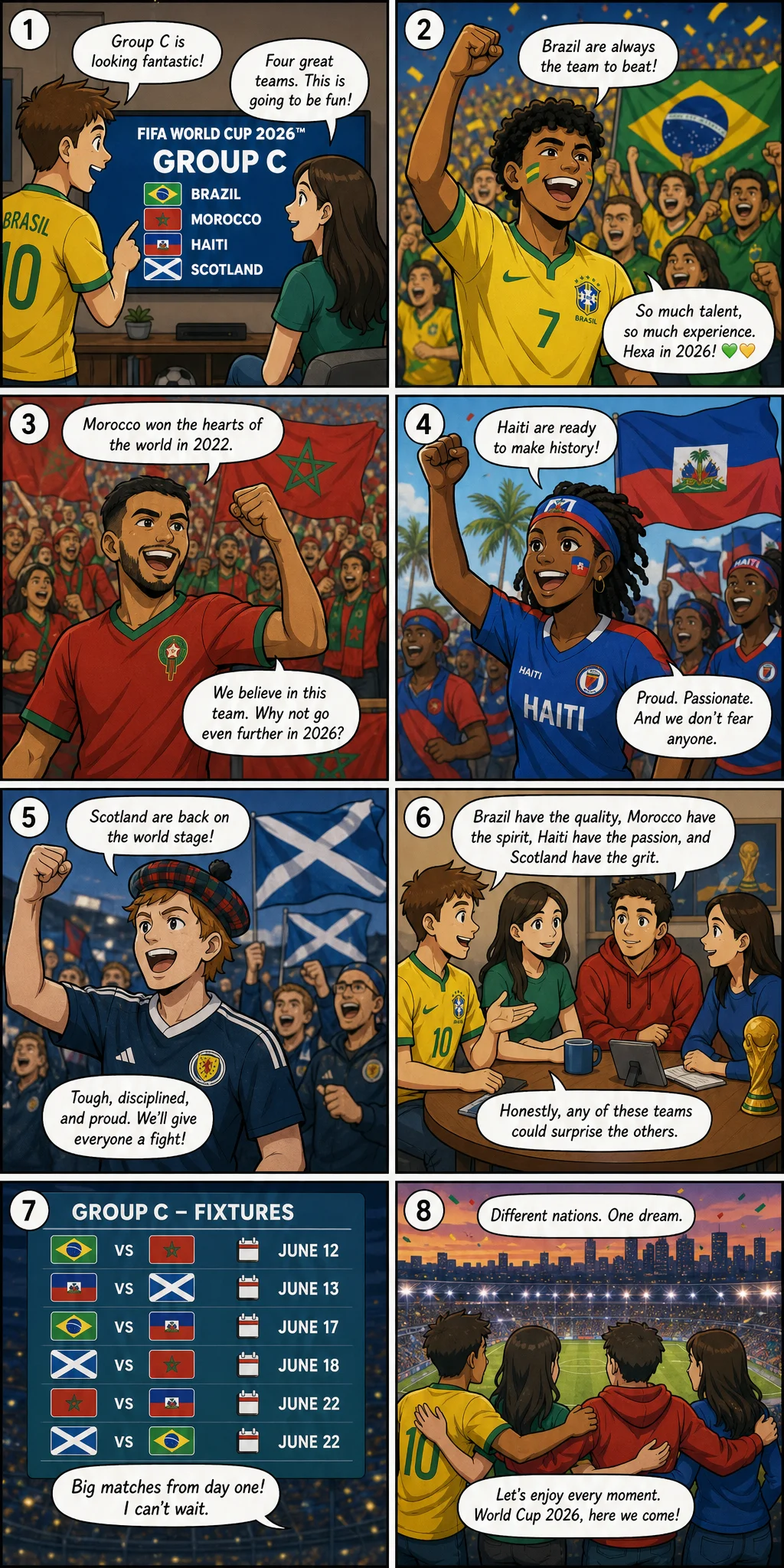
Comic content and match statistics are for entertainment purposes only and may contain inaccuracies. For Accurate Data, please refer to the reference's official website.
Group C: Brazil, Morocco, Scotland, Haiti
I was in Doha in December 2022 when Morocco beat Portugal in the quarterfinal, and I remember the sound. It was not the Moroccan fans -- though they were deafening, a red wall of noise that seemed to originate from somewhere deeper than the lungs. It was the silence on the Portuguese side, the specific silence of a nation processing the end of Cristiano Ronaldo's World Cup in real time. Morocco's run to the semifinal was not a fairy tale. It was the arrival of a football nation that had been building toward this moment for a decade, and the 2026 tournament asks the question that all breakthrough teams must eventually answer: was that the ceiling, or was it the foundation?
Group C assembles four nations whose relationship with the World Cup spans the tournament's entire emotional range. Brazil enters under Carlo Ancelotti -- the most decorated club manager in history, four Champions League titles, league championships in Italy, England, Spain, Germany, and France -- taking charge of the national team that defines World Cup football. The irony is rich: the nation most associated with joyous, improvisational, creative football has hired a manager whose genius lies not in tactical innovation but in making great players feel trusted and free. Ancelotti's Brazil is not the Brazil of 1970 or 1982. It is a Brazil built on structural solidity, on Vinicius Junior operating as the primary attacking weapon with Rodrygo providing complementary threat from the opposite flank, on a midfield that controls space before it controls possession. The question is whether this approach satisfies the Brazilian football public, which has always demanded beauty as well as victory. A World Cup without a Brazil that plays beautifully feels incomplete -- like an Italian meal without wine, like a Sunday without a square full of arguing old men. Ancelotti understands this. Whether his squad can deliver both structure and spectacle is the central tension of Brazil's campaign.
Morocco returns with something the 2022 squad lacked: institutional belief rather than improbable hope. Walid Regragui's team conceded one goal from open play across the entire knockout stage in Qatar -- one goal, across four matches against Spain, Portugal, and France, a defensive record that belongs in the same conversation as Italy 2006 and France 1998. Achraf Hakimi remains the best right-back in the world, a player whose combination of defensive recovery speed and attacking output has no equal at his position. The midfield, anchored by Sofyan Amrabat's tireless ball-winning and Azzedine Ounahi's elegant progression, provides the platform that made Morocco the most difficult team to play through in the last World Cup. The question is whether the attack can generate enough goals against the deep blocks that Morocco will face as a respected opponent rather than an underestimated underdog. Respect changes everything. Morocco must learn to play as the favourite -- a different skill entirely from playing as the disruptor.
Scotland returns after twenty-eight years. The longest World Cup drought in European football ends with a squad built around the overlapping threat of Andy Robertson and Kieran Tierney, the left-sided partnership that has been the foundation of Scotland's competitive revival under Steve Clarke. Scotland at a World Cup is an event that transcends sport. The Tartan Army travels not with hope but with the specific fatalism that Scottish football culture has refined across decades of near-misses and glorious failures. Haiti completes the group as a debutant, the poorest nation in the Western Hemisphere arriving at football's richest table -- a story that deserves its own chapter, its own space, its own acknowledgment that some World Cup journeys matter regardless of results. Group C is Brazil's to lose and Morocco's to prove. Everyone else is here to disrupt the narrative. Haiti's presence matters in ways that no group standings table can capture: a debutant from a nation that has endured earthquakes, political collapse, and generations of poverty, taking the field against Brazil at a World Cup. The Haitian players will kneel for the anthem knowing that a dozen million people in Haiti and its global diaspora are watching, that their every touch represents something larger than football. Scotland's supporters will drink Toronto dry regardless of results. Morocco's fans will travel in numbers that rival the host nations. The group that contains the tournament's widest range of ambition opens with each nation carrying a different definition of what success would mean, and the beauty of the World Cup group stage is that all four definitions can coexist -- until the first whistle blows and only the football remains.