

Group K Power Analysis: Portugal, DR Congo, Uzbekistan, Colombia
Group K is a cartographic argument disguised as a football draw. Portugal, the westernmost nation of continental Europe, a small rectangle of Iberian coast that has produced more world-class footballers per capita than any country except Uruguay and
Published: June 8, 2026
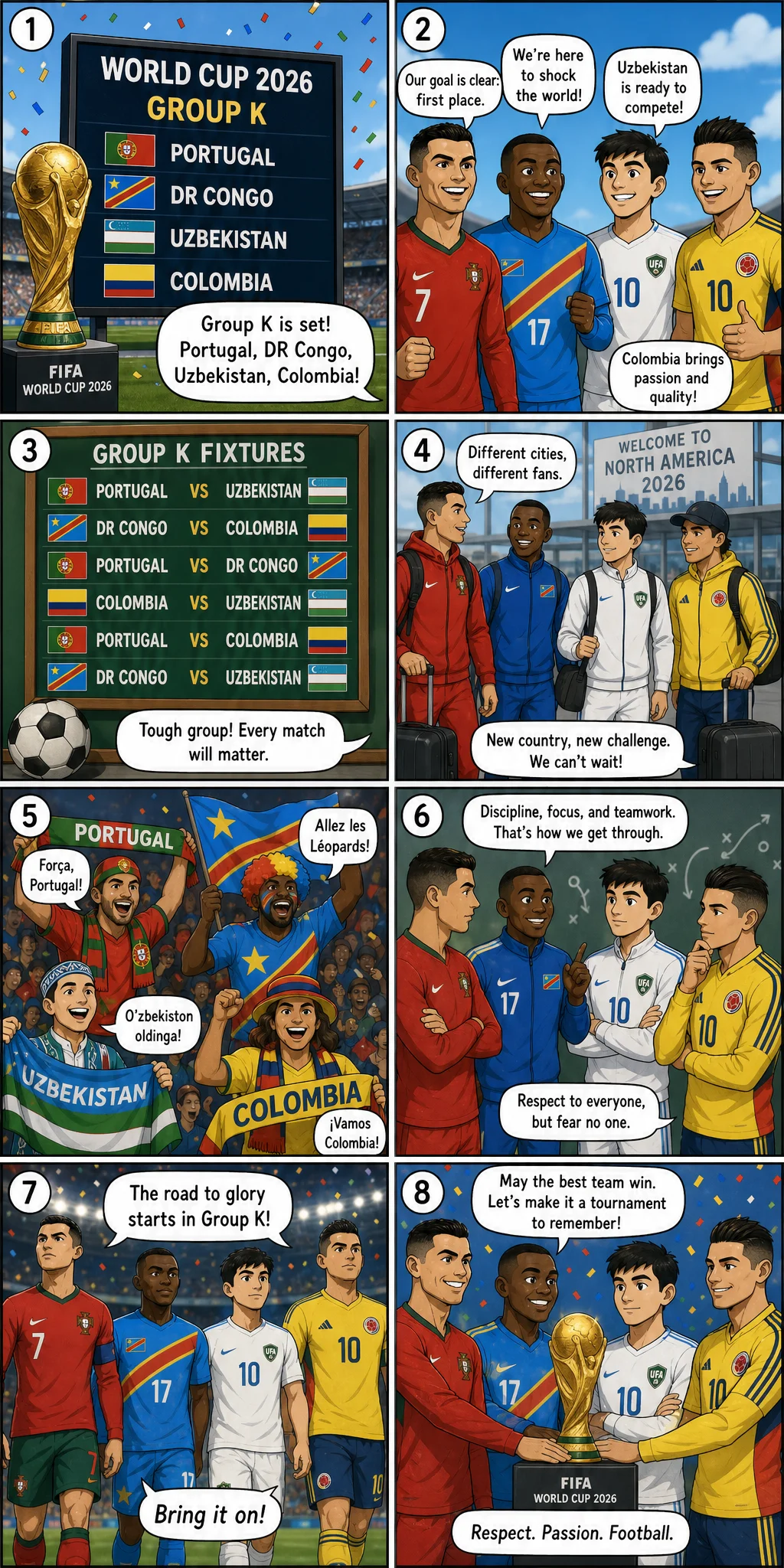
Comic content and match statistics are for entertainment purposes only and may contain inaccuracies. For Accurate Data, please refer to the reference's official website.
# Group K: Portugal's Deepest Squad, DR Congo's Diaspora, and the Geography of Global Football
Group K is a cartographic argument disguised as a football draw. Portugal, the westernmost nation of continental Europe, a small rectangle of Iberian coast that has produced more world-class footballers per capita than any country except Uruguay and Croatia. DR Congo, the vast central African nation whose colonial boundaries were drawn at the 1884 Berlin Conference without a single Congolese voice present and whose footballers have been exported to European leagues for sixty years while the national team remained a marginal presence. Uzbekistan, the Central Asian republic of thirty-five million people attending its first World Cup, a nation whose football identity has been forged in the specific obscurity of Asian qualifying campaigns that the European media covers with the attention it reserves for the reserve divisions of the Scottish league. Colombia, the South American nation whose football history oscillates between genius and self-destruction with a rhythm that no other football culture can replicate. Four nations, four entirely different relationships with the sport, one group.
The structural question that Group K poses is whether the 48-team World Cup format produces competitive balance or merely arranges mismatches across more matchdays. The answer depends on where you point the camera.
Portugal is the group's superpower and the tournament's most fascinating case study in national football psychology. The Portuguese squad that arrives in North America is deeper than the 2006 generation of Figo, Deco, and the young Cristiano Ronaldo — a statement that reads as heresy to anyone who watched that team carry Portugal to a World Cup semifinal and a European Championship final. But the depth comparison is not nostalgia's distortion. It is recognition of what Portuguese football's development infrastructure has produced across the past two decades, the culmination of an academy system that Benfica, Sporting, and Porto constructed and that has been exporting technically refined footballers to Europe's elite leagues at a rate that no nation of comparable population can match.
Ruben Dias anchors the defense with the authority of a man who has won everything at club level by twenty-nine — Premier League titles, Champions League medals, the specific calm that elite centre-backs who have faced every possible attacking configuration project onto teammates who need that calm more than they need tactical instruction. Bruno Fernandes creates from midfield with the controlled chaos that defines his Manchester United career, a player whose risk-reward calculus tilts so aggressively toward reward that his passing maps look like seismographs during an earthquake, and whose capacity to produce the pass that no defensive structure anticipates is matched only by his capacity to lose possession attempting passes that no rational midfielder would attempt. Bernardo Silva provides the technical precision that makes possession football function against the deep blocks that tournament opponents increasingly deploy — the player who receives the ball in spaces where lesser footballers would lose it and emerges with both the ball and a plan. Rafael Leao offers the explosive athleticism that, in the open spaces of international football's transitional moments, turns half-chances into goals with a frequency that statistical models struggle to capture because the data sample of Leao's specific physical profile is too small to generate reliable probabilities.
Joao Felix is the wildcard, the talent that has never fully translated from potential to production, the player whose best performances remain theoretical rather than historical. Every Portuguese generation features at least one player occupying this category — the prodigy who convinces you, every time you watch him, that greatness is imminent, and then the imminent greatness remains imminent. Felix at twenty-six has accumulated enough career to establish his quality and enough disappointment to establish his limitations. Portugal's tournament depends, to a degree that makes Portuguese supporters uncomfortable, on which Felix appears. The 2026 version of Felix determines whether Portugal advances to the semifinals or exits in the round of sixteen. The gap between those outcomes is wider for Portugal than for any other supposed contender, and the width of that gap is measured entirely in Felix's capacity to finally become the player he has been promising to become for eight years.
DR Congo represents a different football story entirely — the story of what happens when a continent's football talent is systematically exported and only recently begins returning. The Congolese diaspora has populated European national teams for generations. France's World Cup-winning squads have consistently featured players of Congolese descent. Belgium's golden generation would not exist without the Congolese community that produced Romelu Lukaku and Vincent Kompany. The Leopards' qualification for 2026 represents the gradual, incomplete reversal of this pattern — a national team that is finally attracting diaspora talent that its soil has always produced. They will not win Group K. Their presence matters in ways that transcend competitive outcomes.
Uzbekistan's debut is the quietest in the tournament. A nation of thirty-five million football-obsessed people arriving at the World Cup without the narrative amplification that accompanies debuts from more geopolitically visible nations. The Uzbek football infrastructure has been methodically constructed across three decades of post-Soviet independence, and the qualification campaign that delivered the White Wolves to North America was the culmination of an institutional project. Colombia, reinvigorated under Luis Diaz's explosive dribbling, completes Group K with South American volatility — capable of beating Portugal, capable of losing to Uzbekistan. Group K belongs to Portugal on paper. The gap between paper and grass is where the World Cup actually happens, and Group K's gap is wider than most.