

Group L Power Analysis: England, Croatia, Ghana, Panama
Group L completes the expanded tournament's first-round puzzle with a quartet representing football's global breadth. This analytical preview examines each team's qualification journey, tactical identities and key individuals, group-stage dynamics, climate and travel variables affecting performance, and what the group's composition reveals about FIFA's vision for a truly global World Cup.
Published: June 8, 2026
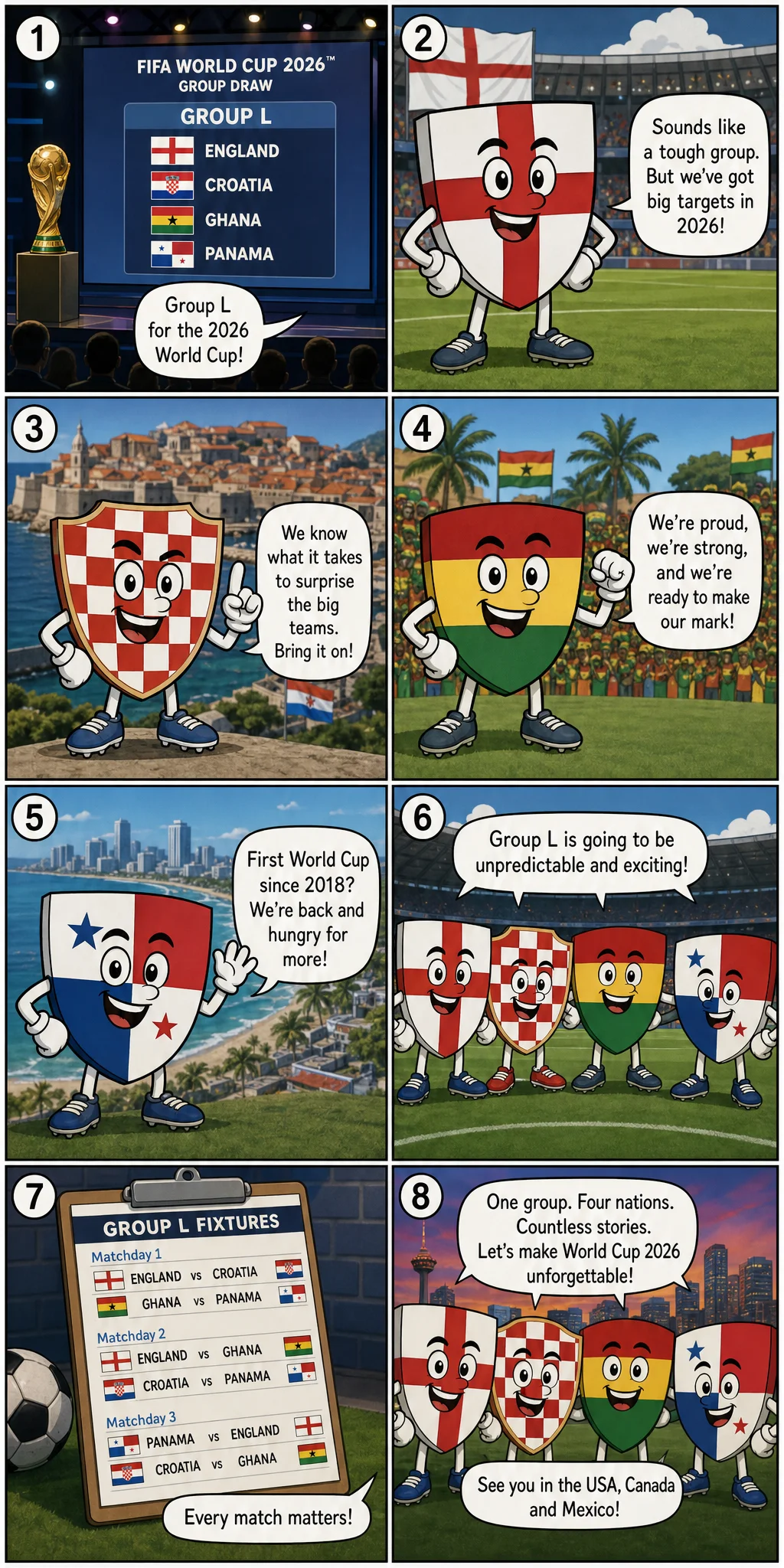
Comic content and match statistics are for entertainment purposes only and may contain inaccuracies. For Accurate Data, please refer to the reference's official website.
Group L: England, Croatia, Ghana, Panama — The Modric Farewell
There is a statistic that has circulated among English football writers for years, passed around press boxes like a cursed object that no one wants to touch but everyone feels compelled to examine: since 1990, Croatia has won more World Cup knockout matches than England. A nation of four million people, born from the dissolution of Yugoslavia in a war that killed twenty thousand and displaced hundreds of thousands, has outperformed the country that invented the game and possesses the world's richest domestic league. The statistic is not a commentary on England's failures, though it has often been deployed as one. It is a commentary on Croatia -- the small nation that has somehow, improbably, become the tournament's most reliable overachiever.
The 2026 World Cup marks the end of the Croatian story that began in 2006, when a slender midfielder with the face of a medieval scholar first appeared in a World Cup squad. Luka Modric is forty years old now, playing his final tournament, the last active link to a generation that reached the 2018 final and the 2022 semifinal. The numbers are absurd: Modric has played more than 170 international matches, won the Ballon d'Or in 2018 -- the only player not named Messi or Ronaldo to do so between 2008 and 2023 -- and captained his country through the most successful period in its football history. The midfield trident of Modric, Mateo Kovacic, and Marcelo Brozovic has been the spine of two deep tournament runs, a unit that combines technical security with the specific competitive intelligence that Croatian footballers seem to absorb from the Adriatic air. The legs are older. The mind is sharper. Modric's final World Cup, wherever it ends, will conclude an international career that belongs in the same conversation as the greatest midfielders the tournament has ever seen.
England enters under Thomas Tuchel, the first German to manage the national team, the first elite club tactician to take the position since Fabio Capello's joyless tenure from 2008 to 2012. Tuchel's appointment was controversial in the specific way that all England managerial appointments are controversial -- too foreign, too tactical, too intellectual for a football culture that has always been suspicious of ideas that cannot be reduced to cliches about passion and desire. He is also the most accomplished knockout tournament manager available: a Champions League winner with Chelsea in 2021, a finalist with Paris Saint-Germain in 2020, a coach whose tactical flexibility -- the capacity to adjust shape, pressing triggers, and build-up patterns mid-match -- is the quality that knockout football uniquely rewards. England's squad is among the tournament's deepest. Jude Bellingham, at twenty-two, is already among the world's five best players. Harry Kane, at thirty-two, enters his fourth World Cup as the national team's all-time leading scorer. The question is the one that has accompanied England to every tournament since 1966: can this team beat a genuinely elite opponent in the knockout stage, and can it do so without the specific psychological collapse that has accompanied every English elimination in the penalty shootout era?
Ghana's World Cup history is defined by a single image that has become one of the tournament's most enduring photographs: Luis Suarez's handball on the goal line in the 2010 quarterfinal, the red card, the penalty that Asamoah Gyan struck against the crossbar, the semifinal that never happened. Sixteen years later, Ghana returns with a squad built on the physicality and athleticism that has characterised West African football for a generation, but with greater tactical discipline -- the specific evolution that has made African teams progressively more difficult World Cup opponents with each tournament cycle. Panama completes the group with its second World Cup appearance, no longer the overwhelmed debutante of 2018 who conceded eleven goals in three matches. Group L belongs to England on paper, but Croatia has spent a decade proving that paper does not win World Cup matches. The Modric farewell and the Tuchel project: two stories that intersect for two hours on a June evening, with the weight of history pressing down on both sides. The group stage, for all the tournament's expansion, still produces moments like this. A forty-year-old man playing his final World Cup match against the nation that invented the game, with the memory of a war, a Ballon d'Or, and an entire country's identity compressed into every touch of his left foot.