

Korea Republic vs Czechia: Structure Shift — Group A Tactical Recap
Korea Republic came from behind to beat Czechia 2-1 in their Group A opener at Estadio Akron, Guadalajara. Hwang In-beom scored and assisted, becoming the third Korean to record both in a World Cup match.
Published: June 12, 2026
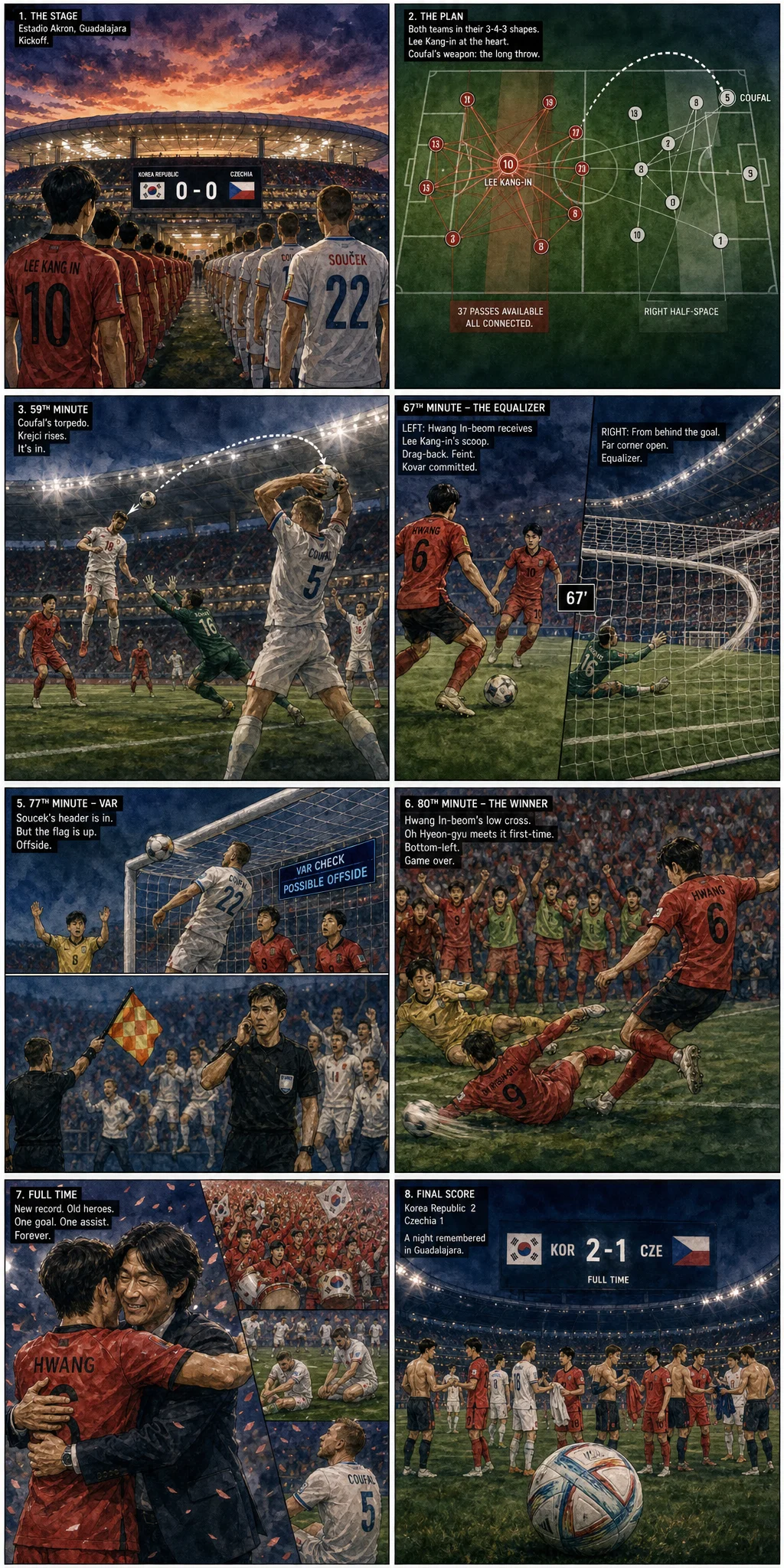
Comic content and match statistics are for entertainment purposes only and may contain inaccuracies. For Accurate Data, please refer to the reference's official website.
Why does a team with 61.7% possession, having conceded zero shots on target in the first half, still find itself trailing to a dead-ball situation? That was the central tactical question of South Korea versus Czechia in Group A, and the answer lies in the mechanics of two mirroring 3-4-3 systems — and one decisive structural shift after the interval.
Hong Myung-bo deployed a 3-4-3 with the left wing-back pushed high, compressing Czechia's right-side buildup. South Korea's passing accuracy was immaculate — Lee Kang-in completed all 37 of his passes across the 90 minutes — but touches inside the Czech penalty area were scarce before the break. Czechia's back three, also in a 3-4-3, packed the central corridor densely enough to force Korea's possession into endless lateral recycling. It was patient chess, but Korea lacked the vertical pass to break the first line. Tellingly, Czechia failed to register a single first-half shot on target. Their attacking plan had been entirely nullified — and yet, paradoxically, so had Korea's: total control, zero incision.
The 59th minute delivered the paradox's payoff. Vladimir Coufal's long throw — approaching corner-kick velocity — found Ladislav Krejci, and here Korea's zonal marking disintegrated. No defender genuinely challenged Krejci's aerial route; Kim Seung-gyu stood rooted with his sightline blocked by his own wall. This was the Czech set-piece machine operating exactly as designed: 11 of their 22 UEFA qualifying goals came from dead balls. 1-0.
Then Hong made his critical intervention. Not a substitution — a structural override.
Korea began tucking the right wing-back inside, manufacturing a midfield overload of four against three. The adjustment paid out in the 67th minute. Lee Kang-in received in the left half-space and, instead of taking the outside route, cut inward — dragging two Czech defenders with him and carving out a receiving pocket for Hwang In-beom on the left. Hwang's drag-back feint was not trickery for its own sake; its tactical function was to freeze Matej Kovar's weight shift, opening the far corner for a curled finish. 1-1.
The 77th-minute offside decision was the match's hinge point. Tomas Soucek headed Michal Sadilek's free-kick past Kim, but VAR confirmed he had drifted half a body beyond the last defender at the moment of delivery. Czechia's best goalscoring window — and their sole threatening sequence from open play all night — slammed shut.
Three minutes later, Hwang swung a cross from the right flank and substitute Oh Hyeon-gyu attacked the near-post gap between two Czech centre-backs — a metre and a half of space that simply cannot exist in a well-drilled back three. Kovar hesitated a beat. In a 3-4-3, centre-back spacing is inherently wider than in a back four, and hesitation in that geometry is fatal. 2-1.
The data tell a clean story: xG of 1.84 to 0.81. The gap was not possession — Korea dominated that from kickoff — but second-half efficiency in converting territorial control into box touches. Czechia's chance creation was almost entirely dependent on Coufal's throw-ins and set-piece routines. The fragility of this approach is structural: when an opponent blocks your solitary channel, what is your second punch?
Hwang In-beom became only the third South Korean to record a goal and an assist in a single World Cup match. The first two? Choi Soon-ho against Italy in 1986 and — in one of those coincidences the tournament occasionally delivers — Hong Myung-bo himself, against Spain in 1994. The coach and the player now share the record.
The comeback matters beyond the three points. In their twelfth World Cup appearance, South Korea have finally won an opening match. For Czechia, back at the tournament after a twenty-year absence, the opening fixture exposed a structural vulnerability: when match plans rely overwhelmingly on throws and set pieces, and the opponent adapts at halftime, you are left without a second threat vector. In the knockout rounds, that is not usually enough.