

Mexico 2-0 South Africa: Three Red Cards and an Azteca Baptism
Quinones scores the tournament's first goal in the 9th minute, Jimenez heads home the second, and three players see red in a chaotic World Cup opener at the Estadio Azteca.
Published: June 12, 2026
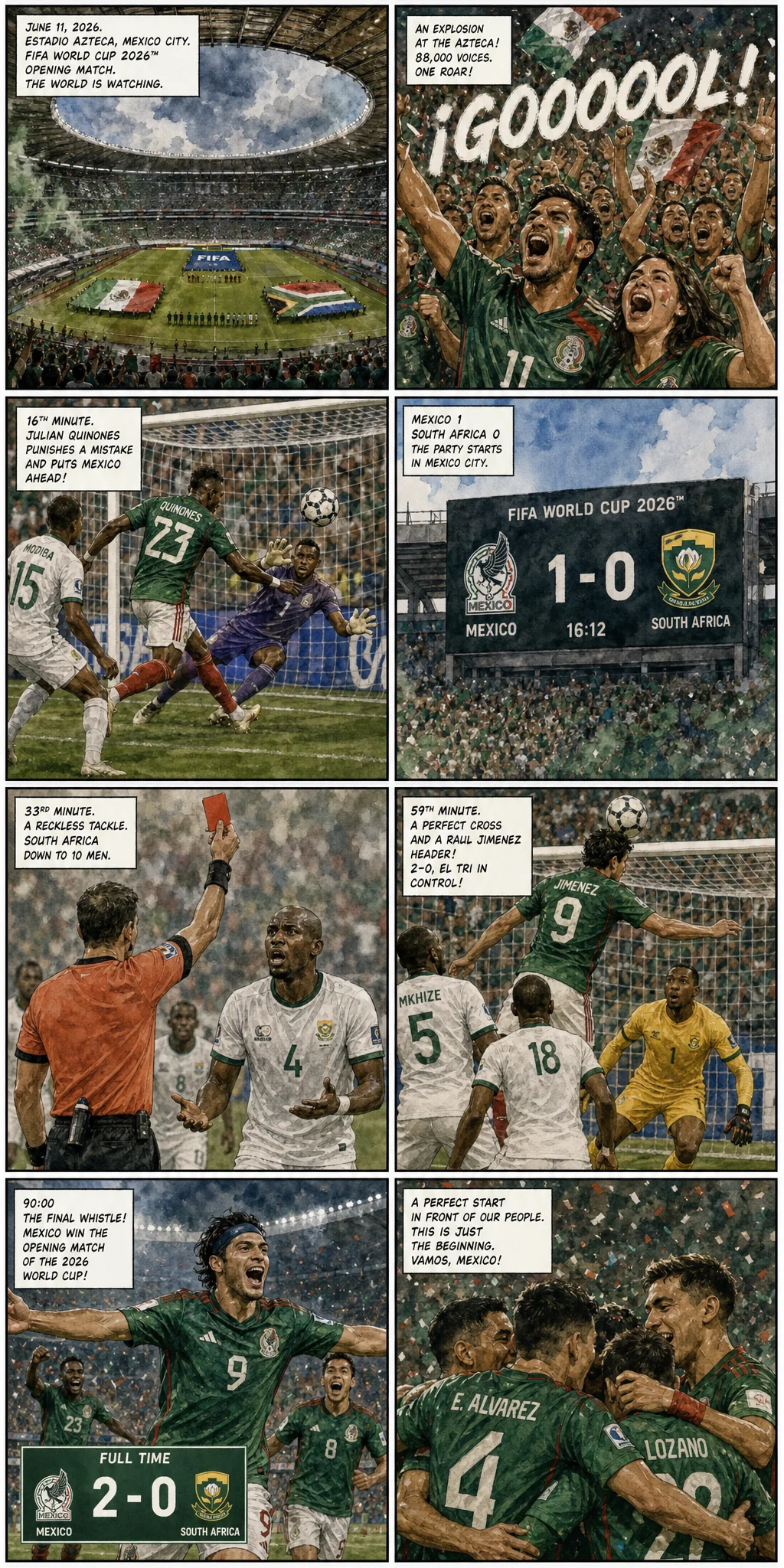
Comic content and match statistics are for entertainment purposes only and may contain inaccuracies. For Accurate Data, please refer to the reference's official website.
Mexico 2-0 South Africa: Three Red Cards and an Azteca Baptism
The opening match of a World Cup is seldom a tactical masterpiece. The weight of the occasion — the ceremony's residue, the host nation's anxiety, the simple neurological overload of launching a tournament four years in the making — tends to produce football that is less a coherent argument and more a series of disconnected emotional outbursts. Mexico's 2-0 victory over South Africa at the Estadio Azteca was not an exception to this rule, but contained within its ninety-plus minutes of chaos — three red cards, two well-taken goals, and a crowd of 80,824 that oscillated between ecstasy and dread — a perfectly legible tactical story.
The pattern was established within nine minutes, and it would recur with the fidelity of a musical motif throughout the match: South Africa, attempting to play out from the back, pressed by Mexico's high block, and a turnover in a dangerous area. The opening goal arrived when Sphephelo Sithole, the South African midfielder, received the ball on the edge of his own penalty area with Julian Quinones already closing the distance. Sithole's touch was heavy; Quinones's reading of the situation was instantaneous. The Mexican forward nicked possession, took one touch to set himself, and slid a low shot through the legs of goalkeeper Ronwen Williams. Nine minutes into the 2026 World Cup, the Azteca had its goal — the tournament's first — and Sithole had begun a personal ordeal from which he would not recover.
Mexico's high press was the defining tactical feature of the first half. Coach Rafael Marquez had constructed a 4-3-3 shape that collapsed into a 4-4-2 defensive block without the ball, with Quinones and Raul Jimenez splitting pressing duties between South Africa's center-backs and holding midfielder. The approach was not subtle, but it did not need to be: South Africa, under Hugo Broos, had built their identity around patient buildup and positional rotation. Mexico's disruption of the first phase of that buildup rendered the visitors' attacking structure largely theoretical. Mexico recorded eight recoveries in the attacking third, five of which led directly to shots; South Africa's Expected Goals total at the interval stood at 0.08.
The match's second major incident arrived four minutes after the restart. Bryan Gutierrez, the young Mexican midfielder, latched onto a through ball and was bearing down on goal when Sithole — the last defender — pulled him back by the shoulder. Referee Sandro Scharer of Switzerland produced a straight red card. South Africa, reduced to ten men with more than forty minutes remaining, retreated into a 5-3-1 shape and conceded possession. The question became whether Mexico could convert territorial dominance into a second goal.
The answer arrived in the 67th minute, constructed with the precision the occasion demanded. Roberto Alvarado, Mexico's most consistent creative outlet, received the ball in space on the right flank — South Africa's defensive block had compressed too narrowly — and delivered a cross of exquisite weight. Raul Jimenez, timing his run to arrive between the two center-backs, met the ball with his forehead and directed it past Williams into the far corner. It was Jimenez's first World Cup goal, his 46th international strike, equalling Jared Borgetti for second on Mexico's all-time scoring chart.
What followed was extraordinary even by the standards of opening-match chaos. In the 84th minute, Themba Zwane — South Africa's captain and most experienced player — was shown a red card after VAR caught him striking Roberto Alvarado in the face during an off-the-ball incident. South Africa reduced to nine men. Then, in stoppage time, Cesar Montes, the Mexican center-back, lunged into a challenge on Khuliso Mudau at the edge of the box and was himself dismissed. Three red cards in a single match — a World Cup opening fixture record — and a reminder that the thin air of the Azteca does strange things to decision-making.
The final whistle arrived at 2-0, and Mexico had won their first-ever opening match at a World Cup after seven previous failures. Marquez's high press worked devastatingly well against an opponent built to play through rather than around pressure. Jimenez's goal provided the cutting edge Mexican teams of previous tournaments had so often lacked. But the Montes red card was an unnecessary self-inflicted wound — the kind of disciplinary lapse that against stronger opposition could prove costly.
Mexico top Group A with three points and a plus-two goal difference. South Africa, zero points and an urgent need to regroup before facing the Czech Republic. Three red cards, two goals, one stadium that has now seen everything — and one hundred and three matches still to play.