

Qatar 1-1 Switzerland: Khoukhi's Last-Gasp Equalizer
Qatar earned their first-ever World Cup point after Boualem Khoukhi's 94th-minute header cancelled out Breel Embolo's 17th-minute penalty. Switzerland dominated with 69% possession and 25 shots to Qatar's 6, but failed to convert control into victory.
Published: June 13, 2026
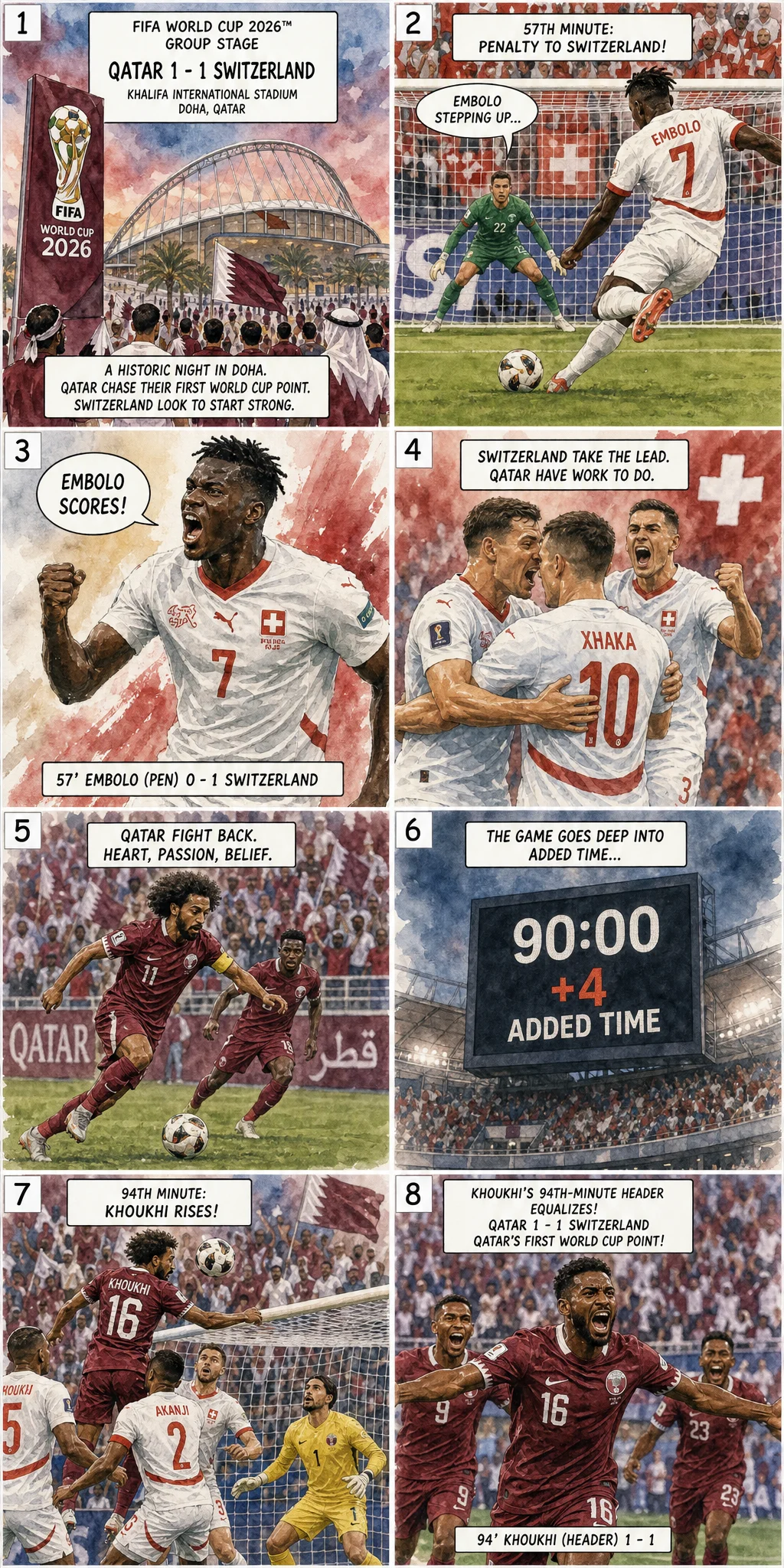
Comic content and match statistics are for entertainment purposes only and may contain inaccuracies. For Accurate Data, please refer to the reference's official website.
Qatar 1-1 Switzerland: A Point Stolen, A System Exposed
The most telling statistic from Levi's Stadium was not the 25 shots Switzerland managed, nor the 69% possession they accumulated. It was this: Switzerland produced 2.1 expected goals from 25 attempts, meaning their average shot quality was 0.08 xG per effort. Qatar, with six shots, generated 0.7 xG — a per-shot average of 0.12. The Swiss fired often. They fired poorly. And football, as it periodically reminds us, punishes inefficiency more ruthlessly than any other sport.
Murat Yakin set Switzerland up in their familiar 4-2-3-1 shape, with Granit Xhaka and Remo Freuler forming the double pivot that has become the national team's spinal column. Against a Qatar side managed by Julen Lopetegui — the former Spain and Real Madrid coach now attempting to extract tournament credibility from a nation still searching for its first World Cup victory — the tactical premise seemed straightforward: control the centre, overload the half-spaces, and let Breel Embolo's physicality bully a backline anchored by the 34-year-old Boualem Khoukhi.
For 93 minutes, the premise held. The execution did not.
The Press That Wasn't
Qatar's defensive shape was, on paper, a 4-3-3. In practice, it was a 5-4-1 that condensed into a narrow block whenever Switzerland crossed the halfway line. Lopetegui's most consequential decision — dropping all-time leading scorer Almoez Ali to the bench — signalled intent. Akram Afif, the two-time Asian Player of the Year, was deployed as a false nine with licence to drift left, but his primary instruction was not to score. It was to occupy Manuel Akanji and Nico Elvedi sufficiently that Switzerland's centre-backs could not step into midfield to create the numerical superiority Yakin's system demands.
It worked, mostly. Akanji, ordinarily one of the most progressive ball-carriers in this Swiss setup, completed just three passes into the final third in the opening half-hour. By removing a traditional No. 9, Lopetegui had removed the pressing trigger Switzerland's centre-backs rely upon to break lines. Afif floated. Akanji hesitated. The build-up stalled.
Switzerland's solution was Xhaka dropping deeper, almost to the left centre-back position, to receive the ball facing forward. From there, his diagonal switches to Dan Ndoye on the right flank became the primary method of advancing through Qatar's narrow block. Ndoye completed seven dribbles in the match — more than any other player — but his final ball repeatedly found Khoukhi's head or the gloves of Mahmoud Abunada. The pattern was set: Switzerland could reach the edge of the box. They could not penetrate it.
The Penalty: Order From Chaos
The opening goal, when it came in the 17th minute, was not the product of Switzerland's structured possession game. It emerged from a set-piece — a corner swung in by Ricardo Rodríguez, a scramble, and a handball from Jassem Gaber that VAR confirmed after a review of nearly two minutes. Embolo's penalty was struck low and hard to Abunada's left. The goalkeeper guessed correctly. The ball was too precise.
Switzerland led. The question, as the match settled back into its established rhythm, was whether they could translate territorial control into a second goal that would make Qatar's defensive posture untenable. They could not. And the reasons are instructive.
The Half-Space Problem
Switzerland's attacking structure under Yakin relies heavily on the relationship between the No. 10 — here, Fabian Rieder — and the two wide forwards cutting inside from their starting positions. The idea is that Rieder receives between the lines, draws a midfielder out of the block, and releases Ndoye or Michel Aebischer into the vacated space. Against Qatar's three-man midfield of Gaber, Ahmed Fathy, and Assim Madibo — all of whom stayed within a 15-metre radius of each other — Rieder found himself receiving the ball with his back to goal, surrounded by three opponents, with no forward passing lane available.
This is where Yakin's system reveals its dependency on individual quality in the pocket. Without a player capable of receiving on the half-turn and breaking a line with one touch — the way Xherdan Shaqiri once did — Switzerland's attacks became lateral. They moved the ball from flank to flank. They did not move it toward goal.
The shot map tells the story. Of Switzerland's 25 attempts, 18 came from outside the penalty area. Ndoye had five from range. Aebischer had four. Freuler tried three. These were not clear-cut chances manufactured through intricate combination play. They were acts of frustration — a team running out of ideas and resorting to distance as a substitute for incision.
Qatar's Counter: The Geometry of Hope
Lopetegui's counter-attacking plan was geometrically simple but athletically demanding. When Switzerland lost possession — which they did 87 times, an unusually high number for a team dominating the ball — Qatar's midfield three would immediately funnel the ball wide to Edmilson Junior or Yusuf Abdurisag, who were tasked with carrying it 30 to 40 metres up the pitch while Afif and the opposite winger sprinted into the channels.
The most dangerous of these transitions came in the 34th minute, when Afif collected a clearance on the left touchline, cut inside past the Swiss right-back, and curled a shot that required Gregor Kobel to tip onto the crossbar. It was Qatar's first shot on target. It would remain their only one until stoppage time. But it was a warning that Switzerland's high defensive line — Elvedi and Akanji routinely stationed five metres inside the Qatar half during settled possession — was vulnerable to a single well-timed diagonal.
The warning went unheeded. Not because Yakin failed to recognise the danger, but because dropping the defensive line would have compressed the space Rieder and the wide forwards needed to operate. Switzerland faced the classic tactical trade-off: defensive security versus attacking fluidity. They chose fluidity. For 93 minutes, they survived. In the 94th, they did not.
The Equaliser: Chaos Theory
The goal that earned Qatar their first World Cup point was simple in execution and devastating in its implications. A free-kick from the right, delivered by Homam Al-Amin, swung toward the near post. Switzerland's zonal marking system — which had dealt comfortably with set-pieces throughout the match — broke down at the critical moment. Khoukhi, the veteran centre-back who had spent the previous 93 minutes heading away crosses at his own end, found himself unmarked six yards from goal. His header looped over Kobel and into the far corner.
The tactical breakdown was twofold. First, Embolo — responsible for the near-post zone — had been substituted three minutes earlier, replaced by Noah Okafor. Defensive set-piece assignments were not adequately recalibrated. Second, Qatar overloaded the near-post area with four attackers against Switzerland's three zonal markers, creating the numerical mismatch that set-piece analysts have warned against for years. Khoukhi's run came from deep, unmarked, at pace. The header was almost unmissable.
From a data perspective, the goal was worth approximately 0.3 xG — a moderate chance, converted through defensive disorganisation rather than attacking brilliance. But the numbers miss the point. This was not about probability. It was about punishment.
The Broader Context
For Switzerland, this result fits an uncomfortable pattern. Yakin's side have now drawn four of their last seven tournament matches, a sequence that includes the Euro 2024 round-of-16 exit to Italy and qualifying stalemates that nearly cost them automatic progression. The common thread is an inability to convert possession dominance into scoreboard separation. Switzerland are a team that controls matches without controlling results — a distinction that separates tournament survivors from tournament winners.
For Qatar, the significance extends beyond the tactical. This was a nation that lost all three group matches as hosts in 2022, conceding seven goals and scoring one. Under Lopetegui, they are not a transformed side — the underlying numbers (31% possession, six shots, 0.7 xG) do not suggest a competitive team — but they are a coherent one. They have a plan. They execute it. And in a 48-team World Cup where third-place group standings introduce new strategic calculations, a single point can reshape the arithmetic of progression.
Khoukhi's header will not change the tactical reality: Qatar were outplayed in every measurable dimension. But it changes the story football tells about itself. The team that dominated the ball left with a point. The team that dominated the match did the same. Switzerland played better football. They did not play smarter football. And in a sport where the scoreboard is the only system that matters, that distinction is everything.