

Brazil 1-1 Morocco: Vinicius Rescues a Point in Ancelotti Structural Warning
Brazil were held 1-1 by Morocco at MetLife Stadium after Ismael Saibari chipped Alisson in the 21st minute and Vinicius Junior equalised with a trademark strike. Ancelotti deployment of CB Roger Ibanez at right-back created structural vulnerabilities Morocco exploited throughout.
Published: June 14, 2026
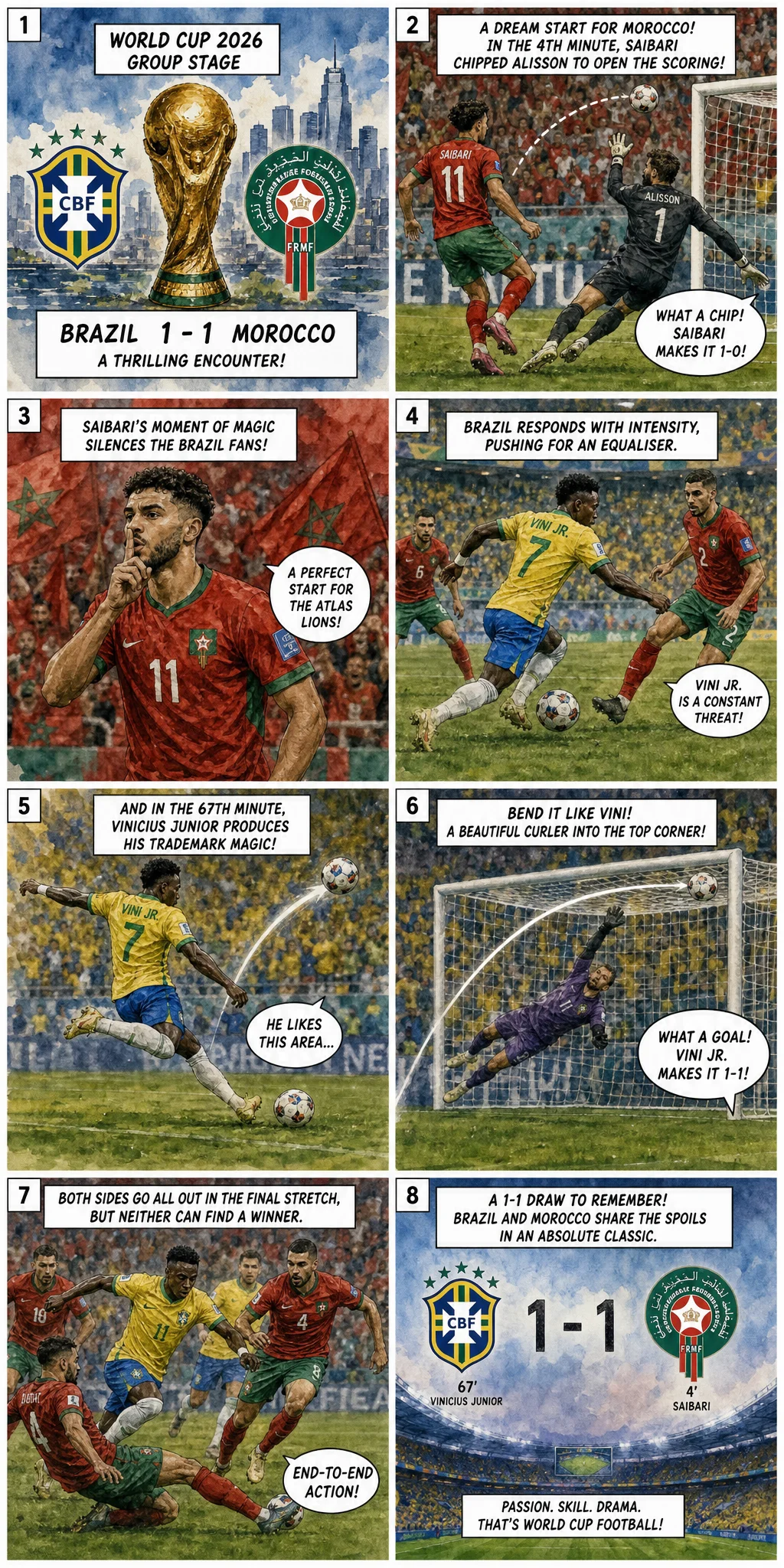
Comic content and match statistics are for entertainment purposes only and may contain inaccuracies. For Accurate Data, please refer to the reference's official website.
Brazil 1-1 Morocco: Ancelotti's Right-Side Experiment and the Seleção's Structural Warning
The most revealing image from MetLife Stadium came not from the 32nd-minute Vinicius Junior equaliser — a strike of such predictable brilliance that it barely qualified as analysis — but from the 21st minute, when Ismael Saibari celebrated Morocco's opener by pointing directly at the right side of Brazil's defence. He was not taunting. He was diagnosing.
Carlo Ancelotti's team sheet contained a decision that will be debated for as long as Brazil remain in this tournament: Roger Ibanez, a central defender by trade and by instinct, was deployed at right-back. The reasoning was pragmatic — first-choice Wesley had withdrawn through injury, and Danilo's lack of match fitness made him a risk. But pragmatism in football, like in chess, is only as sound as the opponent's capacity to exploit its weaknesses. Morocco, under Mohamed Ouahbi, arrived with a plan engineered precisely for this vulnerability.
The 1-1 draw that ensued was not a shock in the scoreline — these were the world's sixth and seventh-ranked sides — but it was a revelation in structure. Brazil were not outplayed. They were out-planned. And the distinction matters.
The False Nine as Systemic Disruptor
Ouahbi's most consequential tactical decision was deploying Saibari — nominally an attacking midfielder — as a false nine. This was not the false nine of Messi dropping to receive and dribble. It was the false nine as systemic disruptor: a player whose primary function was not to score but to manipulate Brazil's central defensive structure.
When Morocco had possession, Saibari would drop 15 to 20 metres into midfield, positioning himself between Brazil's lines. Marquinhos and Gabriel Magalhaes, two of the world's most aggressive front-foot defenders, were faced with the classic dilemma of the false nine: follow him into midfield and vacate the space behind, or hold position and concede numerical superiority in the centre.
They chose the former — repeatedly. And each time, Brahim Diaz or Bilal El Khannouss would spin into the space vacated. The goal, when it came, followed this exact pattern. Saibari dropped. Gabriel followed. Brahim Diaz collected between the lines, turned Bruno Guimaraes, and slid a through ball into the channel where Saibari — having released the ball and continued his run — received and chipped Alisson with the composure of a player who had rehearsed this sequence a hundred times.
The data underscored the structural problem. In the first half, Brazil's centre-backs made seven interventions in the middle third — an unusually high number that reflected not proactive defending but reactive chasing. Morocco completed eight passes into the final third through the central channel, compared to Brazil's four. The Selecao were being pulled apart geometrically.
The Ibanez Problem: A Structural Rather Than Individual Failure
Ancelotti's decision to start Ibanez at right-back was not unreasonable on its face. The Italian has a long history of converting centre-backs into full-backs — consider Sergio Ramos's early years, or the way he used Eder Militao at Real Madrid. The logic is that a third centre-back in the defensive line provides aerial security and allows the left-back to push higher, creating an asymmetrical 3-2 build-up shape.
The problem was not Ibanez individually. He completed 83% of his passes, won four of six aerial duels, and was not directly responsible for the goal. The problem was systemic: Brazil's entire defensive structure tilted toward the right to compensate for his lack of natural full-back instincts, and Morocco exploited the consequent chain reaction.
When Morocco attacked down their left — which they did on 44% of their possessions, a pronounced asymmetry — Brazil's right-sided midfielder (Raphinha in the nominal 4-3-3) was forced to drop deeper to support Ibanez. This pulled Raphinha away from his starting position, which in turn forced Lucas Paqueta to shift right, which in turn left Casemiro isolated in the centre. The chain reaction meant that by the time Morocco recycled possession centrally, Brazil's midfield shape had been stretched horizontally beyond its breaking point.
This is the hidden cost of the converted-centre-back strategy. It is not measured in the individual statistics of the player filling the role. It is measured in the positional compromises it forces on every other player in the structure.
Vinicius: The Individual Within the System
Vinicius Junior's equaliser was, in isolation, a masterpiece. Receiving the ball wide left, he cut inside past Achraf Hakimi — who had pushed high and was caught in transition — and unleashed a strike measured at 114 km/h into the far corner. Yassine Bounou, one of the world's best shot-stoppers, did not move.
But the goal was also instructive in what it revealed about Ancelotti's attacking structure without Neymar. Brazil's creative output was almost entirely concentrated on the left. Of their 14 shots, nine originated from sequences that passed through Vinicius. The right side, anchored by the makeshift Ibanez and a subdued Raphinha, produced two. Brazil's attack had become a one-wing aeroplane.
Ancelotti's system without Neymar is designed to be more balanced — structured patterns rather than individual improvisation — but the Ibanez compromise had knock-on effects that undermined precisely this balance. The right flank, rather than providing width and stretching Morocco's block, became a safety valve. Brazil could circulate possession there. They could not create from there.
Morocco's Transition Defence: The Art of Calculated Risk
Morocco's defensive strategy was as much about managing their own transitions as disrupting Brazil's. Ouahbi's side sat in a mid-block that condensed into a 4-4-2 shape without the ball, with the two wide midfielders tucking inside to deny passes into the half-spaces — the zones where Paqueta and Bruno Guimaraes typically operate.
The risk was clear: by narrowing the block, Morocco conceded space wide. Brazil's full-backs — Douglas Santos on the left, in particular — had time and room to receive. But Ouahbi had calculated that crosses into Igor Thiago, for all the Brentford striker's physical presence, were a lower-percentage threat than through balls into Vinicius cutting inside.
The calculation held. Brazil delivered 18 crosses. They completed four. Igor Thiago won only three of 11 aerial duels. Morocco's centre-back pairing of Issa Diop and Chadi Riad — playing together for the first time in a competitive international — were tested in a way the statistics alone do not capture, but they held.
The Broader Implications
For Brazil, this result will be framed as a missed opportunity. It is better understood as a structural warning. Ancelotti has built this team around positional asymmetry — the idea that the left side (Vinicius, Douglas Santos) provides the thrust while the right side provides balance. But when the right side is compromised by circumstance, the asymmetry becomes a liability. Brazil's next opponents — Haiti, and then Scotland — will have watched this match and noted the same thing Saibari pointed at in the 21st minute.
For Morocco, the significance extends beyond a point against the five-time champions. This was a statement of tactical coherence at a moment of institutional transition. A new coach, a new system, an injury crisis in central defence — and yet they executed a game plan that forced Brazil into structural compromises they could not solve over 90 minutes. Saibari's goal will make the highlights. His movement throughout the match should make the coaching manuals.
The scoreboard at MetLife Stadium read 1-1. But the tactical ledger told a different story. Morocco did not simply survive Brazil. They understood them. And understanding, in tournament football, is the first step toward overcoming.