

Netherlands 2-2 Japan: Kamada Late Strike Rescues Samurai Blue
Japan fought back twice to draw 2-2 with the Netherlands at AT&T Stadium. Van Dijk and Summerville scored for the Oranje; Nakamura and Kamada equalised for Japan. Japan remain unbeaten vs European teams at major tournaments since 2018.
Published: June 14, 2026
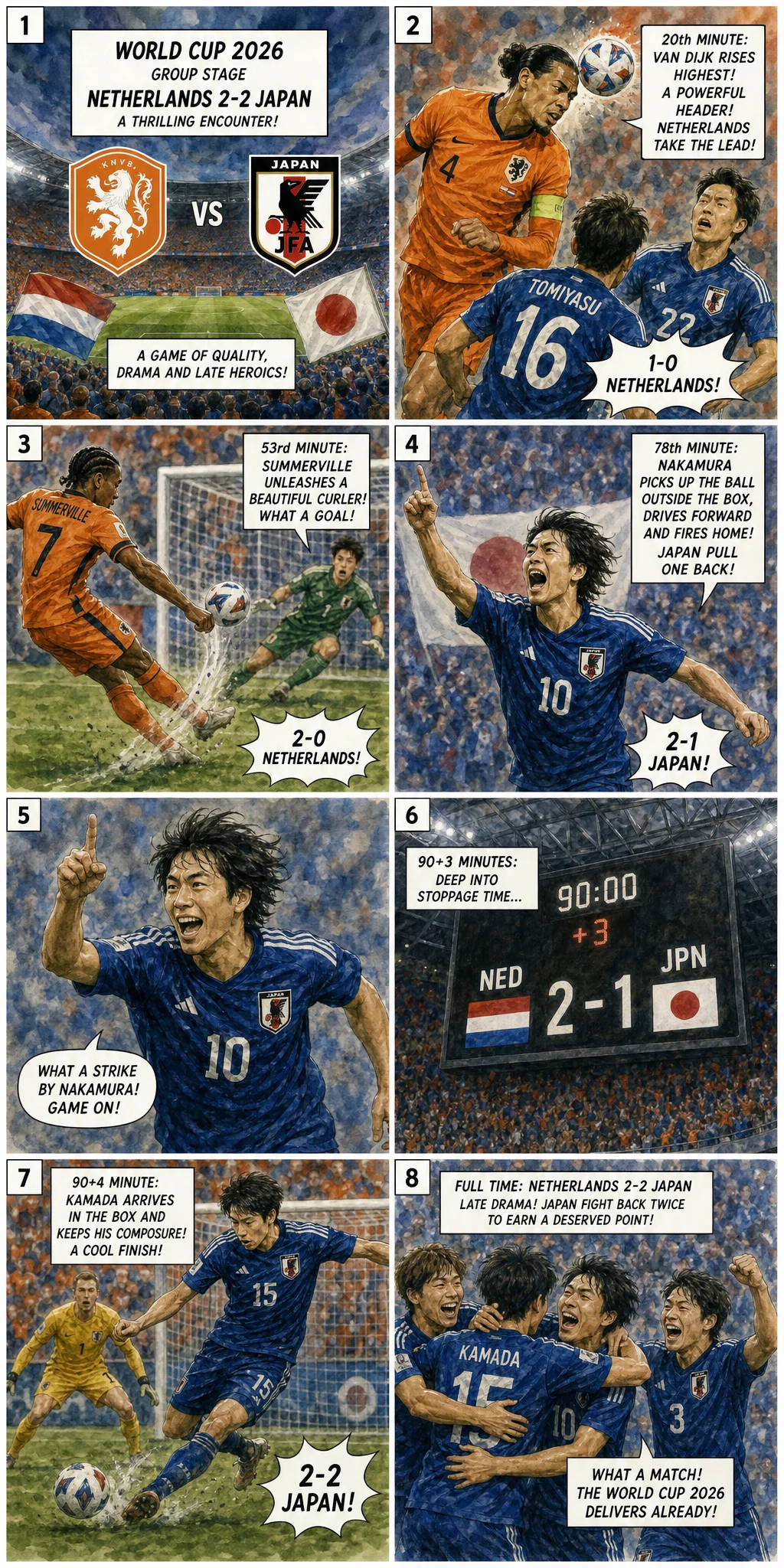
Comic content and match statistics are for entertainment purposes only and may contain inaccuracies. For Accurate Data, please refer to the reference's official website.
Netherlands 2-2 Japan: Kamada's Late Intervention and the Oranje's Unfinished Business
AT&T Stadium witnessed not a result but a revelation. The Netherlands led twice. Japan equalised twice. The 2-2 draw that concluded this Group F opener was not the product of Dutch profligacy or Japanese fortune. It was the product of two systems operating at the edges of their tactical identities — and Japan's late-game structural courage deserves as much analytical attention as the goals themselves.
Ronald Koeman's Netherlands shaped up in their familiar 4-3-3, with Ryan Gravenberch deployed as the deepest midfielder and Xavi Simons operating as the most advanced of the central three. The tactical premise was orthodox Dutch: control possession, overload the right half-space where Denzel Dumfries provides width, and create isolation situations for Cody Gakpo against Japan's right-back. Memphis Depay began on the bench — a decision that would later invite scrutiny — with Donyell Malen preferred as the central striker.
Japan, under Hajime Moriyasu, set up in their fluid 3-4-2-1 that morphs into a 5-4-1 without possession. Takefusa Kubo and Keito Nakamura operated as the dual No. 10s behind Ayase Ueda, with the wing-backs — Yukinari Sugawara and Kaoru Mitoma — positioned to both provide width and track Dumfries and Gakpo respectively. The plan was clear: absorb, compress, and transition through Kubo's carrying ability.
The opening 45 minutes produced no goals but considerable tactical information. The Netherlands completed 312 passes to Japan's 178. They registered seven shots to Japan's two. But the most telling statistic was this: Japan's defensive line held its shape at an average distance of 32 metres from their own goal — a remarkably low block for a side that, in Asian qualifying, routinely pushed 10 to 15 metres higher. Moriyasu had studied the Dutch and concluded, correctly, that the space behind their high defensive line was the avenue to goal.
Van Dijk's opener in the 51st minute was a set-piece goal — Gravenberch's outswinging corner met by the captain's forehead, the ball glancing past Zion Suzuki into the far corner. A simple goal, structurally irrelevant, but psychologically significant. The Netherlands led, and the AT&T Stadium expected control.
Japan's response was both immediate and instructive. Six minutes after conceding, Moriyasu's side produced a sequence that embodied their attacking philosophy in microcosm. Sugawara won possession in midfield. The ball was transferred through three one-touch passes to Kubo in the right channel. Kubo drove at the Dutch back four, drew two defenders, and slipped Nakamura through. The finish, low and hard across Bart Verbruggen into the far corner, was precise. The build-up was the point.
Summerville's goal in the 64th minute restored the Dutch lead and represented the individual quality that separates the Netherlands from all but a handful of teams. Receiving the ball wide right, the Leeds winger cut inside past Mitoma — who had tracked back diligently but was beaten by the change of direction — and curled a shot that seemed to bend around Suzuki's dive. A goal of technical beauty, and one that appeared to have settled the contest.
The equaliser, when it came in the 89th minute, was the product of a tactical adjustment Moriyasu had made 15 minutes earlier. Japan's coach had switched from the 3-4-2-1 to a more aggressive 3-5-2, withdrawing one of the dual No. 10s and introducing Koki Ogawa as a second striker alongside Ueda. The shift changed Japan's corner-kick structure — rather than the zonal marking system they had used for the first 75 minutes, they overloaded the six-yard box with four attackers, trusting their wing-backs to handle transitions.
The corner from the left was delivered by Mitoma. Ogawa rose highest, his header taking a deflection off Daichi Kamada — credited with the goal — and wrong-footing Verbruggen. The ball nestled in the net. Japan had not merely equalised. They had justified Moriyasu's tactical conviction.
The Broader Implications
For the Netherlands, this result continues an uncomfortable pattern under Koeman: an inability to convert territorial dominance into scoreboard separation. The Dutch have now drawn four of their last seven tournament matches. The decision to start Malen over Depay will be debated — Malen's movement created openings but his finishing lacked conviction — but the deeper issue is structural. When the Netherlands lose their defensive shape in transition, as they did for Nakamura's goal, the back four appears disconnected from the midfield three. The spacing between Gravenberch and his centre-backs was a vulnerability that Japan exploited repeatedly.
For Japan, this result extends a remarkable record: they have not lost to a European team at a major tournament since Belgium eliminated them in the 2018 round of sixteen. The equaliser was Kamada's first World Cup goal. It will not be his most significant contribution to this tournament. Japan face Sweden next, and a victory would position them beautifully for qualification from a group that, on this evidence, is more open than pre-tournament analysis suggested.
The scoreboard read 2-2. But Japan's performance carried the weight of a statement: the Samurai Blue are not here to participate. They are here to compete.