

Germany 7-1 Curacao: Havertz Double in Houston Rout
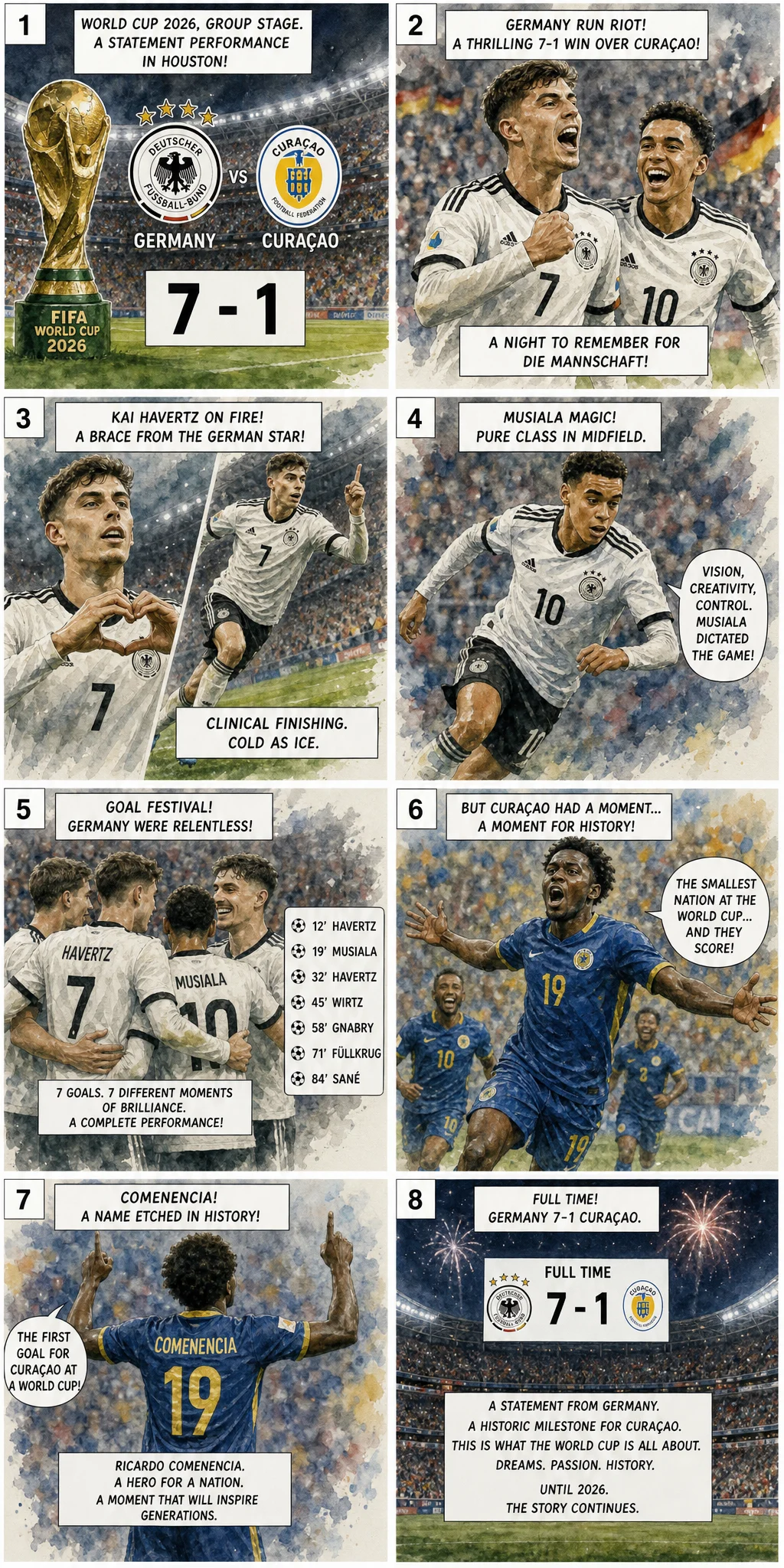
Germany demolished debutants Curacao 7-1 at NRG Stadium. Havertz scored twice, Musiala and Wirtz orchestrated. Comenencia scored Curacao first-ever World Cup goal at 1-1 before Germany scored six unanswered.
Published: June 14, 2026
Comic content and match statistics are for entertainment purposes only and may contain inaccuracies. For Accurate Data, please refer to the reference's official website.
Germany 7-1 Curaçao: Havertz Conducts the Houston Symphony
NRG Stadium, Houston, hosted not a contest but a coronation. Germany's 7-1 demolition of World Cup debutants Curaçao was a match that pivoted on 17 minutes — the 21st, when Livano Comenencia scored Curaçao's first-ever World Cup goal to level at 1-1, to the 38th, when Nico Schlotterbeck's header restored German order. The scoreboard registers seven goals. The tactical ledger records something more instructive: Germany's first truly coherent tournament performance since the 2014 final.
Julian Nagelsmann's selection was a statement of intent. Florian Wirtz and Jamal Musiala started together for the first time in a tournament match, with Kai Havertz positioned as a false nine rather than the target-man role he occupies at Arsenal. The shape was a nominal 4-2-3-1 but functioned as a fluid 3-2-5 in possession, with the full-backs — Nathaniel Brown and Josha Vagnoman — positioned as auxiliary wingers rather than defenders.
Curaçao's fairy-tale moment arrived in the 21st minute with brutal narrative irony. Felix Nmecha had opened the scoring after six minutes — the ball worked down the right, Wirtz cutting inside and finding the Dortmund midfielder at the edge of the area, a low shot past Tyrick Bodak. Germany appeared to be settling into cruise control. Then Comenencia, a 21-year-old right-back who plays his club football in the Dutch second division, intercepted a loose pass from Schlotterbeck, drove 40 yards, exchanged a one-two with Rangelo Janga, and fired low past Marc-André ter Stegen. Curaçao, population 150,000, the smallest nation ever to appear at a World Cup, had scored against Germany.
The moment was beautiful. It lasted 17 minutes.
Germany's response was systematic and devastating. Wirtz, who controlled the tempo throughout, began dropping deeper to receive from the centre-backs, bypassing Curaçao's midfield press entirely. The equaliser had come from a transition. The goals that followed came from structure. Schlotterbeck's header from a Wirtz corner in the 38th minute — 2-1. A Havertz penalty in first-half stoppage time after Musiala was fouled — 3-1. The half-time scoreline was 3-1. The underlying numbers were 2.4 xG to 0.3.
Nagelsmann has spoken repeatedly about Germany's need to rediscover the art of the second-half blitz — the period after the interval where Jürgen Klinsmann's 2006 side and Joachim Löw's 2014 champions routinely put matches beyond reach. Musiala's goal, scored 90 seconds after the restart, was a statement of application. A give-and-go with Havertz, a drop of the shoulder to sell the defender, a finish into the roof of the net. The efficiency was almost insulting in its simplicity.
Brown made it 5-1 in the 68th minute, driving into the box from left-back and finishing with the composure of a forward. Deniz Undav came off the bench to add a sixth, sweeping home from close range after good work from the tireless Wirtz. The seventh, Havertz's second, was the pick of the collection — a delicate chip over the advancing Bodak from the edge of the area, delivered with the nonchalance of a player who had long ceased to consider the opposition goalkeeper an obstacle worth respecting.
For Curaçao, the scoreline was harsh but the experience was invaluable. Dick Advocaat, at 78 the oldest manager in World Cup history, had prepared his team for a contest they could not win but could emerge from with credit. Comenencia's goal ensures that Curaçao's World Cup story begins not with a blank page but with a contribution. They will face Ecuador next, then Ivory Coast, and the tactical lessons from Houston — the danger of transitions, the cost of defensive disorganisation against elite movement — will inform both performances.
For Germany, this was the opening statement that Nagelsmann required. Not the scoreline alone — 7-1 victories against overmatched opponents tell you less than analysts pretend — but the structure behind it. Wirtz as the tempo-setter. Musiala and Havertz interchanging with the fluidity of club teammates. The full-backs providing genuine width. A defensive line that, Comenencia's goal apart, was never seriously troubled. This was the Germany that optimists have imagined since Nagelsmann's appointment. One match against Curaçao does not validate a system. But it begins the process of building belief, and in tournament football, belief is the commodity that compounds faster than any other.