

Sweden 5-1 Tunisia: Ayari Brace Powers Blue-Yellow Statement
Sweden dominated Tunisia 5-1 at Estadio BBVA. Yasin Ayari scored twice, Isak and Gyökeres also netted. Omar Rekik gave Tunisia brief hope at 2-1 before Sweden pulled away. Sweden top Group F.
Published: June 15, 2026
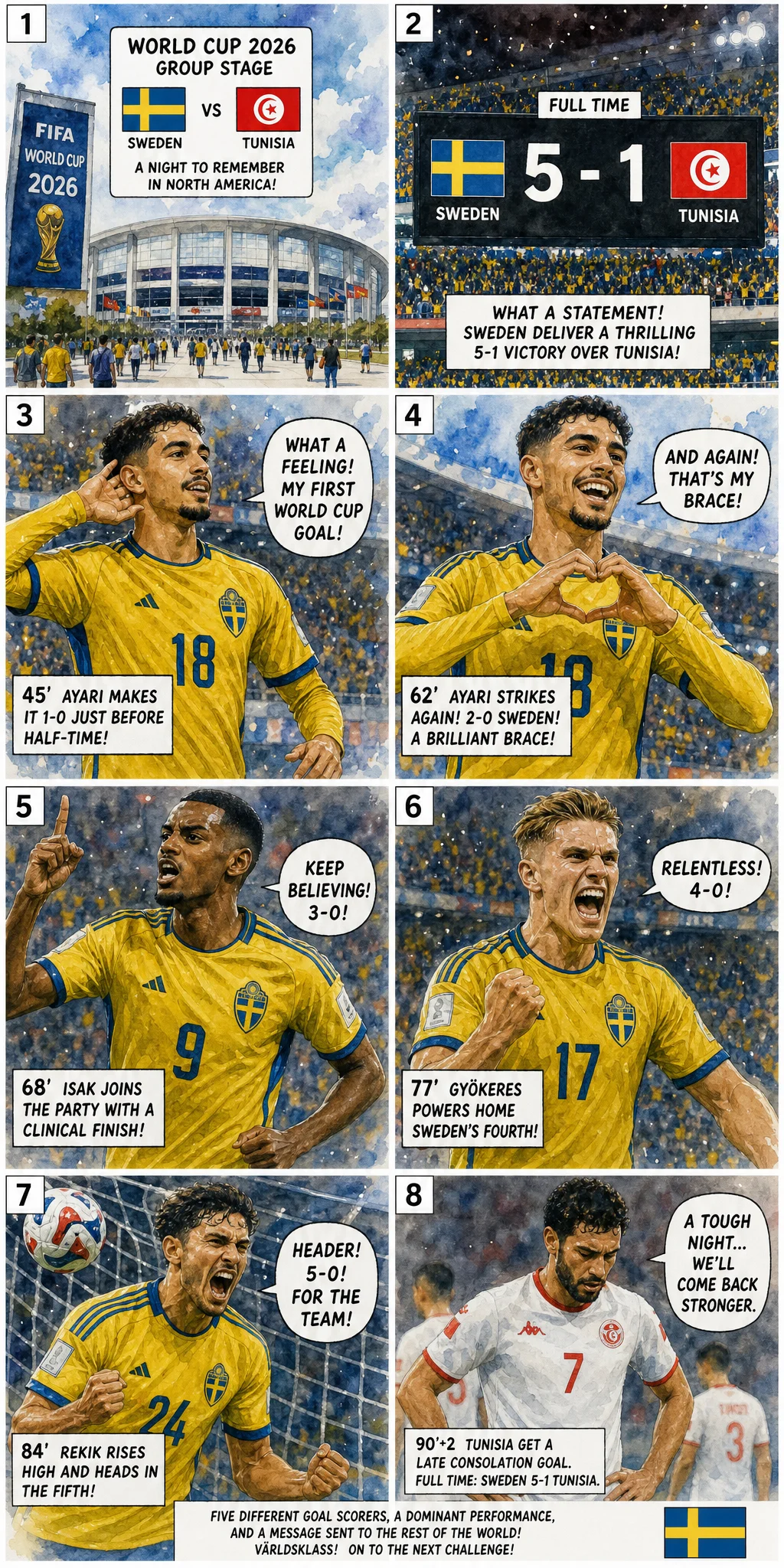
Comic content and match statistics are for entertainment purposes only and may contain inaccuracies. For Accurate Data, please refer to the reference's official website.
Sweden 5-1 Tunisia: Ayari's Brace and the Blue-Yellow Statement
Estadio BBVA in Monterrey witnessed the most complete performance of Group F, and arguably of the tournament's opening four days. Sweden's 5-1 dismantling of Tunisia was not merely a scoreline — it was a tactical manifesto. Jon Dahl Tomasson's side delivered a performance that combined the physical directness of traditional Swedish football with the positional intelligence of a team that has studied the modern game's demands and adapted accordingly.
The narrative of this Swedish generation has been shaped by two names: Alexander Isak and Viktor Gyökeres. Both scored in Monterrey. But the protagonist of the night was Yasin Ayari, the Brighton midfielder whose two goals — a seventh-minute volley and a stoppage-time long-range strike — bookended a performance that announced his arrival on the world stage.
Tomasson set Sweden up in a 4-2-3-1 that morphed into a 3-2-5 in possession, with the full-backs — Ludwig Augustinsson and Emil Holm — pushing high to provide width while the double pivot of Mattias Svanberg and Anton Salétros sat deep to guard transitions. The tactical premise was straightforward: overload the half-spaces where Tunisia's 4-3-3 becomes a 4-5-1 without the ball, and isolate Isak against the slower of Tunisia's centre-backs.
The opening goal, scored in the seventh minute, was a product of precisely this structure. Holm received wide right, cut inside, and found Ayari arriving late at the edge of the area. The volley, struck with the instep, bent away from Aymen Dahmen and into the far corner. It was Sweden's first shot. It was the kind of chance that results from structural superiority, not fortune.
Tunisia, under Faouzi Benzarti, had prepared for a different Swedish side — one more reliant on direct play to Gyökeres. The early concession forced a tactical adjustment that never quite settled. Hannibal Mejbri, the Manchester United midfielder on loan at Sevilla, was the brightest Tunisian presence, his delivery from set-pieces repeatedly testing the Swedish back four. Omar Rekik's goal in the 43rd minute — a glancing header from Hannibal's corner — gave Tunisia brief hope at 2-1.
The second half belonged entirely to Sweden. Gyökeres restored the two-goal cushion in the 59th minute, capitalising on an error by Ellyes Skhiri to fire low past Dahmen. Svanberg added a fourth in the 84th minute, his shot from the edge of the area confirmed after a VAR check. Ayari's second, a long-range strike that screamed into the top corner in the sixth minute of stoppage time, was the exclamation point on a performance that will send tremors through Group F.
The Broader Implications
Sweden's five-goal haul, combined with the Netherlands' 2-2 draw against Japan earlier in the day, positions Tomasson's side at the top of Group F with a goal difference advantage that may prove decisive in a group where three teams could finish level on points. Sweden face the Netherlands next in a match that will test whether this performance was a one-off statement or a genuine indication of tournament readiness.
For Tunisia, the result is sobering but not disqualifying. Benzarti's side were disorganised defensively but created moments — Hannibal's set-piece delivery and Skhiri's passing range remain assets. They face Japan next, and a result is essential to keep qualification hopes alive. The gap between Tunisia and Sweden on this evidence was not merely tactical. It was structural, and closing it in four days will be the most demanding challenge of Benzarti's long career.