

Spain 0-0 Cabo Verde: The Night the Smallest Nations Redrew the Boundaries of Possibility
World Cup 2026 Group H. European champions Spain were held to a goalless draw by World Cup debutants Cabo Verde at Mercedes-Benz Stadium, Atlanta, in one of the tournament's greatest shocks.
Published: June 15, 2026
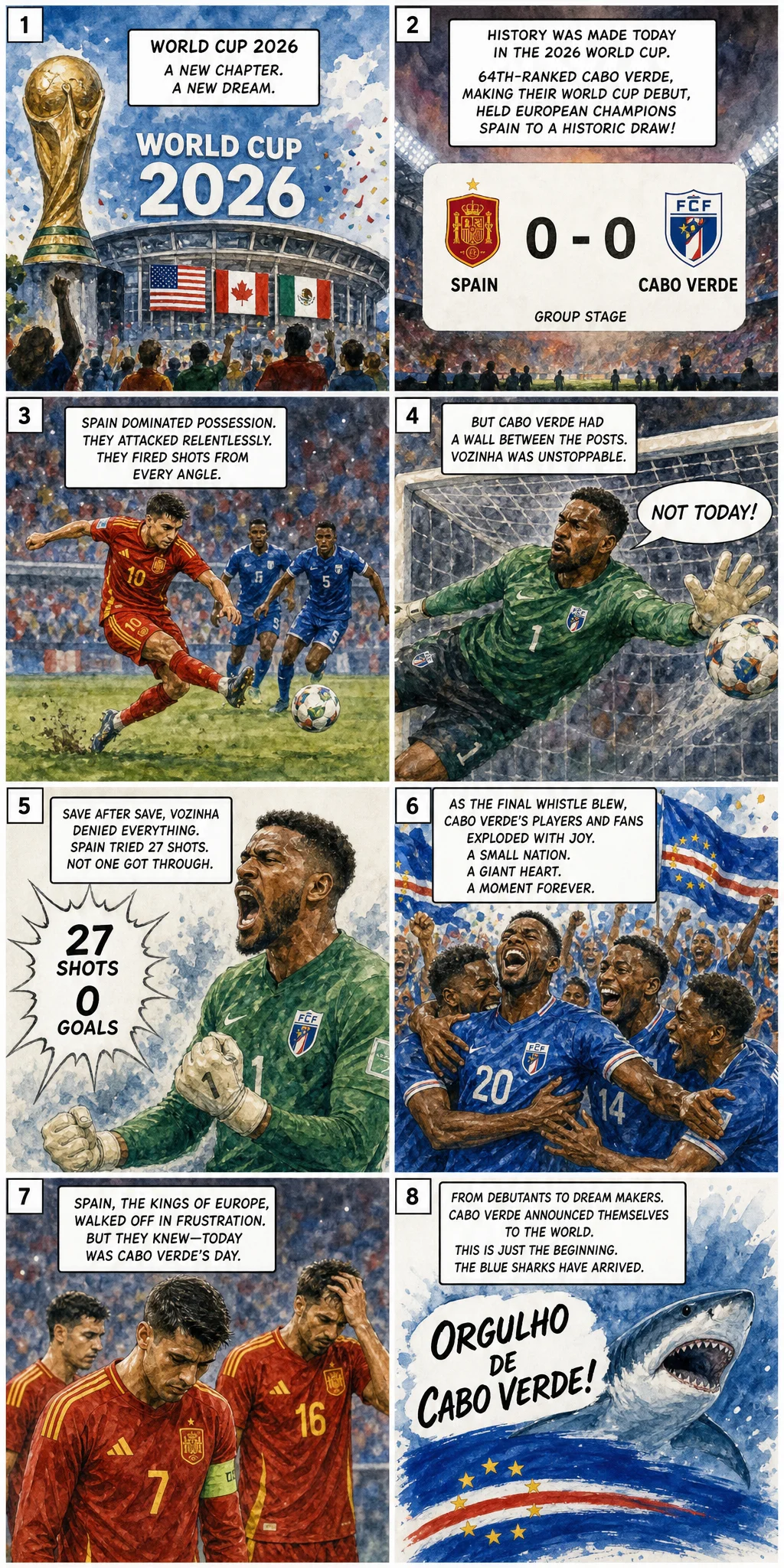
Comic content and match statistics are for entertainment purposes only and may contain inaccuracies. For Accurate Data, please refer to the reference's official website.
# Spain 0–0 Cabo Verde: The Night the Smallest Nations Redrew the Boundaries of Possibility
In the long, tangled history of the World Cup, stretching back to that July afternoon in Montevideo when Lucien Laurent scored the tournament's first goal and no one thought to record it properly because the very idea of a "World Cup" was still an abstraction, there have been results that shook the foundations of the game's assumed order. The United States beating England in 1950, when the New York Times refused to print the scoreline because the editors believed their reporter had filed a practical joke. North Korea's Pak Doo-Ik eliminating Italy in 1966. Cameroon's nine men — nine! — defeating Diego Maradona's Argentina at San Siro in 1990. Senegal over France in Seoul in 2002. Each of these results occupies its own stratum in the archaeology of football's collective memory, a layer of sediment deposited by the seismic collision between expectation and reality.
What happened at the Mercedes-Benz Stadium in Atlanta on the evening of Monday, June 15, 2026, deserves a stratum of its own. Spain, European champions, ranked third in FIFA's deeply flawed but nonetheless widely cited hierarchy of nations, masters of a possession tradition whose intellectual genealogy runs back through Guardiola, through Cruyff, through Rinus Michels, to the very origins of what we have come to call modern football — this Spain was held to a goalless draw by Cabo Verde, a nation of approximately 590,000 people scattered across ten volcanic islands in the central Atlantic Ocean, making its World Cup debut as the third-smallest sovereign state ever to qualify for the tournament. The scoreline read 0–0. The implications cannot be captured by two digits.
## The Geography of the Improbable
To understand what unfolded in Atlanta, one must first understand the scale of the asymmetry. Cabo Verde's entire population — roughly equivalent to that of Sheffield or Las Palmas de Gran Canaria — could fit comfortably inside the Camp Nou, and there would be seats to spare. The nation's football federation, founded in 1982, is younger than Spain's La Roja brand. When Spain won their first European Championship in 1964, Cabo Verde was still a Portuguese overseas province, its footballers ineligible to represent any national team other than the Seleção das Quinas. By the time independence arrived in 1975, Spain had already contested three World Cups.
This is not mere statistical trivia; it is the essential context for understanding why what happened in Atlanta constitutes something far more significant than a footballing anomaly. The result is not best understood through the lens of tactics — though tactics played their part — but through the deeper, slower-moving currents of football history: the democratisation of the international game, the closing of competitive gaps that once appeared unbridgeable, and the peculiar power of organisation and belief to neutralise vastly superior individual talent.
There is a temptation, irresistible to the modern football commentariat, to frame such results as "giant-killings" or "fairytales." Both terms are deeply inadequate. A fairytale implies a one-off, a narrative that cannot be replicated, a suspension of normal laws. But what Cabo Verde achieved was not magic. It was the product of a specific set of conditions — tactical discipline, psychological preparation, and the peculiar dynamics of tournament football's opening round — that have been producing similar outcomes with increasing frequency in the 21st century. The question is not "How could this happen?" but rather "Why does this keep happening, and what does it tell us about the state of the international game?"
## The Architecture of Resistance
The tactical dimension of the match was, in one sense, straightforward. Cabo Verde deployed what might be described — without the slightest hint of condescension — as a defensive architecture of extraordinary coherence. Their formation, nominally a 5-4-1, was less a formation than a manifesto: ten outfield players arranged in two compact lines behind the ball, the distance between the defensive line and the midfield line never exceeding 10 to 12 metres, compressing the space into a suffocating rectangle that Spain spent 94 minutes trying and failing to penetrate.
This was not, it must be emphasised, the desperate, last-ditch defending of a team clinging to survival. It was the reasoned, methodical application of a defensive principle that traces its lineage back at least to Helenio Herrera's catenaccio — though Cabo Verde's coach would likely bristle at the comparison. The system worked because every player understood not only their individual responsibility but the geometric logic of the collective shape. When Spain shifted the ball laterally, the entire Cabo Verde block shifted in unison, like the synchronized movement of a murmuration of starlings, each individual responding to a cue that seemed to bypass conscious thought.
The statistics, as they so often do, tell a partial truth. Spain enjoyed 74.2% possession. Spain attempted 27 shots to Cabo Verde's six. Spain forced 11 corners while conceding only one. These numbers suggest dominance, and in territorial terms, dominance is precisely what occurred. But possession statistics, as the late Johan Cruyff himself observed, are meaningless without the context of what the possession achieves. Spain's 74% produced an expected goals tally — if one is inclined to trust such metrics — that barely exceeded 1.5. The territory was Spain's; the space that mattered — the space inside the Cabo Verde penalty area, the space between the posts — belonged to no one.
## Vozinha: The Keeper as Metaphor
The individual performance of Josimar "Vozinha" Dias, Cabo Verde's 40-year-old goalkeeper, demands its own section not merely because of its quality, but because of what it represents. Vozinha — the nickname means "Little Voice" in Cabo Verdean Creole, a diminutive that belies the authority of his presence — produced a performance that any goalkeeper in the history of the tournament would have been proud to claim. His double save in the 39th minute, parrying Ferran Torres's close-range strike that had rebounded off the crossbar and then scrambling to deny Mikel Oyarzabal's header on the follow-up, was the kind of sequence that goalkeepers train for their entire careers and rarely execute under the white heat of World Cup conditions.
But to reduce Vozinha's contribution to a catalogue of saves is to miss the larger point. A goalkeeper who plays for a club outside Europe's major leagues, who spent most of his career in the modest stadiums of the Cabo Verdean championship and the lower divisions of Portuguese football, who at 40 has accumulated more wisdom than his reflexes can always express — this goalkeeper was not merely having the game of his life. He was demonstrating, in the most visceral terms, that the gap between the world's third-ranked team and its 64th-ranked team can be narrowed to zero by the application of human qualities — courage, concentration, timing, instinct — that transcend rankings and reputations.
There is a tradition in Brazilian football of the goleiro poeta, the poet-goalkeeper, a figure who stands apart from the outfield system, watching the game from a unique vantage point and interpreting it through a different lens. Vozinha, fluent in the Lusophone football culture that connects Cabo Verde to its former colonial power and to Brazil, embodied this archetype in Atlanta. He was not merely saving shots; he was reading Spain's intentions, anticipating angles before they materialised, closing down space before Spain's attackers had even decided to enter it. His performance was a masterclass in the art of goalkeeping as a form of spatial intelligence.
## Lamine Yamal and the Burden of Expectation
Inevitably, much of the post-match analysis centred on Lamine Yamal, Spain's 18-year-old winger whose World Cup debut had been delayed by a minor injury. Yamal entered the match in the 71st minute, replacing Gavi — a substitution that, on paper, injected the tournament's most exciting young talent into a match crying out for a moment of individual genius. The script, beloved by television producers and headline writers, practically wrote itself.
Football's scripts, however, are written by neither television producers nor headline writers. They are written by the unpredictable intersection of 22 individual wills, the physics of a sphere of pressurized air, and the intangible currents of pressure and psychology that swirl around any World Cup match. Yamal, for all his precocious talent — and those who have followed his trajectory from La Masia to the Camp Nou first team know that the word "precocious" barely captures the scale of his gift — could not, in 23 minutes plus stoppage time, dismantle a defensive structure that had been 90 minutes in the forging. He tried. He drifted infield. He sought the ball in pockets of space. He attempted the kind of incisive pass that, in the Barcelona colours, routinely unlocks defences. But this was not a Barcelona match, and Cabo Verde were not a La Liga opponent obligingly deploying a high defensive line.
The failure to break through should not be laid at Yamal's feet. The very expectation that a single player, however gifted, should be able to resolve a collective problem is itself a symptom of football's ongoing romance with the myth of the individual saviour — a romance that the sport's history routinely disproves. The great Brazilian team of 1970, the Dutch Totaalvoetbal of 1974, the Spanish tiki-taka of 2008–2012: these were collective achievements, expressions of systemic thinking, not the work of lone geniuses. Yamal is a prodigious talent, but even prodigious talents operate within systems. On this night, Spain's system — for all its possession, for all its territorial dominance — lacked the specific tools required to dismantle the particular defensive edifice that Cabo Verde had constructed.
## The Question of Spain's Identity
The result poses uncomfortable questions about this Spain team, questions that extend beyond the immediate disappointment of a single result. Spain have always occupied an ambiguous position in the taxonomy of international football. At their best — in the summers of 2008, 2010, and 2012 — they represented the apotheosis of a footballing philosophy, the triumphant vindication of the idea that the ball, properly controlled, is the ultimate defensive and offensive weapon. At their less-than-best, they have been vulnerable to precisely the kind of disciplined, deep-lying defensive strategy that Cabo Verde deployed.
The pattern is not new. Spain's 2014 defence of their World Cup title ended in the group stage at the hands of a Netherlands team that pressed them into submission and a Chile side that refused to be cowed by reputation. In 2018, Russia's deep defensive block and penalty-shootout lottery eliminated them in the round of 16. In 2022, Morocco's similarly disciplined resistance did the same. The recurrence of this pattern — Spain dominating possession, creating chances of moderate rather than acute quality, and ultimately failing to convert territorial supremacy into goals — suggests something structural rather than coincidental.
This is not to diminish Cabo Verde's achievement by reframing it as Spain's failure. The two are inseparable, and football history does not hand out asterisks. But the analyst, as distinct from the journalist or the fan, must ask: what is it about the current iteration of the Spanish national team that makes it susceptible to this particular species of frustration? The answer, perhaps, lies in the quality of the movement in the final third — too often static, too often waiting for the ball to arrive rather than creating the space into which it can be played — and in the absence of the kind of centre-forward whose gravitational pull creates chaos in organised defences. Álvaro Morata, for all his qualities, has never been that player in the national team context; the alternatives on the bench offered different characteristics but not fundamentally different solutions.
## The Meaning of the Result
What, then, does Spain 0–0 Cabo Verde mean? On the most immediate level, it means that Group H — which also contains Saudi Arabia, a team that has invested unprecedented resources in football development, and Uruguay, a nation of 3.4 million people who have nonetheless won two World Cups and whose football culture is among the richest on the planet — is now more unpredictable than any pre-tournament analysis suggested. Cabo Verde's point, earned against the group's theoretical strongest team, transforms the geometry of qualification. Every subsequent match in the group now carries different weight, different calculations, different anxieties.
On a deeper level, the result is a data point in football's ongoing narrative of convergence. The international game has been compressing for decades. The tactical sophistication once reserved for Western Europe's elite leagues and national teams has diffused, through the mechanisms of global broadcasting, international coaching education, and the diaspora of players and coaches across borders, to every corner of the football world. Cabo Verde's defence in Atlanta was not the product of spontaneous heroism but of systematic preparation, of coaching knowledge that would have been unavailable to a nation of this size and circumstance even a generation ago.
And on the deepest level of all — the level at which football, as Simon Kuper once observed, is "never just football" — the result is a reminder of why this tournament continues to matter. The World Cup is not merely a competition to determine the world's best football team; it is a theatre of human possibility, a space in which the assumed hierarchies of the sport can be — must be, from time to time — overturned. The 64th-ranked nation in the world, population half a million, held the European champions to a goalless draw in a stadium built for the NFL. If that does not quicken the pulse, if that does not stir something in the soul, then football has lost its power over you.
Cabo Verde will leave Atlanta — they face Saudi Arabia next in Philadelphia, then Uruguay in Los Angeles — knowing that they have already achieved something historic, but also knowing that history is not a destination. History is a process. And this process, this improbable, beautiful, bewildering process, has only just begun.
The score was 0–0. The meaning is infinite.