

Saudi Arabia 1-1 Uruguay: When History Refuses to Follow the Script
World Cup 2026 Group H. Saudi Arabia earned a historic point against Uruguay at Hard Rock Stadium, Miami. Abdulelah Al-Amri scored first from a corner rebound, before Maximiliano Araujo's 79th-minute equaliser salvaged a draw for Marcelo Bielsa's side.
Published: June 16, 2026
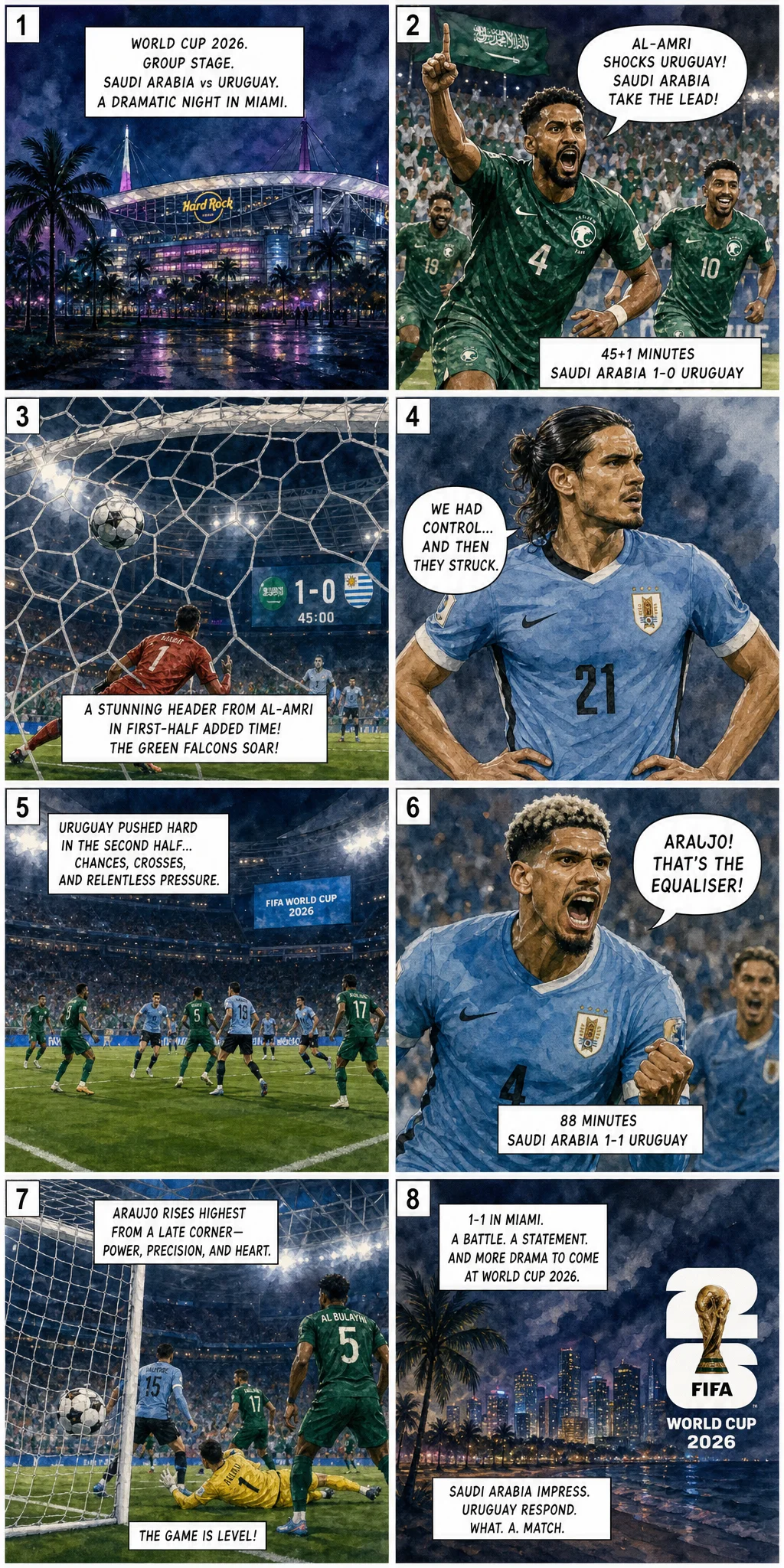
Comic content and match statistics are for entertainment purposes only and may contain inaccuracies. For Accurate Data, please refer to the reference's official website.
# Saudi Arabia 1–1 Uruguay: When History Refuses to Follow the Script
There is a particular kind of silence that follows an unexpected World Cup result — not the silence of emptiness, but the silence of recalibration. It is the sound of millions of people simultaneously adjusting their understanding of what is possible, of what the tournament's narrative had promised them, of who these players on the screen actually are. That silence descended on the Hard Rock Stadium in Miami at the final whistle on Monday night, settling over a crowd that had come expecting one story and been given another entirely.
The scoreboard read Saudi Arabia 1, Uruguay 1. The implications would take considerably longer to process.
Uruguay are not merely a football team; they are a historical project. A nation of three and a half million people wedged between Brazil and Argentina on the eastern edge of South America, Uruguay have won two World Cups, the most recent of them in 1950 at the Maracanã — still the most traumatic event in Brazilian sporting history, still the wound that will not close. They have produced more footballers of genuine world-class quality per capita than any nation on earth. Their identity is built, in part, on the refusal to accept that size determines destiny. When Uruguayans speak of garra charrúa — that untranslatable compound of grit, defiance, and indomitable will — they are not merely describing a style of play. They are articulating a national philosophy.
Saudi Arabia, by contrast, arrived at this World Cup carrying an entirely different historical weight. A nation whose football identity has been constructed largely in the past three decades, accelerated by vast investment and an explicit state project to become a serious football power. The Saudi league's transformation — the arrival of global superstars on contracts that rewrote the economics of the sport — has been impossible to ignore, but it has also been impossible to separate from the broader questions that accompany it: about sportswashing, about the relationship between football and political power, about what it means for a nation to purchase relevance rather than earn it through the slow accumulation of footballing tradition. These are uncomfortable questions, and they resist easy answers. But they are not questions that disappear simply because a match kicks off.
The Hard Rock Stadium, a venue more accustomed to hosting NFL Sundays and Rolling Stones concerts than World Cup group-stage drama, provided an appropriately dislocated setting. This was not Montevideo's Estadio Centenario, where the first World Cup final was played in 1930, nor the King Fahd International Stadium in Riyadh. It was a neutral ground in the most literal sense: a place with no historical claim on either side, a blank canvas on which both teams would attempt to impose their competing visions.
The first half unfolded according to a pattern that, for long stretches, appeared to confirm the pre-match assumptions. Uruguay, managed by Marcelo Bielsa — a man whose entire career has been an extended argument about the primacy of principles over pragmatism — controlled the ball and the territory. Federico Valverde, operating in the midfield role that has become his default setting for both club and country, dictated tempo with the quiet authority of a player who has long since ceased to be surprised by his own excellence. Darwin Núñez, leading the line with the chaotic energy that makes him simultaneously devastating and unpredictable, worked the channels. Uruguay were not dominant, but they were in charge. The sense was of a team waiting for the moment to arrive.
The moment arrived in the 41st minute, but it arrived for the wrong team.
A Saudi Arabian corner, swung in from the left by Salem Al-Dawsari — the winger whose goal against Argentina in the opening match of the 2022 World Cup had been the first indication that Qatar's tournament would not respect the established order — floated toward the near post. Fernando Muslera, Uruguay's 40-year-old goalkeeper, came to claim it and did not. The ball spilled from his grasp, a moment of uncertainty that is every goalkeeper's private nightmare rendered public, and there, reacting faster than any Uruguayan defender, was Abdulelah Al-Amri. The centre-back stabbed the ball home from close range. The Hard Rock Stadium, temporarily transformed into a small corner of Riyadh, erupted.
The goal was not the product of sustained tactical pressure or a carefully constructed attacking sequence. It was simpler than that, and in its simplicity lay something approaching profundity: a set piece, a goalkeeper's error, a defender doing what defenders in the opposition penalty area are not supposed to do but occasionally, gloriously, do anyway. These are the goals that World Cups are built from — not the ones that can be diagrammed on a tactics board, but the ones that emerge from the chaos that no system can fully eliminate.
Al-Amri's goal meant that Saudi Arabia had scored first in a World Cup match for the first time since Saeed Al-Owairan's immortal solo run against Belgium in 1994. That goal — Al-Owairan picking up the ball inside his own half, slaloming through five Belgian defenders, and finishing as if he had been doing it every day of his life — remains one of the tournament's most replayed moments. Al-Amri's was not in the same category of aesthetic achievement, but its emotional resonance was comparable. The past, for Saudi football, had suddenly stopped being a weight and become a platform.
The second half was Bielsa's half, in the sense that it was Bielsa who had the problem to solve. His response was characteristically aggressive: Darwin Núñez removed, Federico Viñas introduced, the shape adjusted to push more bodies into the Saudi penalty area. The question, as it so often is with Bielsa's teams, was whether the intensity of the response would generate a goal before the intensity exhausted the players attempting to deliver it.
The answer arrived in the 79th minute. Viñas, whose introduction had added physical presence to the Uruguayan attack, unleashed a shot from the edge of the area that was struck with sufficient venom to trouble any goalkeeper. Mohammed Al-Owais, the Saudi goalkeeper, managed to parry the effort — but the parry was not definitive. The ball looped into the path of Maximiliano Araújo, the 26-year-old who plays his club football in Mexico with Toluca, and Araújo did what footballers train to do from the moment they first kick a ball: he followed the shot, believed in the possibility of a rebound, and converted the gift.
The goal was Araújo's third for Uruguay, and none of the previous two had been scored on a stage remotely comparable to this one. It was also, in its way, a goal that embodied the contradictions of this Uruguay side: a team that under Bielsa has sought to play with greater attacking ambition than any recent Uruguayan iteration, yet a team that still relies, when the situation demands it, on the oldest instincts of the game — press, shoot, follow up, score.
The final ten minutes plus stoppage time were played at an intensity that the preceding eighty had only intermittently approached. Both teams pushed for a winner, and both teams were too exhausted — physically, emotionally, tactically — to find one. The draw was imperfect for both sides, insufficient for both sides, and yet, in the cold mathematics of group-stage progression, entirely acceptable for both sides.
What does it mean, this 1–1 draw between Saudi Arabia and Uruguay in the opening round of Group H? On the surface, it means that both teams have one point, that the group is now poised in a state of productive uncertainty, and that the fixtures to come — Uruguay against Spain, Saudi Arabia against Cabo Verde — carry an urgency they might otherwise have lacked. Beneath the surface, the meaning is more elusive and more interesting.
For Saudi Arabia, the result was a vindication of a football project that has been widely, and not always unfairly, dismissed as a vanity exercise. The Saudi league's spending has been characterised as an attempt to purchase legitimacy, and the accusation is not without foundation. But football has a way of resisting reduction to political calculus. The players on the pitch in Miami were not the instruments of a state project; they were footballers doing what footballers do, and Abdulaleh Al-Amri scoring from a corner rebound cannot be dismissed as a function of sovereign wealth. Sometimes a goal is just a goal, and sometimes a draw is just a draw, and sometimes the simplest explanation is the truest one: Saudi Arabia played well enough to deserve a point against one of the tournament's most storied nations, and they got one.
For Uruguay, the result was a warning. Bielsa's project — to transform Uruguay from a team defined by defensive resilience and opportunism into one capable of imposing itself through possession and positional play — is ambitious and admirable, but it is also fragile. The absence of José Giménez and Ronald Araújo in defence was evident not only in the goal Uruguay conceded but in the uncertainty that permeated their defensive organisation whenever Saudi Arabia advanced beyond the halfway line. The equaliser, when it came, was a product of individual instinct rather than systemic design. That is not sustainable over the course of a tournament in which Uruguay will face Spain — the European champions, whatever their opening draw against Cabo Verde might suggest — and a Cabo Verde side that has already demonstrated its capacity to frustrate superior opponents.
The larger meaning, perhaps, is this: the World Cup remains the most democratic institution in global sport, not because of FIFA's governance structures — on that front, the tournament is irredeemably autocratic — but because of what happens on the pitch. In ninety minutes, plus stoppage time, the accumulated hierarchies of world football can be suspended. Saudi Arabia and Uruguay drew 1–1. The scoreline is a fact. The meaning is still being written.