

Belgium 1-1 Egypt: Lukaku's Gravity, Salah's Precision, and the Own Goal That Defined a Tactical Stalemate
World Cup 2026 Group G. Belgium and Egypt drew 1-1 at Lumen Field, Seattle. Emam Ashour scored a stunning 19th-minute opener assisted by Salah, before Mohamed Hany's own goal levelled the match seconds after Romelu Lukaku's introduction.
Published: June 15, 2026
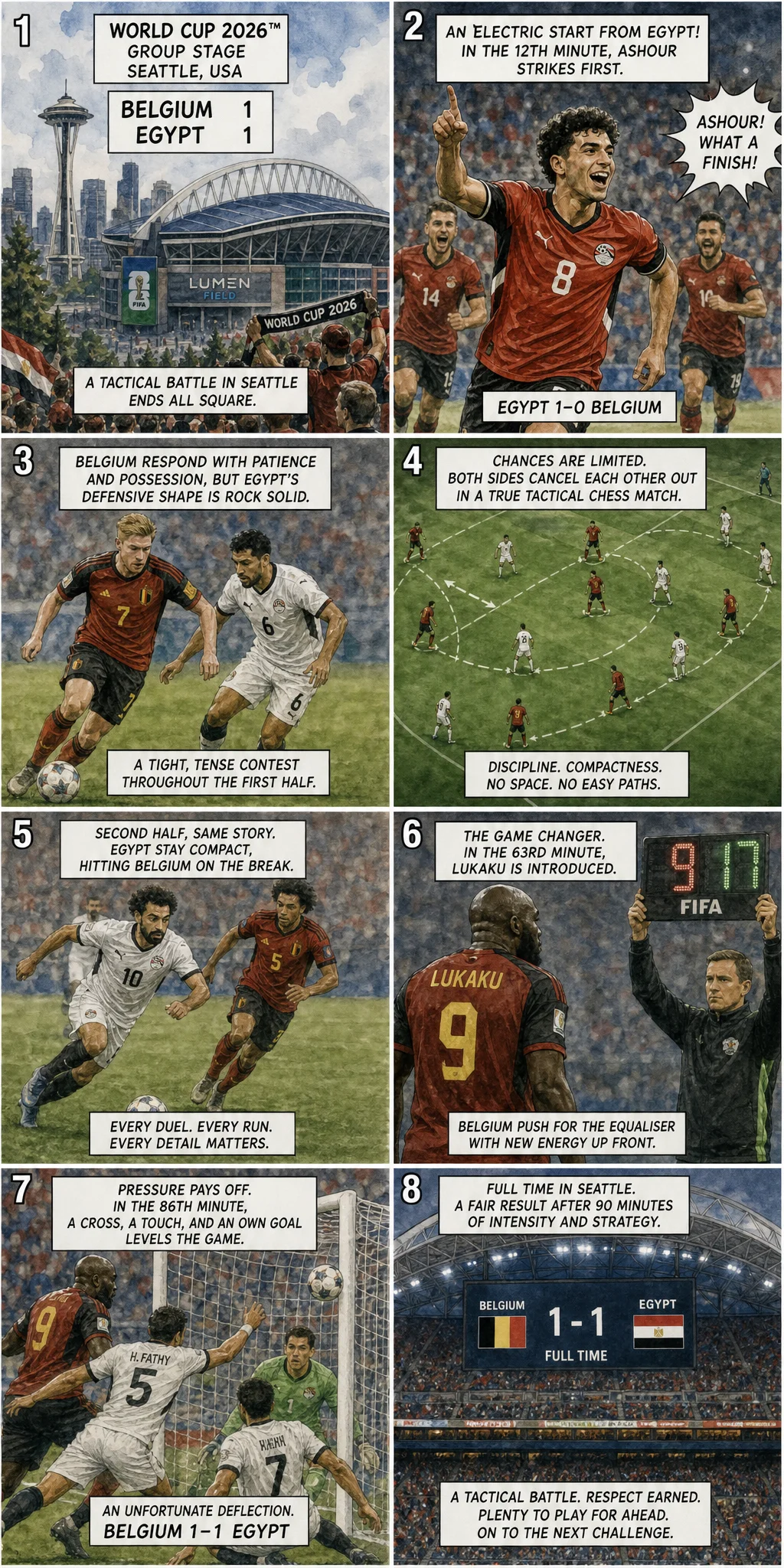
Comic content and match statistics are for entertainment purposes only and may contain inaccuracies. For Accurate Data, please refer to the reference's official website.
# Belgium 1–1 Egypt: Lukaku's Gravity, Salah's Precision, and the Own Goal That Defined a Tactical Stalemate
Opening matches at World Cups are rarely tactical blueprints. The combination of nerves, incomplete match fitness, and the simple fact that neither side has yet been forced to reveal its true shape means that the first round of group fixtures tends to produce football that is reactive rather than proactive, shaped more by what teams are afraid of losing than by what they intend to win. Belgium's 1–1 draw with Egypt at Lumen Field in Seattle was, in this respect, a perfectly orthodox opening match — which is to say it was a contest defined by two contrasting defensive structures, one moment of attacking clarity from each side, and a second half in which the introduction of a single substitute altered the geometry of the entire match.
## Belgium's 4-2-3-1 Against Egypt's 5-3-2 Mid-Block
The tactical framework was established within the opening five minutes. Belgium, managed by Domenico Tedesco, set up in their customary 4-2-3-1 shape without the ball, but in possession the structure morphed into something closer to a 3-2-5 — Timothy Castagne advancing from right-back to form a back three with Wout Faes and Zeno Debast, while the left-back pushed high to provide width on the opposite flank. The intention was clear: create a numerical advantage in the first line of buildup (three versus Egypt's two forwards), freeing one of the double pivot to receive between the lines.
Egypt, under Hossam Hassan, responded with a 5-3-2 mid-block that was less about pressing high and more about closing the passing lanes into Belgium's most dangerous spaces — specifically the half-spaces where Kevin De Bruyne likes to operate. The two Egyptian forwards, Mohamed Salah and Mostafa Mohamed, did not engage in a coordinated press on Belgium's centre-backs; instead they positioned themselves to screen passes into the double pivot while Emam Ashour, the most advanced of Egypt's midfield three, tracked De Bruyne's movements with a diligence that would define the first half.
The result was a possession map that told a misleading story. Belgium enjoyed 58.3% possession in the first half but registered zero shots on target — a statistical anomaly that can only be explained by the quality of Egypt's defensive organisation. Belgium were not being prevented from having the ball; they were being permitted to have it in areas where it could not hurt them. The space between Egypt's defensive line and their midfield line was compressed to approximately 15 metres, leaving De Bruyne and Charles De Ketelaere with no pocket to receive and turn. Egypt were, in effect, playing a game of spatial denial — conceding territory while protecting the zones that actually matter.
## Ashour's Goal: The Geometry of a Long-Range Strike
The opening goal, when it arrived in the 19th minute, was the product of a transition moment that exposed the one structural vulnerability in Belgium's attacking shape. When Belgium lost possession high up the pitch — Leandro Trossard attempting a through ball that was intercepted by Ahmed Fatouh — the back three had already shifted into its attacking configuration, with Castagne advanced on the right. Egypt's transition was vertical and direct: Fatouh to Salah in the inside-right channel, Salah drawing two Belgian defenders toward him before laying the ball laterally to Emam Ashour, who had arrived at the edge of the area after a 40-metre sprint from his own half.
Ashour's finish was a strike of considerable technical quality — hit with the instep from 22 metres, the ball arrowing into the bottom-right corner past Thibaut Courtois's dive — but the goal itself was less about individual brilliance than about the exploitation of space. Belgium's attacking structure, designed to create overloads in possession, had left a gap of approximately 25 metres between the defensive line and the midfield line during the transition. Ashour occupied precisely that space. The goal was not, in the tactical sense, a surprise; it was the logical consequence of the shape Belgium had chosen to adopt.
The statistics at half-time painted the picture of a Belgium side that had controlled the ball without controlling the game. Possession: Belgium 58.2%. Passes completed: Belgium 287, Egypt 164. But the Expected Goals tally told a different story: Belgium 0.31, Egypt 0.44. Egypt had created the better chances despite having less of the ball. Their shot map — one from Ashour's goal, one from a Salah header saved by Courtois — showed two efforts from inside the penalty area. Belgium's shot map showed four efforts, all from outside the box, none on target.
## De Bruyne's Free-Kick and the Half-Space Problem
The second half began with an incident that crystallised Belgium's attacking problem. In the 52nd minute, Belgium won a free-kick 22 metres from goal, slightly to the left of centre. De Bruyne, whose ability to bend the ball over a wall and into the top corner is among the most reliable weapons in Belgium's attacking arsenal, struck the ball cleanly — and watched it rebound off the outside of the post.
The free-kick was close, but it was also symptomatic. Belgium's best chance of the half had come not from open-play construction but from a dead-ball situation. In open play, Belgium continued to find the half-spaces blocked. De Bruyne, who for Manchester City routinely receives the ball in the right half-space with time to turn and assess his options, was being forced to receive with his back to goal, a defender within touching distance. His pass map from the second half shows a player operating 5 to 8 metres deeper than his optimal position — a function of Egypt's midfield block refusing to be drawn out of shape.
The issue was not De Bruyne's movement but Belgium's failure to create the conditions for him to operate in. When a team plays with a single pivot — as Belgium effectively did in their 3-2-5 attacking shape, with the double pivot reduced to one holder as the other pushed forward — the opposition's defensive strategy is simple: mark the advanced midfielder, block the passing lane from the centre-backs, and force the ball wide. Belgium's full-backs saw more of the ball than any other players on the pitch in the second half (Castagne 47 touches, Maxim De Cuyper 41), but the quality of delivery from wide areas was insufficient to trouble Egypt's three centre-backs.
## The Lukaku Substitution and the Physics of an Own Goal
The match's defining tactical moment arrived in the 65th minute, when Tedesco introduced Romelu Lukaku for Lois Openda. The substitution was not merely a change of personnel; it was a change of physics. Lukaku, at 191 centimetres and approximately 94 kilograms, introduces a different kind of gravitational field into a penalty area. Defenders who had been comfortable dealing with Openda's movement in behind suddenly found themselves having to contest aerial balls, hold their ground against a player who could back into them, and — most critically — adjust their positioning to account for the simple fact of Lukaku's presence.
The equaliser, which arrived within 60 seconds of Lukaku's introduction, was officially recorded as a Mohamed Hany own goal. A cross from the right flank — delivered by Castagne after De Bruyne had switched the play — was directed into the six-yard box. Lukaku's run toward the near post drew two Egyptian defenders, including Hany, whose attempted clearance sliced off his right foot and looped over goalkeeper Mohamed El Shenawy into the far corner.
To describe this as luck would be to misunderstand the nature of attacking pressure in football. Own goals are not random events; they are the product of defenders being forced to make decisions under physical and spatial duress. Lukaku did not touch the ball during the sequence, but his movement created the conditions for the error — pulling Hany toward the near post, forcing him to adjust his body shape while the ball was travelling, and leaving him attempting a clearance from an awkward position. The own goal was, in the tactical sense, an assist of a different kind — an assist created not by a pass but by the manipulation of defensive positioning through physical presence.
## Belgium's Push and Egypt's Defensive Resilience
The final 25 minutes followed a pattern that was predictable but no less absorbing for it. Belgium, with Lukaku now offering a focal point, pushed their defensive line higher and committed more numbers forward. Tedesco replaced De Ketelaere with Jérémy Doku, adding directness and one-against-one threat to the Belgian attack. The shape shifted to something approaching a 3-1-6 in the attacking phase, with the double pivot effectively abandoned in favour of a single holder and five players occupying the forward line.
Egypt responded by compressing their shape even further. The 5-3-2 mid-block became a 5-4-1 low block, with Salah and Mostafa Mohamed dropping into the two banks of four to form a structure that left Belgium with possession in areas from which they could not penetrate. The midfield three of Ashour, Hamdi Fathi, and Mahmoud Trezeguet — the latter having been substituted into the match — formed a narrow, compact unit that effectively sealed the central channel. Belgium were forced wide repeatedly, and while Doku's introduction added penetration on the left — he completed four dribbles in his 25-minute appearance — the final ball consistently found an Egyptian head or a goalkeeper's gloves.
The Expected Goals tally for the final quarter-hour told the story: Belgium 0.17, Egypt 0.04. Belgium had pushed and probed, but they had not created a single clear chance. Egypt's defensive structure, built on positional discipline rather than last-ditch tackling, had absorbed the pressure without cracking.
## What the Result Means for Group G
From a tactical perspective, this match offered a template for how both Belgium and Egypt will approach the remainder of their Group G fixtures — and, equally, a template for how their opponents might approach them. Belgium's vulnerability to a compact mid-block, particularly when their full-backs are asked to provide the width and the half-spaces are denied to De Bruyne, is a known quantity. Iran and New Zealand, Belgium's remaining opponents, will have studied Egypt's first-half structure with considerable interest. The introduction of Lukaku clearly altered Belgium's attacking geometry, but the question Tedesco must answer is whether his side can create high-quality chances without relying on a substitution to change the physics of the match.
For Egypt, the performance was tactically astute and structurally sound. The 5-3-2 mid-block functioned as designed, and the transition moments — limited though they were — produced the game's best chance. The concern, if there is one, is sustainability: defending in a compact block for extended periods requires immense concentration and physical output, and Egypt's squad depth will be tested as the tournament progresses. But for a team still seeking their first World Cup victory, this was a performance that demonstrated clear tactical identity — and that, in the modern international game, is half the battle.
The score was 1–1. The tactical story was richer than the scoreline suggests.