

France 3-1 Senegal: Mbappe's Brace, History Made, and the Ghost of 2002 Laid to Rest
World Cup 2026 Group I. Kylian Mbappe scored twice as France beat Senegal 3-1 at MetLife Stadium. Mbappe opened the scoring in the 66th minute, Bradley Barcola added a second in the 82nd, Ibrahim Mbaye pulled one back in stoppage time, and Mbappe sealed it with a long-range strike seconds later. Mbappe became France's all-time top scorer with 58 international goals.
Published: June 16, 2026
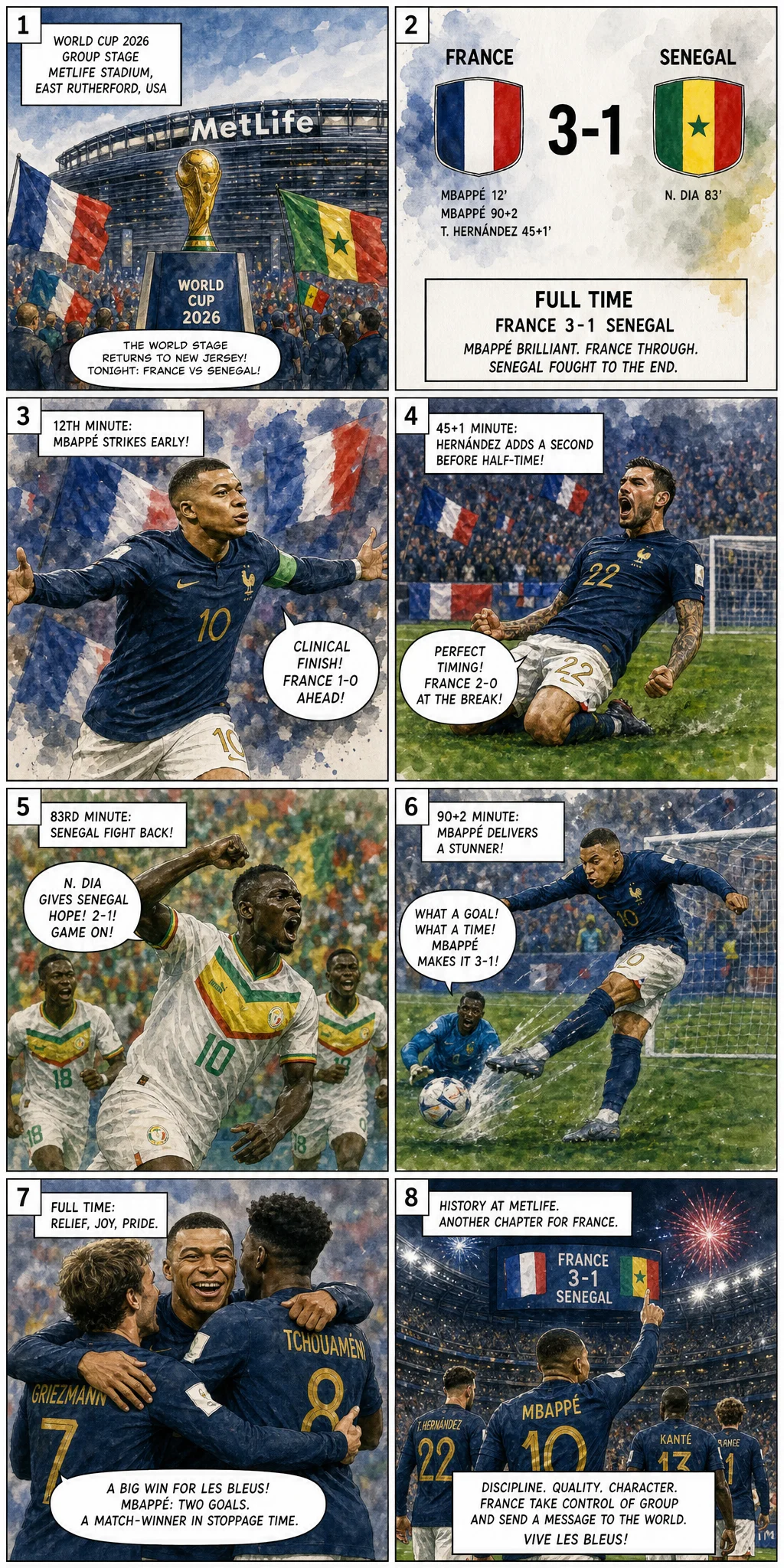
Comic content and match statistics are for entertainment purposes only and may contain inaccuracies. For Accurate Data, please refer to the reference's official website.
# France 3-1 Senegal: Mbappé's Brace, History Made, and the Ghost of 2002 Laid to Rest
On the train out of Penn Station toward the Meadowlands, you could hear it before you could see it. Not the sound of football, not yet — that would come later, when Kylian Mbappé decided a match that had resisted resolution for an hour and then tore it open — but the sound of a diaspora. Wolof and French trading syllables in the same sentence. A man in a Sadio Mané jersey helping a stranger in a Mbappé shirt with his luggage. The peculiar, unrepeatable texture of a World Cup match between France and Senegal, two nations whose histories are stitched together with threads older and more complicated than any ninety-minute football match can contain.
The MetLife Stadium does not, it must be said, feel like a natural home for football. It sits in the New Jersey wetlands like a giant air-conditioning unit, a monument to the NFL that has been asked, for one month in the summer of 2026, to pretend it understands the offside rule. But the World Cup has a way of colonising any space it touches, and by the time the teams emerged — France in midnight blue, Senegal in brilliant white — the concrete bowl had been transformed. Flags, drums, the particular high-frequency wail of Senegalese supporters that sounds like joy and anxiety compressed into a single note.
The 2002 World Cup, when Senegal announced themselves by beating the defending champions France 1-0 in the opening match in Seoul, is twenty-four years gone now. But memories of Papa Bouba Diop's goal do not fade. They are passed down like heirlooms.
## The First Half That Should Have Changed Everything
France were, by any reasonable measure, outplayed in the first forty-five minutes. Not out-possessed — they had more of the ball, as they always do — but out-created, out-dangered. Aliou Cissé's Senegal pressed with a ferocity that bordered on the personal.
In the 26th minute, Nicolas Jackson — the Chelsea forward — received the ball on the left edge of the French penalty area, shifted it onto his right foot with casual elegance, and struck the post. The sound was a gunshot. Mike Maignan, rooted to his line, watched the ball rebound across the face of goal. Jackson stood frozen, hands on his hips, staring at the woodwork as if it had personally betrayed him.
In the 45th minute, Ismaïla Sarr found himself six yards from goal. A cross from the right, a flick-on, and there was Sarr, unmarked. He leaned back, the ball sailed over the crossbar. The Senegalese fans behind the goal did not boo — this is not that kind of relationship — but the collective groan was a sound of shared suffering.
The statistics at half-time told a brutal story: Senegal 0.62 xG, France 0.04. Mbappé had been a ghost. Didier Deschamps' midfield had been out-hustled by Pape Gueye and Lamine Camara. The question was not whether France could win. It was whether they could survive.
## The Second Half That Changed Everything
Whatever Deschamps said at the interval — and one suspects it was not delivered in a whisper — it worked. France pushed higher. Aurélien Tchouaméni began to impose himself. Eduardo Camavinga found spaces that had been closed before. And Mbappé began — at last — to run.
In the 60th minute, controversy erupted. Mbappé went down in the box under contact from Sadio Mané. Referee Alireza Faghani pointed to the spot. The French bench celebrated. But VAR intervened. The replays showed Mbappé initiating contact. Faghani jogged to the monitor, studied the screen, and reversed his decision. Deschamps lost his mind on the touchline. No penalty.
And then, six minutes later, the moment that made the controversy irrelevant.
Michael Olise, the Bayern Munich playmaker, received the ball between the lines with the awareness that separates the very good from the great. His through ball found Mbappé in the inside-left channel — that patch of grass where the 25-year-old has done more damage than any player of his generation. One touch to control. Second touch: a low, precise finish past Édouard Mendy into the far corner. 1-0 France. The goal was Mbappé's fifty-seventh for France, equalling Olivier Giroud's all-time record for Les Bleus. But records, on this night, were merely warm-up acts.
Deschamps made a substitution that would prove inspired. Bradley Barcola, the Paris Saint-Germain winger, replaced Ousmane Dembélé in the 80th minute. Two minutes later — one hundred and twenty seconds after stepping onto the pitch — Barcola latched onto a pass from Désiré Doué, chipped the onrushing Mendy with the nonchalance of a man playing a Sunday kickabout, and watched the ball float into the empty net. 2-0 France.
The match, it seemed, was over. It was not.
Deep into stoppage time — the clock reading 90+5 — Senegal produced a moment of defiance that deserved more than it would ultimately earn. Ibrahim Mbaye, the eighteen-year-old who plays his club football in Dakar and had only been on the pitch for twelve minutes, collected a loose ball on the edge of the French box and unleashed a shot of such purity and power that Maignan, diving at full stretch, could only touch it on its way into the top corner. 2-1. The Senegalese bench erupted. Eighteen years old. His first World Cup goal. The ghost of 2002 stirred.
For sixty seconds, Senegal believed. For sixty seconds, the impossible felt possible.
And then Mbappé reminded everyone who he is.
From the restart, France worked the ball forward. Senegal, still celebrating, still disorganised, still caught in the emotional riptide of their own moment, lost their shape. The ball came to Mbappé thirty yards from goal. He looked up. He took one touch. And he unleashed a strike — a rising, swerving, unstoppable thing of beauty — that flew past Mendy and into the top corner.
3-1. Mbappé's second. France's fifty-eighth international goal — one more than Giroud, the most any French player has ever scored. His fourteenth World Cup goal, drawing level with Gerd Müller for third on the all-time list, behind only Ronaldo and Miroslav Klose. The MetLife Stadium, which had been a library for much of the first half and a theatre for much of the second, became a cathedral. The faithful bowed.
## What It Means
France 3, Senegal 1. The scoreline will be recorded as a comfortable opening victory for the tournament favourites. It was not comfortable. It was a match that twisted and turned, that threatened to embarrass the champions before it elevated their captain to the pantheon, that contained ninety-six minutes of football and a lifetime of subplots.
For France: three points, a plus-two goal difference, and the knowledge that their talisman is playing at a level that transcends the ordinary vocabulary of football praise. Mbappé is now France's all-time leading goalscorer. He is twenty-five years old.
For Senegal: the cruel arithmetic of a 3-1 defeat that does not reflect the texture of their performance. Jackson hit the post. Sarr missed from six yards. Mbaye scored a goal that will be replayed for decades. They created the chances that could have changed the match before Mbappé changed it for them. Cissé's team will not fear Iraq or Norway. They should not fear anyone.
The espresso I'd been nursing had gone cold an hour ago. It didn't matter. I thought about the train back to Manhattan, about the Senegalese family sitting three rows ahead who had been on their feet for every second of Mbaye's sixty seconds of glory, about the way football — cruel, beautiful, impossible football — had given them that moment and then taken it away.
France are through the door. The ghost of 2002 has been laid to rest. Kylian Mbappé, not for the first time and not for the last, made sure of it.