

Iraq 1-4 Norway: Haaland's Baptism, Iraq's Hour of Hope, and the Weight of Forty Years
World Cup 2026 Group I. Erling Haaland scored twice on his World Cup debut as Norway beat Iraq 4-1 at Gillette Stadium. Aymen Hussein scored Iraq's first World Cup goal in 40 years to briefly equalise, before Haaland struck again from a defensive error. Leo Ostigard and Kristian Thorstvedt added second-half goals.
Published: June 17, 2026
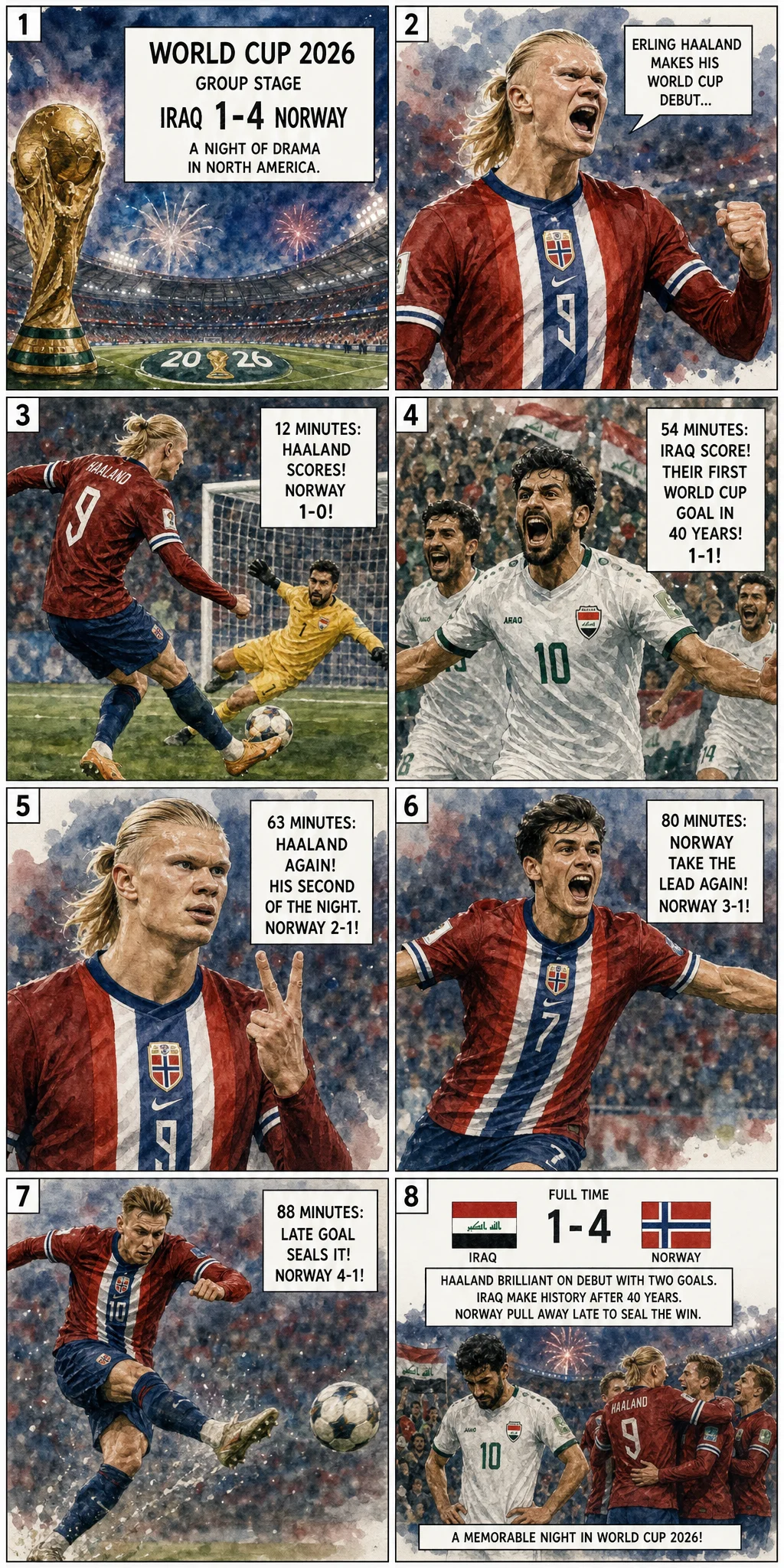
Comic content and match statistics are for entertainment purposes only and may contain inaccuracies. For Accurate Data, please refer to the reference's official website.
# Iraq 1-4 Norway: Haaland's Baptism, Iraq's Hour of Hope, and the Weight of Forty Years
In the long, tangled history of the World Cup, there are nations that arrive carrying the accumulated weight of decades — not mere years, but generations. Norway, returning to the tournament after a twenty-eight-year absence, carried the memory of Kjetil Rekdal's penalty against Brazil in 1998, the last time a Norwegian footballer had scored at this level. Iraq, returning after forty years, carried something heavier: the memory of their single previous World Cup goal, scored by Ahmed Radhi against Belgium in 1986, a moment that had been preserved in the national consciousness like an artefact in a museum.
The Gillette Stadium in Foxborough, Massachusetts — a venue more accustomed to the choreographed violence of the NFL's New England Patriots — became, for one humid June evening, the stage upon which these two returning nations would write their opening chapters. The scoreline, Iraq 1 Norway 4, tells a story of Norwegian dominance. The match itself told a more complicated one.
## The Prodigy Arrives
The first goal of Norway's World Cup return belonged, inevitably, to Erling Haaland. In the 29th minute, David Møller Wolfe — the AZ Alkmaar left-back whose overlapping runs had been Norway's most consistent attacking outlet in the opening exchanges — delivered a low cross toward the back post. Haaland, having lost his marker with a movement that was half power and half geometry, slid in to redirect the ball past Jalal Hassan. It was his first World Cup goal, his 56th for Norway, and the kind of finish that makes the extraordinary appear routine.
But the goal was not merely a goal. It was the end of a narrative that had been running since before Haaland was born. Norway had not scored at a World Cup since Rekdal's penalty in Marseille. The goal was an exorcism, a release of pressure that had been building for nearly three decades. The Norwegian supporters, a travelling contingent of perhaps eight thousand who had turned one corner of Gillette Stadium into a fjord of red and blue, erupted with a sound that contained within it every year of absence.
## Iraq's Hour of Light
The second act of the first half belonged to Iraq — and it lasted, in its purest form, for exactly four minutes.
In the 39th minute, Amir Al-Ammari — the midfield engine whose journey from the Swedish lower divisions to the World Cup stage is the kind of story this tournament exists to tell — received the ball on the left flank and delivered a cross of exquisite precision. Aymen Hussein, the 30-year-old striker whose 33 international goals had carried Iraq through qualification, rose between two Norwegian defenders and powered a header past Ørjan Nyland. Hussein — bald, barrel-chested, the physical embodiment of Iraqi football's indomitable spirit — wheeled away toward the corner flag, pursued by teammates who seemed to understand, even in that moment of ecstasy, the historical weight of what they had just achieved.
Iraq's first World Cup goal in forty years. The first since Ahmed Radhi. The first since 1986. The goal was not merely an equaliser; it was a bridge across four decades of longing, a moment that connected the Iraq of Saddam Hussein's war years to the Iraq of today, a nation that has known more suffering than any football match can heal but that found, in Hussein's header, a moment of pure, uncomplicated joy.
For four minutes — from the 39th to the 43rd — Iraq were level with a European football power in a World Cup match. For four minutes, the score was 1-1 and anything felt possible.
## The Mistake
The third goal of the match — Haaland's second, Norway's second — arrived in the 43rd minute, and it was the kind of goal that will be replayed for all the wrong reasons by Iraqi supporters for decades to come.
A back-pass. That most innocuous of footballing actions, the simple transfer of possession from one defender to his goalkeeper. Except this back-pass — from Ali Adnan, the veteran left-back whose 120 caps represent the accumulated wisdom of a career spent navigating the most demanding of footballing environments — was struck with insufficient weight. Haaland, who had been jogging back toward the halfway line with the disinterested air of a man who believes the half is effectively over, suddenly engaged. His acceleration was startling — not the acceleration of a footballer running toward a ball, but the acceleration of a predator who has spotted prey that does not yet know it is prey.
Jalal Hassan rushed from his line. Haaland got there first. The ball ricocheted off the Norwegian's outstretched leg and rolled into the empty net. 2-1 Norway. The Gillette Stadium, which had been vibrating with the energy of Iraq's equaliser, fell into the particular silence that follows a goal of catastrophic self-infliction.
The goal was, in the tactical sense, a function of Norway's high press — Graham Arnold's Iraq had been attempting to play out from the back all evening, a brave philosophy that had produced moments of genuine fluency but also, fatally, moments of vulnerability. But to reduce the goal to tactics is to miss the human dimension entirely. Ali Adnan, one of the finest footballers Iraq has ever produced, had made a mistake. Haaland, one of the finest footballers the world has ever produced, had punished it. Football, at this level, is a game of margins measured in milliseconds and metres.
## The Second Half: Norway's Authority
The second half belonged to Norway in a way the first half had not. Martin Ødegaard, the Arsenal captain whose creative intelligence is the quiet foundation upon which Norway's more explosive attacking talents are built, began to dictate the tempo with the calm authority of a conductor who knows his orchestra is finally in tune.
In the 76th minute, Leo Østigård — the Rennes centre-back whose aerial prowess had been a weapon on set pieces throughout Norway's qualification campaign — rose highest at a corner and powered a header past Hassan. 3-1 Norway. The goal was Østigård's first at a World Cup, and it effectively ended the match as a contest.
The fourth goal arrived in the dying moments — a sweeping counter-attack that began with a Norwegian interception on the edge of their own penalty area and ended, six seconds later, with Kristian Thorstvedt heading home a Haaland cross at the back post. 4-1 Norway. The scoreline was, by this point, an accurate reflection of the gulf in quality between the two sides over ninety minutes. But it was also, and this is the essential point, a scoreline that did not fully capture the texture of the match — the forty minutes in which Iraq had been not merely competitive but genuinely threatening, the four minutes in which they had been level, the single moment of defensive catastrophe that had shifted the match's gravitational centre irreversibly toward Norway.
## What It Means
For Norway, the result was a statement of intent. Haaland's brace — his 56th and 57th international goals — announced his arrival on the World Cup stage with the subtlety of a thunderclap. Ødegaard's second-half orchestration demonstrated the creative depth that makes this Norwegian generation the most talented in the nation's football history. The defensive structure, built around Østigård and Andreas Hanche-Olsen, was solid enough to weather Iraq's first-half storm. Norway will face France in their next match, and on this evidence, they will not be intimidated.
For Iraq, the result was cruel but not without honour. Hussein's goal — a moment of genuine quality — will be celebrated for as long as Iraqi football is discussed. The first-half performance, for forty minutes, suggested that Arnold's team can compete at this level. The mistake that led to Haaland's second goal will haunt Ali Adnan, but football history is full of such moments, and the players who overcome them are the players who are remembered. Iraq face Senegal next, and they will face them knowing that they have already accomplished something their nation had not achieved in forty years: a World Cup goal.
The bigger picture, as always with returning nations, is about what it means to be here at all. Norway's 28-year absence and Iraq's 40-year absence were not accidents of sporting fortune; they were the products of structural realities — the difficulty of qualifying from competitive confederations, the challenge of developing football infrastructure in nations where other priorities often take precedence, the simple mathematics of a tournament that admits only a fraction of the world's footballing nations. That both teams are here, in 2026, is itself a form of victory.
Haaland walked off the pitch with the match ball — a gesture of possession that felt both earned and inevitable. Iraq's players walked off to a standing ovation from their supporters, who had not stopped singing from the first minute to the ninety-fifth. The score was Norway 4, Iraq 1. The meaning, as always, was larger than the numbers.